

this means that the molybdenum/tungsten active site centre must be kept reduced at
the proper reduction potential (Eq. 12). Although at first sight obvious, the
necessity to keep the enzyme active site reduced is most often overlooked, what
may explain why there are so many reports in the literature of FDHs unable to
reduce CO 2 . This is particularly true for metal-dependent FDHs: if the reduction
potential of one (or more) of the FDH redox centres is (are) relatively high, it could
be difficult to “push” the electrons into the active site (the centre with the higher
reduction potential could stay reduced, “blocking” the electron transfer to the other
(s) centre(s) with lower reduction potentials and the active site in particular). In
addition to thermodynamics, also the kinetics has to be taken into account to
evaluate if the CO 2 reduction is going to be efficient, or too slow relatively to the
formate oxidation to be relevant (rate of formate oxidation versus CO 2 reduction,
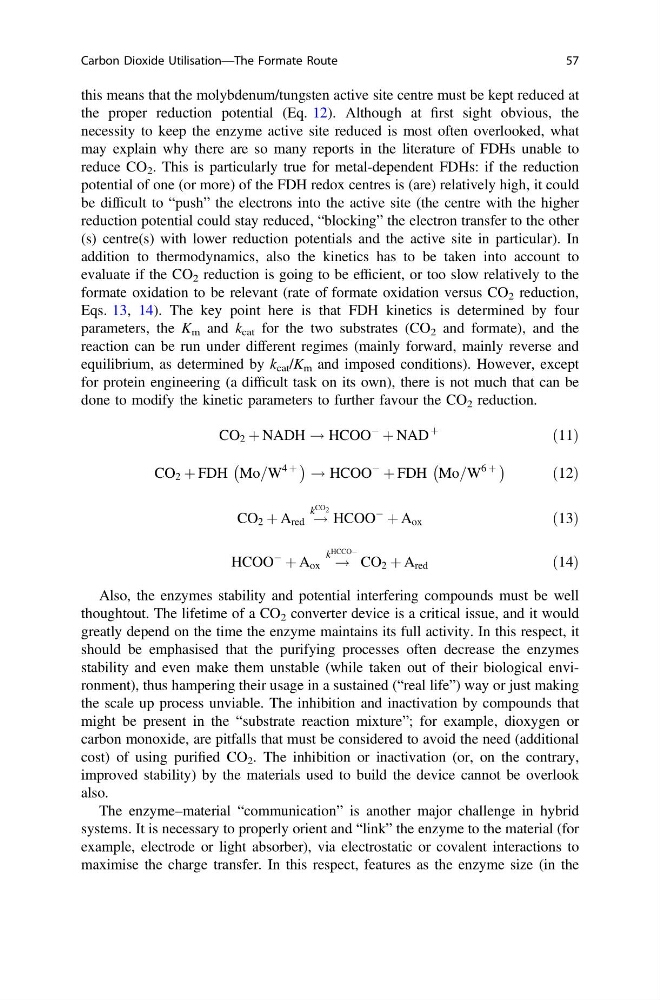
Eqs. 13, 14). The key point here is that FDH kinetics is determined by four
parameters, the K m and k cat for the two substrates (CO 2 and formate), and the
reaction can be run under different regimes (mainly forward, mainly reverse and
equilibrium, as determined by k cat /K m and imposed conditions). However, except
for protein engineering (a difficult task on its own), there is not much that can be
done to modify the kinetic parameters to further favour the CO 2 reduction.
CO 2 þ NADH ! HCOO
À
þ NAD
þ
ð11Þ
CO 2 þ FDH Mo=W
4 þ
À
Á ! HCOO
À
þ FDH Mo=W
6 þ
À
Á
ð12Þ
CO 2 þ A red !
k
CO 2 HCOO
À
þ A ox
ð13Þ
HCOO
À
þ A ox !
k
HCCOÀ CO 2 þ A red
ð14Þ
Also, the enzymes stability and potential interfering compounds must be well
thoughtout. The lifetime of a CO 2 converter device is a critical issue, and it would
greatly depend on the time the enzyme maintains its full activity. In this respect, it
should be emphasised that the purifying processes often decrease the enzymes
stability and even make them unstable (while taken out of their biological environment), thus hampering their usage in a sustained (“real life”) way or just making
the scale up process unviable. The inhibition and inactivation by compounds that
might be present in the “substrate reaction mixture”; for example, dioxygen or
carbon monoxide, are pitfalls that must be considered to avoid the need (additional
cost) of using purified CO 2 . The inhibition or inactivation (or, on the contrary,
improved stability) by the materials used to build the device cannot be overlook
also.
The enzyme–material “communication” is another major challenge in hybrid
systems. It is necessary to properly orient and “link” the enzyme to the material (for
example, electrode or light absorber), via electrostatic or covalent interactions to
maximise the charge transfer. In this respect, features as the enzyme size (in the
Carbon Dioxide Utilisation—The Formate Route
57
the proper reduction potential (Eq. 12). Although at first sight obvious, the
necessity to keep the enzyme active site reduced is most often overlooked, what
may explain why there are so many reports in the literature of FDHs unable to
reduce CO 2 . This is particularly true for metal-dependent FDHs: if the reduction
potential of one (or more) of the FDH redox centres is (are) relatively high, it could
be difficult to “push” the electrons into the active site (the centre with the higher
reduction potential could stay reduced, “blocking” the electron transfer to the other
(s) centre(s) with lower reduction potentials and the active site in particular). In
addition to thermodynamics, also the kinetics has to be taken into account to
evaluate if the CO 2 reduction is going to be efficient, or too slow relatively to the
formate oxidation to be relevant (rate of formate oxidation versus CO 2 reduction,
Eqs. 13, 14). The key point here is that FDH kinetics is determined by four
parameters, the K m and k cat for the two substrates (CO 2 and formate), and the
reaction can be run under different regimes (mainly forward, mainly reverse and
equilibrium, as determined by k cat /K m and imposed conditions). However, except
for protein engineering (a difficult task on its own), there is not much that can be
done to modify the kinetic parameters to further favour the CO 2 reduction.
CO 2 þ NADH ! HCOO
À
þ NAD
þ
ð11Þ
CO 2 þ FDH Mo=W
4 þ
À
Á ! HCOO
À
þ FDH Mo=W
6 þ
À
Á
ð12Þ
CO 2 þ A red !
k
CO 2 HCOO
À
þ A ox
ð13Þ
HCOO
À
þ A ox !
k
HCCOÀ CO 2 þ A red
ð14Þ
Also, the enzymes stability and potential interfering compounds must be well
thoughtout. The lifetime of a CO 2 converter device is a critical issue, and it would
greatly depend on the time the enzyme maintains its full activity. In this respect, it
should be emphasised that the purifying processes often decrease the enzymes
stability and even make them unstable (while taken out of their biological environment), thus hampering their usage in a sustained (“real life”) way or just making
the scale up process unviable. The inhibition and inactivation by compounds that
might be present in the “substrate reaction mixture”; for example, dioxygen or
carbon monoxide, are pitfalls that must be considered to avoid the need (additional
cost) of using purified CO 2 . The inhibition or inactivation (or, on the contrary,
improved stability) by the materials used to build the device cannot be overlook
also.
The enzyme–material “communication” is another major challenge in hybrid
systems. It is necessary to properly orient and “link” the enzyme to the material (for
example, electrode or light absorber), via electrostatic or covalent interactions to
maximise the charge transfer. In this respect, features as the enzyme size (in the
Carbon Dioxide Utilisation—The Formate Route
57