

clear and definitive experimental evidences, both scenarios—dissociated and bound
selenocysteine/cysteine—seem to be possible and this is an aspect that will remain
in open for now. Certainly, future research will shed light in these aspects of the
FDH reaction, allowing a critic evaluation of this mechanistic proposal.
4.4 Formate Dehydrogenases in the Context of Carbon
Dioxide Utilisation
The majority of currently known FDHs function in vivo to oxidise formate, with
only a few participating in metabolic pathways to reduce (fix) CO 2 —the reaction
direction that is interesting to “solve humankind’s problem” with atmospheric CO 2 .
However, the CO 2 /formate interconversion is thermodynamically reversible (E º′
(CO 2 /HCOO
− ) = −0.43 V) and in vitro there is no a priori reason for a FDH to be
unable to catalyse the CO 2 reduction, as long as there is sufficient reducing power
available
13 . Regarding the metal-independent FDHs, this simply means the adequate NADH/NAD
+ ratio (Eq. 11); in what concerns the metal-dependent FDHs,
H
+ +2e
−
H
+ +2e
−
reductant
solvent
oxidant
solvent
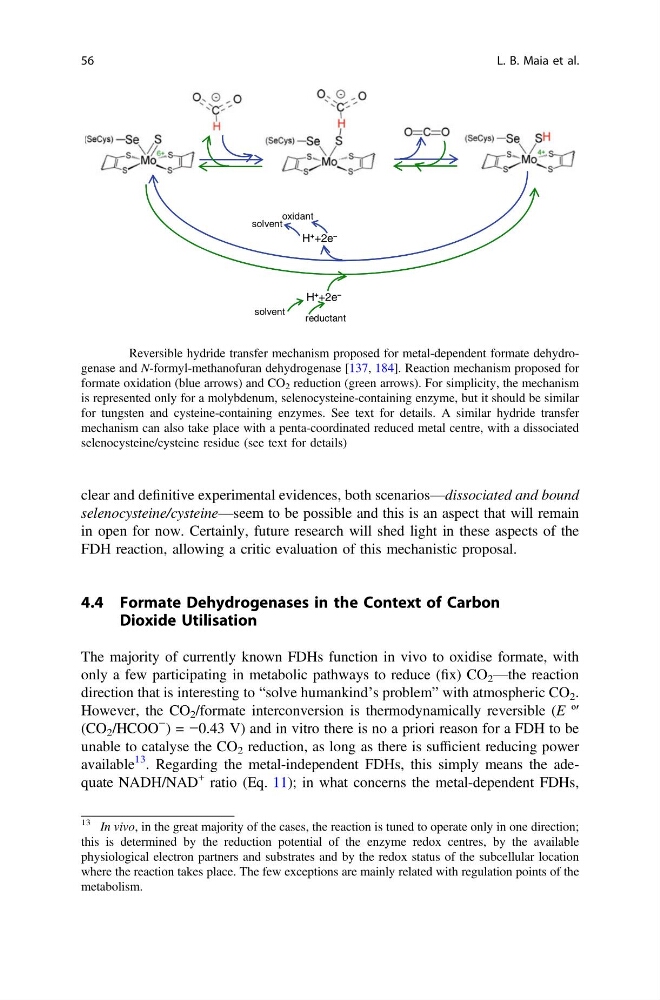
Fig. 13 Reversible hydride transfer mechanism proposed for metal-dependent formate dehydrogenase and N-formyl-methanofuran dehydrogenase [137, 184]. Reaction mechanism proposed for
formate oxidation (blue arrows) and CO 2 reduction (green arrows). For simplicity, the mechanism
is represented only for a molybdenum, selenocysteine-containing enzyme, but it should be similar
for tungsten and cysteine-containing enzymes. See text for details. A similar hydride transfer
mechanism can also take place with a penta-coordinated reduced metal centre, with a dissociated
selenocysteine/cysteine residue (see text for details)
13 In vivo, in the great majority of the cases, the reaction is tuned to operate only in one direction;
this is determined by the reduction potential of the enzyme redox centres, by the available
physiological electron partners and substrates and by the redox status of the subcellular location
where the reaction takes place. The few exceptions are mainly related with regulation points of the
metabolism.
56
L. B. Maia et al.
selenocysteine/cysteine—seem to be possible and this is an aspect that will remain
in open for now. Certainly, future research will shed light in these aspects of the
FDH reaction, allowing a critic evaluation of this mechanistic proposal.
4.4 Formate Dehydrogenases in the Context of Carbon
Dioxide Utilisation
The majority of currently known FDHs function in vivo to oxidise formate, with
only a few participating in metabolic pathways to reduce (fix) CO 2 —the reaction
direction that is interesting to “solve humankind’s problem” with atmospheric CO 2 .
However, the CO 2 /formate interconversion is thermodynamically reversible (E º′
(CO 2 /HCOO
− ) = −0.43 V) and in vitro there is no a priori reason for a FDH to be
unable to catalyse the CO 2 reduction, as long as there is sufficient reducing power
available
13 . Regarding the metal-independent FDHs, this simply means the adequate NADH/NAD
+ ratio (Eq. 11); in what concerns the metal-dependent FDHs,
H
+ +2e
−
H
+ +2e
−
reductant
solvent
oxidant
solvent
Fig. 13 Reversible hydride transfer mechanism proposed for metal-dependent formate dehydrogenase and N-formyl-methanofuran dehydrogenase [137, 184]. Reaction mechanism proposed for
formate oxidation (blue arrows) and CO 2 reduction (green arrows). For simplicity, the mechanism
is represented only for a molybdenum, selenocysteine-containing enzyme, but it should be similar
for tungsten and cysteine-containing enzymes. See text for details. A similar hydride transfer
mechanism can also take place with a penta-coordinated reduced metal centre, with a dissociated
selenocysteine/cysteine residue (see text for details)
13 In vivo, in the great majority of the cases, the reaction is tuned to operate only in one direction;
this is determined by the reduction potential of the enzyme redox centres, by the available
physiological electron partners and substrates and by the redox status of the subcellular location
where the reaction takes place. The few exceptions are mainly related with regulation points of the
metabolism.
56
L. B. Maia et al.