

D. gigas [130] or D. vulgaris [129, 131, 132], with “only” four [4Fe–4S] centres
and one tungsten centre (Fig. 6) [133, 134], or the more “complex” heteromeric
(abc) Mo-FDH of D. desulfuricans [135–137] or D. vulgaris [129, 131] that
contains eight redox-active centres ([4Fe–4S] centres and c-type haems) in addition
to the molybdenum centre. Remarkably, the overall protein fold of the molybdenum
—and tungsten-containing subunits, including the arrangement of Fe/S centre, is
highly conserved
4 [116, 117, 119, 130, 132, 138–140].
The diversity of metal-dependent FDHs is also observed through their “molecular plasticity”. Some FDHs take part in formate-hydrogen lyase systems, as is the
case of FDH H from E. coli (Mo-FDH) [141], Pectobacterium atrosepticum
(Mo-FDH) [142] or C. carboxidovorans (W-FDH) [143–147]. Physiologically, the
E. coli formate-hydrogen lyase is a membrane-bound system involved in formate
A
B
Mo
Fe/S
SeCys 140
His 141
Arg 333
C
D
SeCys 140
His 141
Arg 333
E
SeCys 140
His 141
Arg 333
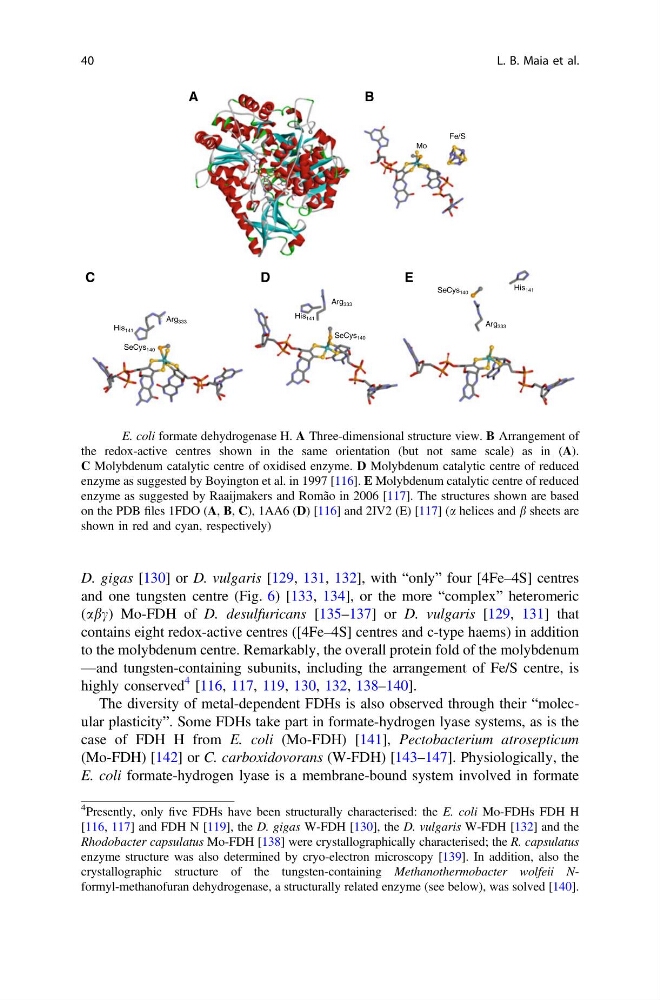
Fig. 4 E. coli formate dehydrogenase H. A Three-dimensional structure view. B Arrangement of
the redox-active centres shown in the same orientation (but not same scale) as in (A).
C Molybdenum catalytic centre of oxidised enzyme. D Molybdenum catalytic centre of reduced
enzyme as suggested by Boyington et al. in 1997 [116]. E Molybdenum catalytic centre of reduced
enzyme as suggested by Raaijmakers and Romão in 2006 [117]. The structures shown are based
on the PDB files 1FDO (A, B, C), 1AA6 (D) [116] and 2IV2 (E) [117] (a helices and b sheets are
shown in red and cyan, respectively)
4
Presently, only five FDHs have been structurally characterised: the E. coli Mo-FDHs FDH H
[116, 117] and FDH N [119], the D. gigas W-FDH [130], the D. vulgaris W-FDH [132] and the
Rhodobacter capsulatus Mo-FDH [138] were crystallographically characterised; the R. capsulatus
enzyme structure was also determined by cryo-electron microscopy [139]. In addition, also the
crystallographic structure of the tungsten-containing Methanothermobacter wolfeii Nformyl-methanofuran dehydrogenase, a structurally related enzyme (see below), was solved [140].
40
L. B. Maia et al.
and one tungsten centre (Fig. 6) [133, 134], or the more “complex” heteromeric
(abc) Mo-FDH of D. desulfuricans [135–137] or D. vulgaris [129, 131] that
contains eight redox-active centres ([4Fe–4S] centres and c-type haems) in addition
to the molybdenum centre. Remarkably, the overall protein fold of the molybdenum
—and tungsten-containing subunits, including the arrangement of Fe/S centre, is
highly conserved
4 [116, 117, 119, 130, 132, 138–140].
The diversity of metal-dependent FDHs is also observed through their “molecular plasticity”. Some FDHs take part in formate-hydrogen lyase systems, as is the
case of FDH H from E. coli (Mo-FDH) [141], Pectobacterium atrosepticum
(Mo-FDH) [142] or C. carboxidovorans (W-FDH) [143–147]. Physiologically, the
E. coli formate-hydrogen lyase is a membrane-bound system involved in formate
A
B
Mo
Fe/S
SeCys 140
His 141
Arg 333
C
D
SeCys 140
His 141
Arg 333
E
SeCys 140
His 141
Arg 333
Fig. 4 E. coli formate dehydrogenase H. A Three-dimensional structure view. B Arrangement of
the redox-active centres shown in the same orientation (but not same scale) as in (A).
C Molybdenum catalytic centre of oxidised enzyme. D Molybdenum catalytic centre of reduced
enzyme as suggested by Boyington et al. in 1997 [116]. E Molybdenum catalytic centre of reduced
enzyme as suggested by Raaijmakers and Romão in 2006 [117]. The structures shown are based
on the PDB files 1FDO (A, B, C), 1AA6 (D) [116] and 2IV2 (E) [117] (a helices and b sheets are
shown in red and cyan, respectively)
4
Presently, only five FDHs have been structurally characterised: the E. coli Mo-FDHs FDH H
[116, 117] and FDH N [119], the D. gigas W-FDH [130], the D. vulgaris W-FDH [132] and the
Rhodobacter capsulatus Mo-FDH [138] were crystallographically characterised; the R. capsulatus
enzyme structure was also determined by cryo-electron microscopy [139]. In addition, also the
crystallographic structure of the tungsten-containing Methanothermobacter wolfeii Nformyl-methanofuran dehydrogenase, a structurally related enzyme (see below), was solved [140].
40
L. B. Maia et al.