

4.2.1 The Metal-Independent Formate Dehydrogenases
Comparatively, the metal-independent FDHs are quite simple enzymes, generally
forming homodimers, containing a NAD(H) and a formate-binding pockets in a
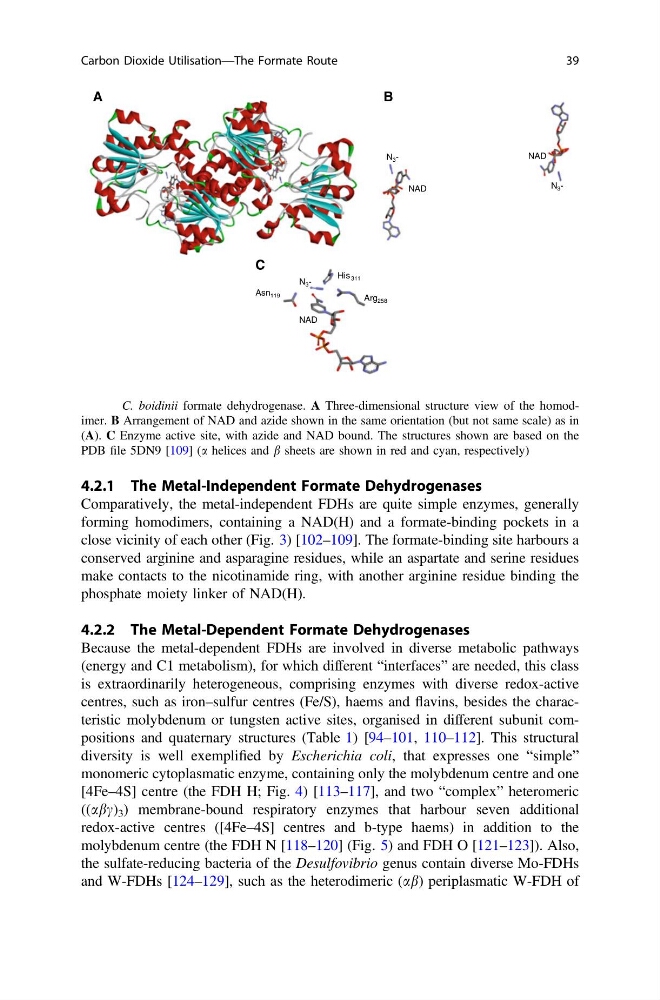
close vicinity of each other (Fig. 3) [102–109]. The formate-binding site harbours a
conserved arginine and asparagine residues, while an aspartate and serine residues
make contacts to the nicotinamide ring, with another arginine residue binding the
phosphate moiety linker of NAD(H).
4.2.2 The Metal-Dependent Formate Dehydrogenases
Because the metal-dependent FDHs are involved in diverse metabolic pathways
(energy and C1 metabolism), for which different “interfaces” are needed, this class
is extraordinarily heterogeneous, comprising enzymes with diverse redox-active
centres, such as iron–sulfur centres (Fe/S), haems and flavins, besides the characteristic molybdenum or tungsten active sites, organised in different subunit compositions and quaternary structures (Table 1) [94–101, 110–112]. This structural
diversity is well exemplified by Escherichia coli, that expresses one “simple”
monomeric cytoplasmatic enzyme, containing only the molybdenum centre and one
[4Fe–4S] centre (the FDH H; Fig. 4) [113–117], and two “complex” heteromeric
((abc) 3 ) membrane-bound respiratory enzymes that harbour seven additional
redox-active centres ([4Fe–4S] centres and b-type haems) in addition to the
molybdenum centre (the FDH N [118–120] (Fig. 5) and FDH O [121–123]). Also,
the sulfate-reducing bacteria of the Desulfovibrio genus contain diverse Mo-FDHs
and W-FDHs [124–129], such as the heterodimeric (ab) periplasmatic W-FDH of
A
B
NAD
N 3 -
NAD
N 3 -
C
N 3 -
NAD
His 311
Arg 258
Asn 119
Fig. 3 C. boidinii formate dehydrogenase. A Three-dimensional structure view of the homodimer. B Arrangement of NAD and azide shown in the same orientation (but not same scale) as in
(A). C Enzyme active site, with azide and NAD bound. The structures shown are based on the
PDB file 5DN9 [109] (a helices and b sheets are shown in red and cyan, respectively)
Carbon Dioxide Utilisation—The Formate Route
39
Comparatively, the metal-independent FDHs are quite simple enzymes, generally
forming homodimers, containing a NAD(H) and a formate-binding pockets in a
close vicinity of each other (Fig. 3) [102–109]. The formate-binding site harbours a
conserved arginine and asparagine residues, while an aspartate and serine residues
make contacts to the nicotinamide ring, with another arginine residue binding the
phosphate moiety linker of NAD(H).
4.2.2 The Metal-Dependent Formate Dehydrogenases
Because the metal-dependent FDHs are involved in diverse metabolic pathways
(energy and C1 metabolism), for which different “interfaces” are needed, this class
is extraordinarily heterogeneous, comprising enzymes with diverse redox-active
centres, such as iron–sulfur centres (Fe/S), haems and flavins, besides the characteristic molybdenum or tungsten active sites, organised in different subunit compositions and quaternary structures (Table 1) [94–101, 110–112]. This structural
diversity is well exemplified by Escherichia coli, that expresses one “simple”
monomeric cytoplasmatic enzyme, containing only the molybdenum centre and one
[4Fe–4S] centre (the FDH H; Fig. 4) [113–117], and two “complex” heteromeric
((abc) 3 ) membrane-bound respiratory enzymes that harbour seven additional
redox-active centres ([4Fe–4S] centres and b-type haems) in addition to the
molybdenum centre (the FDH N [118–120] (Fig. 5) and FDH O [121–123]). Also,
the sulfate-reducing bacteria of the Desulfovibrio genus contain diverse Mo-FDHs
and W-FDHs [124–129], such as the heterodimeric (ab) periplasmatic W-FDH of
A
B
NAD
N 3 -
NAD
N 3 -
C
N 3 -
NAD
His 311
Arg 258
Asn 119
Fig. 3 C. boidinii formate dehydrogenase. A Three-dimensional structure view of the homodimer. B Arrangement of NAD and azide shown in the same orientation (but not same scale) as in
(A). C Enzyme active site, with azide and NAD bound. The structures shown are based on the
PDB file 5DN9 [109] (a helices and b sheets are shown in red and cyan, respectively)
Carbon Dioxide Utilisation—The Formate Route
39