

Chl a can be found in almost all microalgae and cyanobacteria, and it presents
two intense absorption maxima at the edges of the visible spectrum (%430 and
%680 nm). This results in a green absorption gap of %250 nm that can be further
reduced to the spectral region between 500 and 600 nm if the Chl b pigment is
also expressed by the oxygenic organism (Chl b absorption maxima at k max %460
and k max %650 nm) [17].
In APB, the major pigments are known as Bchls and thus far, six have been found
in nature: Bchl a, b, c, d, e and g. Bchl c, d, and e have the particularity of being
organized into large light-harvesting organelles known as chlorosomes that
enable phototrophy in very low-light environments [10, 16]. The six pigments are
distributed among the diverse APB, and while Heliobacter only contain Bchl g,
purple phototrophic bacteria (PPB) of the phylum Proteobacteria contain BChls
a, b, Chloroflexi contain BChls a, c or d, and Chlorobi contain BChls a, c, d or e
[17]. Unlike Chls that only absorb in the visible range, the absorption maxima of
Bchls occurs in the far-red light with BChls c, d and e showing absorptions in the
range of 700–750 nm and BChls a, b and g absorbing even farther in the infrared
light 800–1020 nm. The latest pigments also present a blue-shifted absorption
maxima in the near-UV (< 400 nm). As such, organisms containing BChls a,
b and g can extend the usable spectrum beyond both directions of the visible
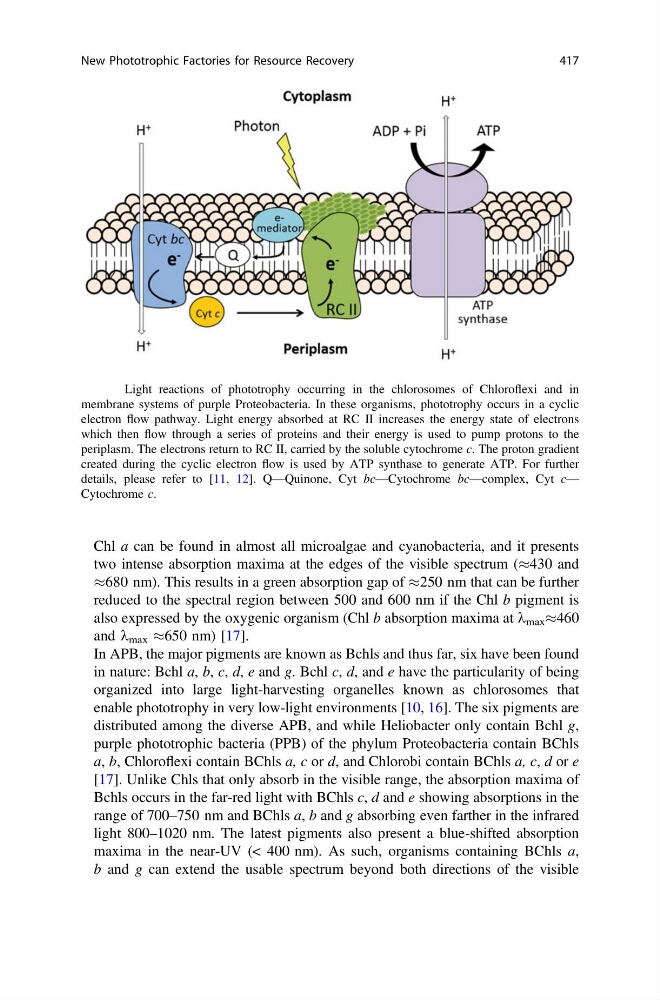
Fig. 2 Light reactions of phototrophy occurring in the chlorosomes of Chloroflexi and in
membrane systems of purple Proteobacteria. In these organisms, phototrophy occurs in a cyclic
electron flow pathway. Light energy absorbed at RC II increases the energy state of electrons
which then flow through a series of proteins and their energy is used to pump protons to the
periplasm. The electrons return to RC II, carried by the soluble cytochrome c. The proton gradient
created during the cyclic electron flow is used by ATP synthase to generate ATP. For further
details, please refer to [11, 12]. Q—Quinone, Cyt bc—Cytochrome bc—complex, Cyt c—
Cytochrome c.
New Phototrophic Factories for Resource Recovery
417
two intense absorption maxima at the edges of the visible spectrum (%430 and
%680 nm). This results in a green absorption gap of %250 nm that can be further
reduced to the spectral region between 500 and 600 nm if the Chl b pigment is
also expressed by the oxygenic organism (Chl b absorption maxima at k max %460
and k max %650 nm) [17].
In APB, the major pigments are known as Bchls and thus far, six have been found
in nature: Bchl a, b, c, d, e and g. Bchl c, d, and e have the particularity of being
organized into large light-harvesting organelles known as chlorosomes that
enable phototrophy in very low-light environments [10, 16]. The six pigments are
distributed among the diverse APB, and while Heliobacter only contain Bchl g,
purple phototrophic bacteria (PPB) of the phylum Proteobacteria contain BChls
a, b, Chloroflexi contain BChls a, c or d, and Chlorobi contain BChls a, c, d or e
[17]. Unlike Chls that only absorb in the visible range, the absorption maxima of
Bchls occurs in the far-red light with BChls c, d and e showing absorptions in the
range of 700–750 nm and BChls a, b and g absorbing even farther in the infrared
light 800–1020 nm. The latest pigments also present a blue-shifted absorption
maxima in the near-UV (< 400 nm). As such, organisms containing BChls a,
b and g can extend the usable spectrum beyond both directions of the visible
Fig. 2 Light reactions of phototrophy occurring in the chlorosomes of Chloroflexi and in
membrane systems of purple Proteobacteria. In these organisms, phototrophy occurs in a cyclic
electron flow pathway. Light energy absorbed at RC II increases the energy state of electrons
which then flow through a series of proteins and their energy is used to pump protons to the
periplasm. The electrons return to RC II, carried by the soluble cytochrome c. The proton gradient
created during the cyclic electron flow is used by ATP synthase to generate ATP. For further
details, please refer to [11, 12]. Q—Quinone, Cyt bc—Cytochrome bc—complex, Cyt c—
Cytochrome c.
New Phototrophic Factories for Resource Recovery
417