

centers have redox potentials that range from + 300 to + 500 mV, being capable of
oxidizing only lower potential (<+100 mV) electron donors [13]. Water cannot be
used as an electron donor and thus APB do not evolve oxygen. In the particular case
of APB with a Type II RC (e.g., Chloroflexi and the purple phototrophic bacteria of
the phylum Proteobacteria), a cyclic electron transport is operated to generate ATP
and as such, no NADPH is directly synthesized (Fig. 2). Instead, a reverse electron
transport is used to regenerate NAD(P)H through the oxidation of electron donors
with higher redox potential than NAD(P)H/NAD(P)
+ , like hydrogen, hydrogen
sulfide, and organic molecules [10, 14]. The ATP and NAD(P)H generated from
light-induced electron transport can then be used to assimilate carbon through
diverse carbon metabolic pathways ranging from autotrophic CO 2 assimilation
(e.g., CBB cycle, reverse Krebs cycle, and 3-hydroxy-propionate bicycle) to the
heterotrophic uptake of external organic molecules [11].
• Pigments
To increase the amount of light energy harvested by the cells, the reaction centers
of microalgae/cyanobacteria and APB are assisted by light-harvesting antenna
complexes that capture light and transfer the excitation energy to the photochemical reaction centers [15]. The major photoactive pigments that can be found
in the antenna complexes are chlorophylls (Chls) or bacteriochlorophylls (BChls)
and carotenoids, which ensure photosynthesis function over a wide range of
incident light intensity from near-UV to visible and infrared [16].
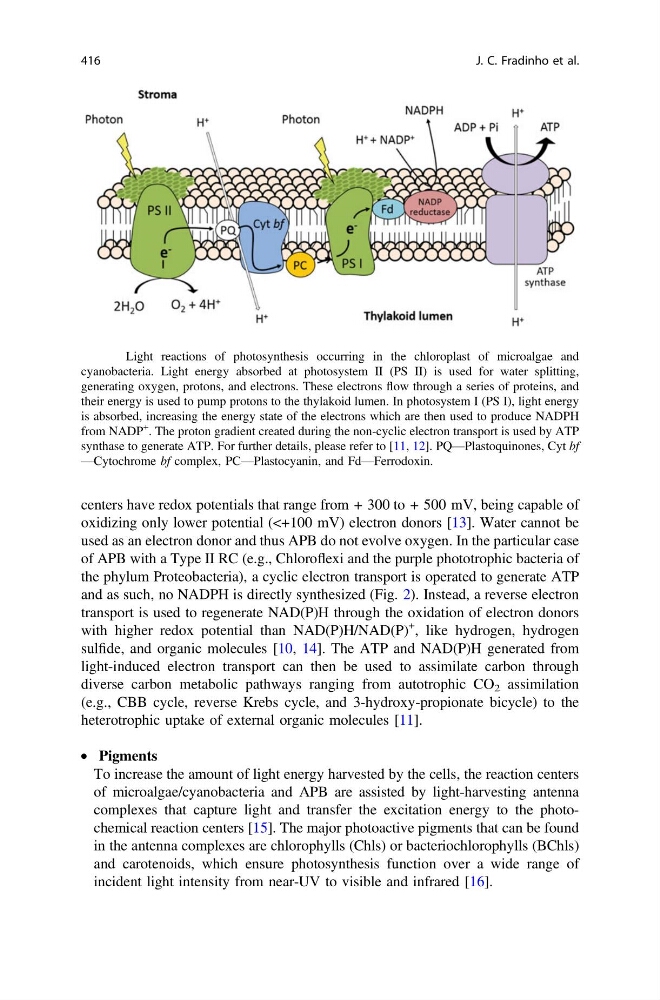
Fig. 1 Light reactions of photosynthesis occurring in the chloroplast of microalgae and
cyanobacteria. Light energy absorbed at photosystem II (PS II) is used for water splitting,
generating oxygen, protons, and electrons. These electrons flow through a series of proteins, and
their energy is used to pump protons to the thylakoid lumen. In photosystem I (PS I), light energy
is absorbed, increasing the energy state of the electrons which are then used to produce NADPH
from NADP
+ . The proton gradient created during the non-cyclic electron transport is used by ATP
synthase to generate ATP. For further details, please refer to [11, 12]. PQ—Plastoquinones, Cyt bf
—Cytochrome bf complex, PC—Plastocyanin, and Fd—Ferrodoxin.
416
J. C. Fradinho et al.
oxidizing only lower potential (<+100 mV) electron donors [13]. Water cannot be
used as an electron donor and thus APB do not evolve oxygen. In the particular case
of APB with a Type II RC (e.g., Chloroflexi and the purple phototrophic bacteria of
the phylum Proteobacteria), a cyclic electron transport is operated to generate ATP
and as such, no NADPH is directly synthesized (Fig. 2). Instead, a reverse electron
transport is used to regenerate NAD(P)H through the oxidation of electron donors
with higher redox potential than NAD(P)H/NAD(P)
+ , like hydrogen, hydrogen
sulfide, and organic molecules [10, 14]. The ATP and NAD(P)H generated from
light-induced electron transport can then be used to assimilate carbon through
diverse carbon metabolic pathways ranging from autotrophic CO 2 assimilation
(e.g., CBB cycle, reverse Krebs cycle, and 3-hydroxy-propionate bicycle) to the
heterotrophic uptake of external organic molecules [11].
• Pigments
To increase the amount of light energy harvested by the cells, the reaction centers
of microalgae/cyanobacteria and APB are assisted by light-harvesting antenna
complexes that capture light and transfer the excitation energy to the photochemical reaction centers [15]. The major photoactive pigments that can be found
in the antenna complexes are chlorophylls (Chls) or bacteriochlorophylls (BChls)
and carotenoids, which ensure photosynthesis function over a wide range of
incident light intensity from near-UV to visible and infrared [16].
Fig. 1 Light reactions of photosynthesis occurring in the chloroplast of microalgae and
cyanobacteria. Light energy absorbed at photosystem II (PS II) is used for water splitting,
generating oxygen, protons, and electrons. These electrons flow through a series of proteins, and
their energy is used to pump protons to the thylakoid lumen. In photosystem I (PS I), light energy
is absorbed, increasing the energy state of the electrons which are then used to produce NADPH
from NADP
+ . The proton gradient created during the non-cyclic electron transport is used by ATP
synthase to generate ATP. For further details, please refer to [11, 12]. PQ—Plastoquinones, Cyt bf
—Cytochrome bf complex, PC—Plastocyanin, and Fd—Ferrodoxin.
416
J. C. Fradinho et al.