

have been shown to accelerate the ene reductase-catalyzed reaction but existing
regeneration methods of NADPH fail for mNADHs. Nonetheless, the ATHase
regenerated mNADH by using formate therefore only catalytic amount of mNADH
was needed for ene reductase to catalyze the reduction with TON reaching 2000
(Scheme 5).
3.1.2 Cascade Reactions Employing Other Artificial Reductases
An artificial reductase using formate to regenerate NADPH from NADP
+ was
prepared by covalently grafting a Cp*Rh(III) 1,10-phenathroline or 1,1’-bipyridine
complex (Cp* = pentamethylcyclopentadienyl) in the active site of alcohol dehydrogenase (ADH) [110]. The natural ADH uses NADPH to reduce ketones into
alcohol. The combination of ADH with the artificial reductase enabled the recycling
of NADPH by formate thus requiring only a catalytic amount of NADPH
(Scheme 6).
3.2 In Vivo Catalysis
The main problem faced by in vivo catalysis by transition metal complexes is the
potential deactivation of the catalyst in the living cell medium, which is quite
different from simple in vitro aqueous media. Living cells are indeed complex
entities containing very large amounts of potential inhibitors for unprotected catalysts such as glutathione that has clearly been identified as a major inhibitor for
precious metal catalysts in aqueous media [85]. One way to protect catalysts for
in vivo applications is their incorporation into a protein scaffold. This does not only
protect the catalysts from the living cell environment but also helps their solubilization in aqueous media.
ATHase
HCO 2 Na
CO 2
imine
(R)-amine
(S)-amine
MAO-N-D9
O 2
H 2 O 2
catalase
HRP
H 2 O
H 2 O
Scopoletin
or
ATHase
HCO 2 Na
CO 2
O 2
H 2 O 2
catalase
Bleached
scopoletin
DAAO
N
1/ 2 O 2
H 2 O
CO 2 H
N
H
CO 2 H
N
H
CO 2 H
H 2 N
CO 2 H
NH 2
LAAO
O 2
Examples of resolved amines:
NH
99 % ee
N
H
99 % ee
N
N
79 % ee
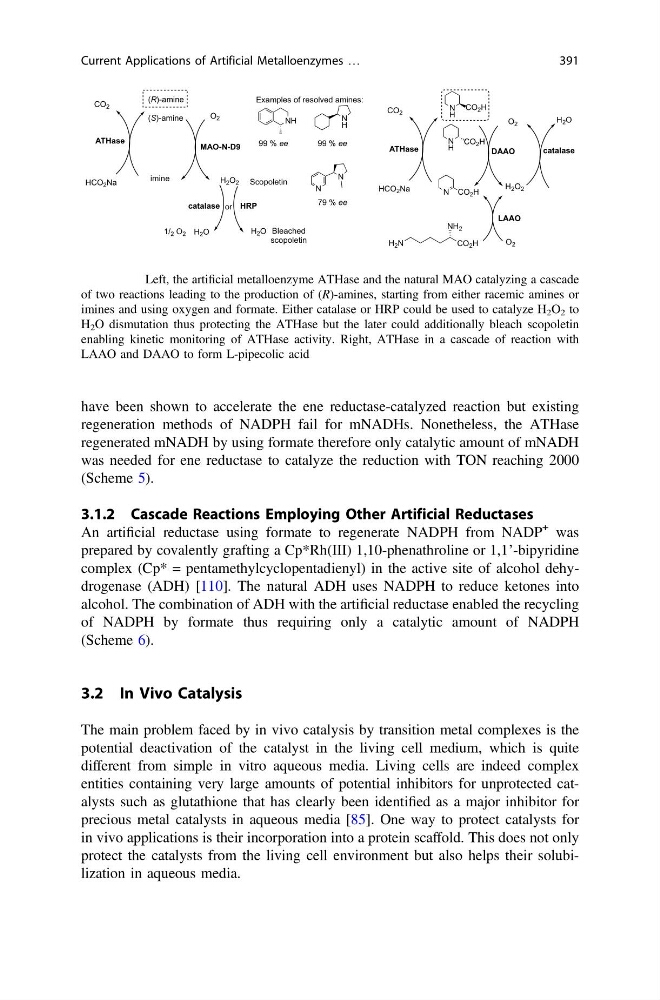
Scheme 4 Left, the artificial metalloenzyme ATHase and the natural MAO catalyzing a cascade
of two reactions leading to the production of (R)-amines, starting from either racemic amines or
imines and using oxygen and formate. Either catalase or HRP could be used to catalyze H 2 O 2 to
H 2 O dismutation thus protecting the ATHase but the later could additionally bleach scopoletin
enabling kinetic monitoring of ATHase activity. Right, ATHase in a cascade of reaction with
LAAO and DAAO to form L-pipecolic acid
Current Applications of Artificial Metalloenzymes …
391
regeneration methods of NADPH fail for mNADHs. Nonetheless, the ATHase
regenerated mNADH by using formate therefore only catalytic amount of mNADH
was needed for ene reductase to catalyze the reduction with TON reaching 2000
(Scheme 5).
3.1.2 Cascade Reactions Employing Other Artificial Reductases
An artificial reductase using formate to regenerate NADPH from NADP
+ was
prepared by covalently grafting a Cp*Rh(III) 1,10-phenathroline or 1,1’-bipyridine
complex (Cp* = pentamethylcyclopentadienyl) in the active site of alcohol dehydrogenase (ADH) [110]. The natural ADH uses NADPH to reduce ketones into
alcohol. The combination of ADH with the artificial reductase enabled the recycling
of NADPH by formate thus requiring only a catalytic amount of NADPH
(Scheme 6).
3.2 In Vivo Catalysis
The main problem faced by in vivo catalysis by transition metal complexes is the
potential deactivation of the catalyst in the living cell medium, which is quite
different from simple in vitro aqueous media. Living cells are indeed complex
entities containing very large amounts of potential inhibitors for unprotected catalysts such as glutathione that has clearly been identified as a major inhibitor for
precious metal catalysts in aqueous media [85]. One way to protect catalysts for
in vivo applications is their incorporation into a protein scaffold. This does not only
protect the catalysts from the living cell environment but also helps their solubilization in aqueous media.
ATHase
HCO 2 Na
CO 2
imine
(R)-amine
(S)-amine
MAO-N-D9
O 2
H 2 O 2
catalase
HRP
H 2 O
H 2 O
Scopoletin
or
ATHase
HCO 2 Na
CO 2
O 2
H 2 O 2
catalase
Bleached
scopoletin
DAAO
N
1/ 2 O 2
H 2 O
CO 2 H
N
H
CO 2 H
N
H
CO 2 H
H 2 N
CO 2 H
NH 2
LAAO
O 2
Examples of resolved amines:
NH
99 % ee
N
H
99 % ee
N
N
79 % ee
Scheme 4 Left, the artificial metalloenzyme ATHase and the natural MAO catalyzing a cascade
of two reactions leading to the production of (R)-amines, starting from either racemic amines or
imines and using oxygen and formate. Either catalase or HRP could be used to catalyze H 2 O 2 to
H 2 O dismutation thus protecting the ATHase but the later could additionally bleach scopoletin
enabling kinetic monitoring of ATHase activity. Right, ATHase in a cascade of reaction with
LAAO and DAAO to form L-pipecolic acid
Current Applications of Artificial Metalloenzymes …
391