

Finally, Mahy et al. covalently and selectively grafted a non-heme Fe(II)
polyazadentate complex to the accessible cysteine 121 of bovine b-lactoglobulin.
The biohybrid catalyzed the chemoselective oxidation of thioanisole by H 2 O 2 into
phenylmethylsulfoxide with an ee of 20%. Mechanistic studies showed that the
reaction proceeded via a high spin (S = 5/2) Fe
III (η
2 -O 2 ) intermediate that was
proposed to be responsible for the catalytic sulfoxidation [50].
2.1.4 Catechol Oxidation
Itoh and collaborators converted a bacterial hydrolytic di-zinc b-lactamase, into a
redox-active di-copper oxidase. For this, they used a mutational method based on a
rational computer-assisted recasting of the metal-binding site. This analysis suggested generating a triple D88G/S185H/P224G mutant of this protein, which made
it possible to convert its active site into a type III dicopper reactive center. The new
metalloprotein showed spectroscopic characteristics similar to those of type III
copper proteins and showed high catalytic activity with an increase of two orders of
magnitude in the k cat /K M value in the oxidation of catechols under aerobic conditions [51].
2.1.5 C–H Oxidation
Very few artificial metalloenzymes have been reported so far for the catalysis of
alkane hydroxylation. However, Ricoux et al. produced monoclonal antibodies
raised against microperoxidase 8 (MP8), that possesses an iron(III)-heme c cofactor.
The association of these antibodies with MP8 gave an antibody-MP8 complex that
was capable of effectively catalyzing the regioselective nitration of phenol to 2- and
4-nitrophenol by NO 2
− in the presence of H 2 O 2 [52]. Inhibition by cyanide and
radical scavengers suggested a peroxidase-like mechanism mediated by MP8,
involving the formation of high-valent iron oxo species. The successive
one-electron reduction of these intermediates by NO 2
− and phenol, respectively, led
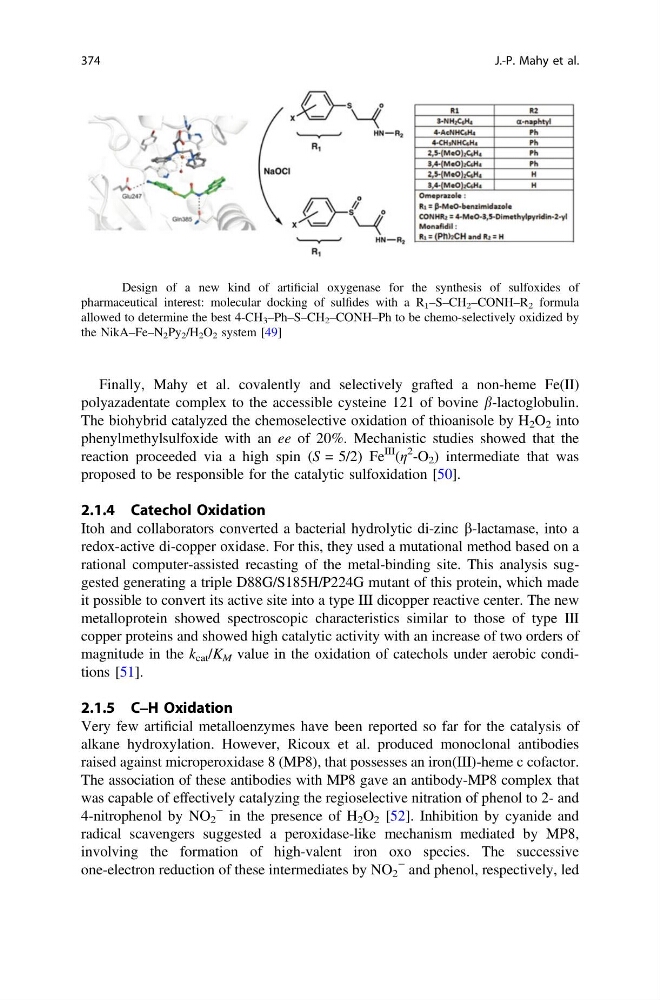
Fig. 7 Design of a new kind of artificial oxygenase for the synthesis of sulfoxides of
pharmaceutical interest: molecular docking of sulfides with a R 1 –S–CH 2 –CONH–R 2 formula
allowed to determine the best 4-CH 3 –Ph–S–CH 2 –CONH–Ph to be chemo-selectively oxidized by
the NikA–Fe–N 2 Py 2 /H 2 O 2 system [49]
374
J.-P. Mahy et al.
polyazadentate complex to the accessible cysteine 121 of bovine b-lactoglobulin.
The biohybrid catalyzed the chemoselective oxidation of thioanisole by H 2 O 2 into
phenylmethylsulfoxide with an ee of 20%. Mechanistic studies showed that the
reaction proceeded via a high spin (S = 5/2) Fe
III (η
2 -O 2 ) intermediate that was
proposed to be responsible for the catalytic sulfoxidation [50].
2.1.4 Catechol Oxidation
Itoh and collaborators converted a bacterial hydrolytic di-zinc b-lactamase, into a
redox-active di-copper oxidase. For this, they used a mutational method based on a
rational computer-assisted recasting of the metal-binding site. This analysis suggested generating a triple D88G/S185H/P224G mutant of this protein, which made
it possible to convert its active site into a type III dicopper reactive center. The new
metalloprotein showed spectroscopic characteristics similar to those of type III
copper proteins and showed high catalytic activity with an increase of two orders of
magnitude in the k cat /K M value in the oxidation of catechols under aerobic conditions [51].
2.1.5 C–H Oxidation
Very few artificial metalloenzymes have been reported so far for the catalysis of
alkane hydroxylation. However, Ricoux et al. produced monoclonal antibodies
raised against microperoxidase 8 (MP8), that possesses an iron(III)-heme c cofactor.
The association of these antibodies with MP8 gave an antibody-MP8 complex that
was capable of effectively catalyzing the regioselective nitration of phenol to 2- and
4-nitrophenol by NO 2
− in the presence of H 2 O 2 [52]. Inhibition by cyanide and
radical scavengers suggested a peroxidase-like mechanism mediated by MP8,
involving the formation of high-valent iron oxo species. The successive
one-electron reduction of these intermediates by NO 2
− and phenol, respectively, led
Fig. 7 Design of a new kind of artificial oxygenase for the synthesis of sulfoxides of
pharmaceutical interest: molecular docking of sulfides with a R 1 –S–CH 2 –CONH–R 2 formula
allowed to determine the best 4-CH 3 –Ph–S–CH 2 –CONH–Ph to be chemo-selectively oxidized by
the NikA–Fe–N 2 Py 2 /H 2 O 2 system [49]
374
J.-P. Mahy et al.