

sulfoxide (ee = 40%) could be obtained in the presence of 100 equivalents of
imidazole as a co-catalyst [11, 45].
The host-guest strategy was also applied by Ménage et al. who used NikA as a
guest protein, a periplasmic nickel-binding protein involved in the transport of
nickel in E. coli and other related Gram-negative bacteria. It was shown by X-ray
diffraction studies that NikA required in vivo butane-1,2,4-tricarboxylate (BTC) as
a specific metal-binding ligand [47]. Structural characterization of a putative
endogenous metal chelator in the Periplasmic Nickel Transporter NikA showed that
it was also able to bind Fe(EDTA)(H 2 O) [48]. Ménage et al. then took advantage of
this property and inserted into NikA EDTA-like inorganic metal complexes of the
N 2 Py 2 type that mimic the metal environment of iron oxygenases. After the crystal
structure of one of the NikA–Fe–N 2 Py 2 complexes have been solved at 1.7 Å
resolution, they followed an original approach based on molecular docking calculations to screen sulfide substrates, of the C 6 H 5 –S–CH 2 –X type, for catalytic
oxidation by the series of iron complex NikA hybrids. A set of 374 potential sulfide
substrates was identified, among which six potential substrates had a common R 1 –
S–CH 2 –CONH–R 2 motif. Interestingly, the skeleton of the defined substrate is
comparable to the one of omeprazole or modafinil, which are major drugs from the
pharmaceutical industry. The catalytic oxidation of those six substrates was performed in the presence of each hybrid, and the best catalytic results were obtained
for the oxidation of 4-CH 3 –Ph–S–CH 2 –CONH–Ph by NaOCl, in the presence of
one NikA–Fe–N 2 Py 2 catalyst, that led to the chemoselective formation of sulfoxide
in 78% yield, with a TON of 199 but a weak enantiomeric excess (5%). This study
constituted a nice proof-of-concept for the design of a substrate family, that allowed
Ménage et al. to define a new kind of artificial oxygenase for the catalysis of
sulfoxidation reactions of pharmaceutical interest (Fig. 7) [49].
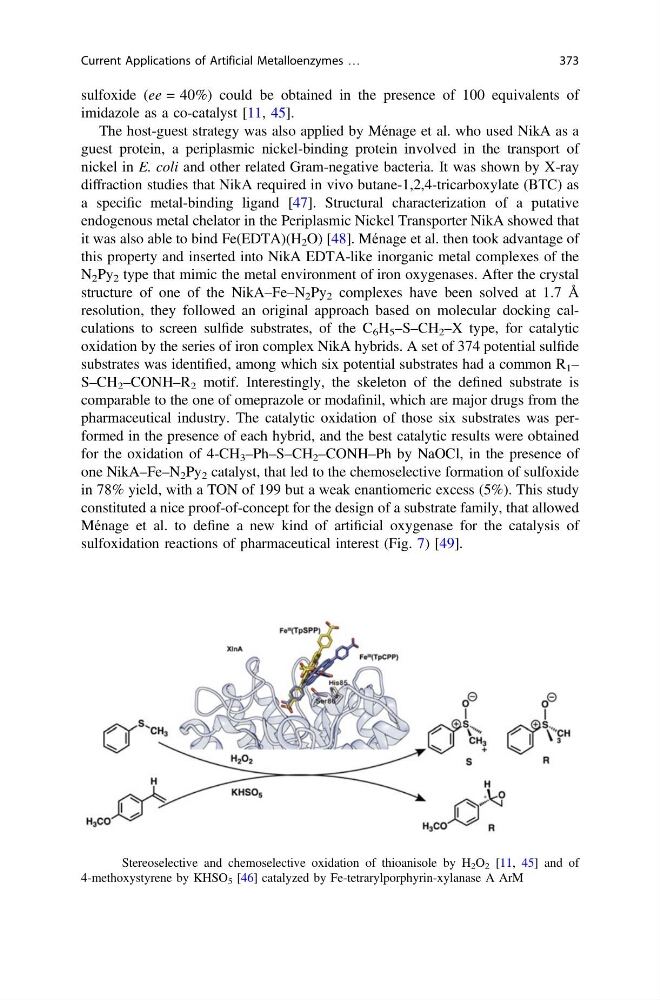
Fig. 6 Stereoselective and chemoselective oxidation of thioanisole by H 2 O 2 [11, 45] and of
4-methoxystyrene by KHSO 5 [46] catalyzed by Fe-tetrarylporphyrin-xylanase A ArM
Current Applications of Artificial Metalloenzymes …
373
imidazole as a co-catalyst [11, 45].
The host-guest strategy was also applied by Ménage et al. who used NikA as a
guest protein, a periplasmic nickel-binding protein involved in the transport of
nickel in E. coli and other related Gram-negative bacteria. It was shown by X-ray
diffraction studies that NikA required in vivo butane-1,2,4-tricarboxylate (BTC) as
a specific metal-binding ligand [47]. Structural characterization of a putative
endogenous metal chelator in the Periplasmic Nickel Transporter NikA showed that
it was also able to bind Fe(EDTA)(H 2 O) [48]. Ménage et al. then took advantage of
this property and inserted into NikA EDTA-like inorganic metal complexes of the
N 2 Py 2 type that mimic the metal environment of iron oxygenases. After the crystal
structure of one of the NikA–Fe–N 2 Py 2 complexes have been solved at 1.7 Å
resolution, they followed an original approach based on molecular docking calculations to screen sulfide substrates, of the C 6 H 5 –S–CH 2 –X type, for catalytic
oxidation by the series of iron complex NikA hybrids. A set of 374 potential sulfide
substrates was identified, among which six potential substrates had a common R 1 –
S–CH 2 –CONH–R 2 motif. Interestingly, the skeleton of the defined substrate is
comparable to the one of omeprazole or modafinil, which are major drugs from the
pharmaceutical industry. The catalytic oxidation of those six substrates was performed in the presence of each hybrid, and the best catalytic results were obtained
for the oxidation of 4-CH 3 –Ph–S–CH 2 –CONH–Ph by NaOCl, in the presence of
one NikA–Fe–N 2 Py 2 catalyst, that led to the chemoselective formation of sulfoxide
in 78% yield, with a TON of 199 but a weak enantiomeric excess (5%). This study
constituted a nice proof-of-concept for the design of a substrate family, that allowed
Ménage et al. to define a new kind of artificial oxygenase for the catalysis of
sulfoxidation reactions of pharmaceutical interest (Fig. 7) [49].
Fig. 6 Stereoselective and chemoselective oxidation of thioanisole by H 2 O 2 [11, 45] and of
4-methoxystyrene by KHSO 5 [46] catalyzed by Fe-tetrarylporphyrin-xylanase A ArM
Current Applications of Artificial Metalloenzymes …
373