

constructs were found to catalyze the sulfoxidation of thioanisole derivatives by
hydrogen peroxide with conversions up to 98% and up to 74% ee [31]. Generally,
better activities, selectivities as well as stabilities were obtained with albuminMn-corrole complexes with respect to their iron counterparts. More recently, the
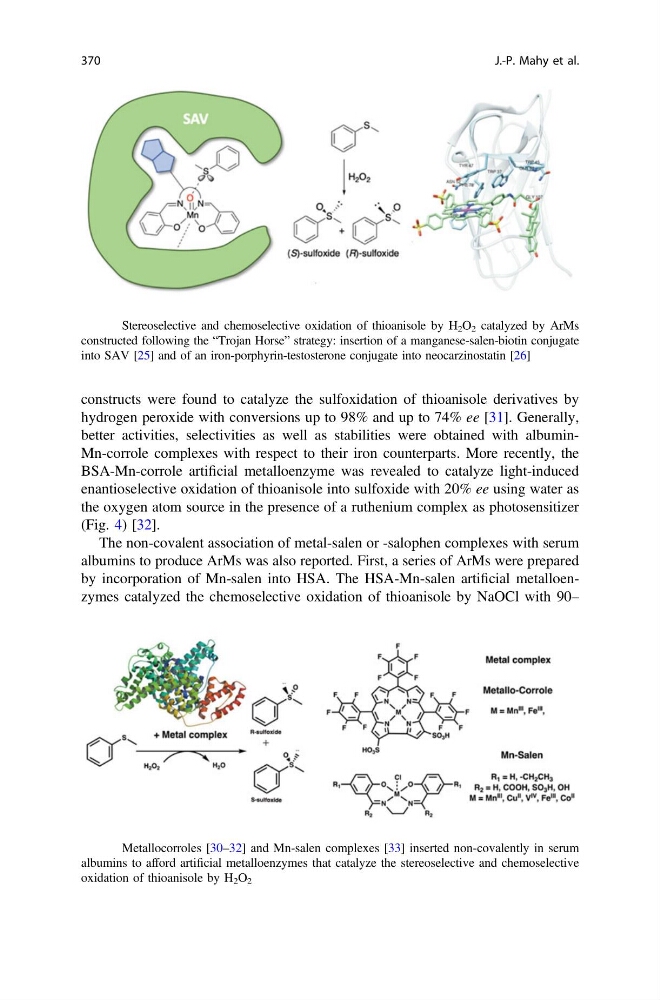
BSA-Mn-corrole artificial metalloenzyme was revealed to catalyze light-induced
enantioselective oxidation of thioanisole into sulfoxide with 20% ee using water as
the oxygen atom source in the presence of a ruthenium complex as photosensitizer
(Fig. 4) [32].
The non-covalent association of metal-salen or -salophen complexes with serum
albumins to produce ArMs was also reported. First, a series of ArMs were prepared
by incorporation of Mn-salen into HSA. The HSA-Mn-salen artificial metalloenzymes catalyzed the chemoselective oxidation of thioanisole by NaOCl with 90–
Fig. 3 Stereoselective and chemoselective oxidation of thioanisole by H 2 O 2 catalyzed by ArMs
constructed following the “Trojan Horse” strategy: insertion of a manganese-salen-biotin conjugate
into SAV [25] and of an iron-porphyrin-testosterone conjugate into neocarzinostatin [26]
Fig. 4 Metallocorroles [30–32] and Mn-salen complexes [33] inserted non-covalently in serum
albumins to afford artificial metalloenzymes that catalyze the stereoselective and chemoselective
oxidation of thioanisole by H 2 O 2
370
J.-P. Mahy et al.
hydrogen peroxide with conversions up to 98% and up to 74% ee [31]. Generally,
better activities, selectivities as well as stabilities were obtained with albuminMn-corrole complexes with respect to their iron counterparts. More recently, the
BSA-Mn-corrole artificial metalloenzyme was revealed to catalyze light-induced
enantioselective oxidation of thioanisole into sulfoxide with 20% ee using water as
the oxygen atom source in the presence of a ruthenium complex as photosensitizer
(Fig. 4) [32].
The non-covalent association of metal-salen or -salophen complexes with serum
albumins to produce ArMs was also reported. First, a series of ArMs were prepared
by incorporation of Mn-salen into HSA. The HSA-Mn-salen artificial metalloenzymes catalyzed the chemoselective oxidation of thioanisole by NaOCl with 90–
Fig. 3 Stereoselective and chemoselective oxidation of thioanisole by H 2 O 2 catalyzed by ArMs
constructed following the “Trojan Horse” strategy: insertion of a manganese-salen-biotin conjugate
into SAV [25] and of an iron-porphyrin-testosterone conjugate into neocarzinostatin [26]
Fig. 4 Metallocorroles [30–32] and Mn-salen complexes [33] inserted non-covalently in serum
albumins to afford artificial metalloenzymes that catalyze the stereoselective and chemoselective
oxidation of thioanisole by H 2 O 2
370
J.-P. Mahy et al.