

4.2 Nitrogen Oxide Reductases
Among reported reductase-based biosensors, nitrate and nitrite reductases are the
most widely explored enzymes. This is likely due to a combination of factors,
including relatively easy purification processes, commercial availability of NaRs
from different organisms, high catalytic activities, and/or facile ET with conductive
supports. Importantly, NaRs and NiRs catalyze reactions of high environmental
importance, as they take part of the denitrification pathway (bacterial driven
multi-step reduction of nitrate to N 2 ), one of the main branches of the global
nitrogen cycle [225]. The impact of high concentrations of the enzymes’ substrates,
nitrate and nitrite, in the environment, as well as, the potentially toxic effects in
human health have prompted the World Health Organization and other regulation
agencies to establish maximum levels, e.g., in drinking waters and meat products
[206, 209]. The importance of nitrate and nitrite as biomarkers of human health and
disease is another driving force for the development of new biosensing tools. These
ions are involved in several physiological processes, either directly, in the case of
nitrite, or through the connection to NO metabolism, which is an important
mediator of cell signal transduction with critical roles in diverse physiological
functions and in the pathophysiology of many human diseases [226, 227].
Several nitrate reductase biosensors have been proposed in the past three decades. NaRs are molybdenum dependent enzymes found in bacteria, algae, fungi,
and plants. They constitute a heterogeneous group owing to their involvement in
different biochemical pathways. NaRs have multiple redox centers and differ in
terms of active site constitution, subunit structure, cellular localizations, and
functions. Accordingly, they can be divided into four basic types: eukaryotic
(eNaRs) and prokaryotic assimilatory (Nas), dissimilatory (Nap), and respiratory
(Nar) nitrate reductases. Nitrate reduction to nitrite occurs at the molybdenum
active site, which is coordinated by one or two pyranopterin cofactor molecules in
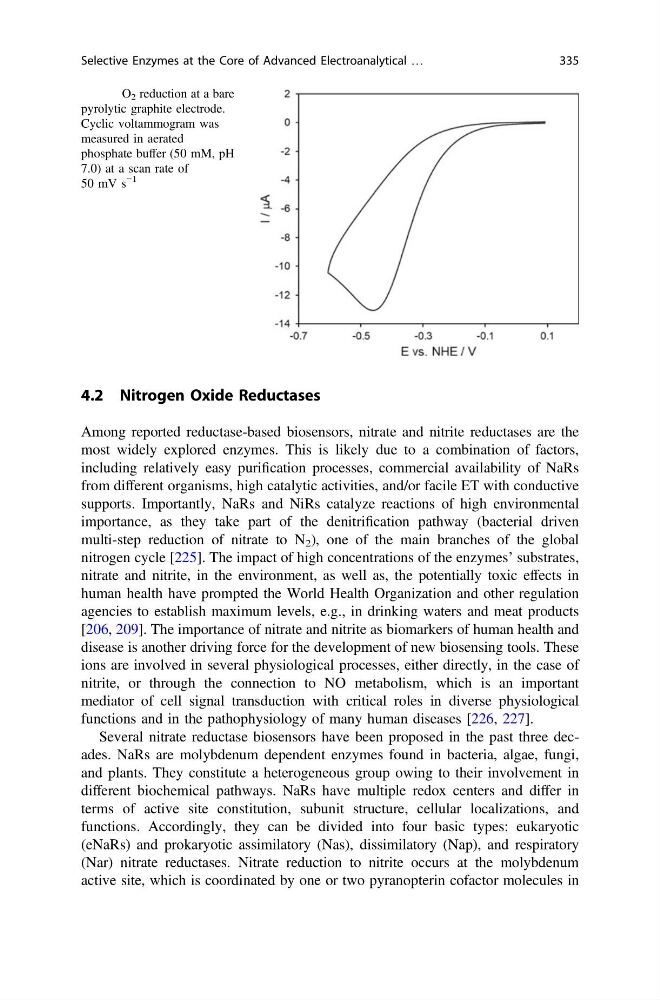
Fig. 9 O 2 reduction at a bare
pyrolytic graphite electrode.
Cyclic voltammogram was
measured in aerated
phosphate buffer (50 mM, pH
7.0) at a scan rate of
50 mV s
−1
Selective Enzymes at the Core of Advanced Electroanalytical …
335
Among reported reductase-based biosensors, nitrate and nitrite reductases are the
most widely explored enzymes. This is likely due to a combination of factors,
including relatively easy purification processes, commercial availability of NaRs
from different organisms, high catalytic activities, and/or facile ET with conductive
supports. Importantly, NaRs and NiRs catalyze reactions of high environmental
importance, as they take part of the denitrification pathway (bacterial driven
multi-step reduction of nitrate to N 2 ), one of the main branches of the global
nitrogen cycle [225]. The impact of high concentrations of the enzymes’ substrates,
nitrate and nitrite, in the environment, as well as, the potentially toxic effects in
human health have prompted the World Health Organization and other regulation
agencies to establish maximum levels, e.g., in drinking waters and meat products
[206, 209]. The importance of nitrate and nitrite as biomarkers of human health and
disease is another driving force for the development of new biosensing tools. These
ions are involved in several physiological processes, either directly, in the case of
nitrite, or through the connection to NO metabolism, which is an important
mediator of cell signal transduction with critical roles in diverse physiological
functions and in the pathophysiology of many human diseases [226, 227].
Several nitrate reductase biosensors have been proposed in the past three decades. NaRs are molybdenum dependent enzymes found in bacteria, algae, fungi,
and plants. They constitute a heterogeneous group owing to their involvement in
different biochemical pathways. NaRs have multiple redox centers and differ in
terms of active site constitution, subunit structure, cellular localizations, and
functions. Accordingly, they can be divided into four basic types: eukaryotic
(eNaRs) and prokaryotic assimilatory (Nas), dissimilatory (Nap), and respiratory
(Nar) nitrate reductases. Nitrate reduction to nitrite occurs at the molybdenum
active site, which is coordinated by one or two pyranopterin cofactor molecules in
Fig. 9 O 2 reduction at a bare
pyrolytic graphite electrode.
Cyclic voltammogram was
measured in aerated
phosphate buffer (50 mM, pH
7.0) at a scan rate of
50 mV s
−1
Selective Enzymes at the Core of Advanced Electroanalytical …
335