

connected to the electrode via the heme group, which works as an internal ET
mediator, paving the way to a direct electrochemical response [173, 182]. In fact, a
considerable number of multi-cofactor DHs have been successfully employed in
third generation biosensors, thereby improving the selectivity and stability of
analysis while avoiding interfering reactions. Ikeda and coworkers were the first to
prove the concept, either using a flavohemo enzyme, such as D-gluconate DH
(GADH) [183], or quinohemoproteins like fructose DH (FDH) [184] and ADH
[185, 186]. These bacterial membrane-bound oxidoreductases were simply adsorbed on carbon paste [183, 185] or metal electrodes [185], and produced anodic
currents in the presence of their substrates. Neither mediators nor promoters were
necessary, demonstrating a facile heterogeneous ET. The heme domains were
properly oriented towards the electrode surface while the catalytic sites were facing
the solution side. Nevertheless, it was later shown that experimental variables such
as pH, ionic strength, the composition in metal cations and the electrode material
were crucial to achieving a favorable protein orientation towards the transducer
surface and electronic communication between the heme domain and the electrode
as well as a smooth internal ET from the catalytic site to the heme center. In this
context, two interesting examples are the flavocytochrome cellobiose dehydrogenases (CDH) and FDH. CDHs, in particular, are extracellular enzymes expressed by
several fungi involved in wood degradation and have found wide applications in
food technology, biomedicine, for which several lactose and glucose biosensors
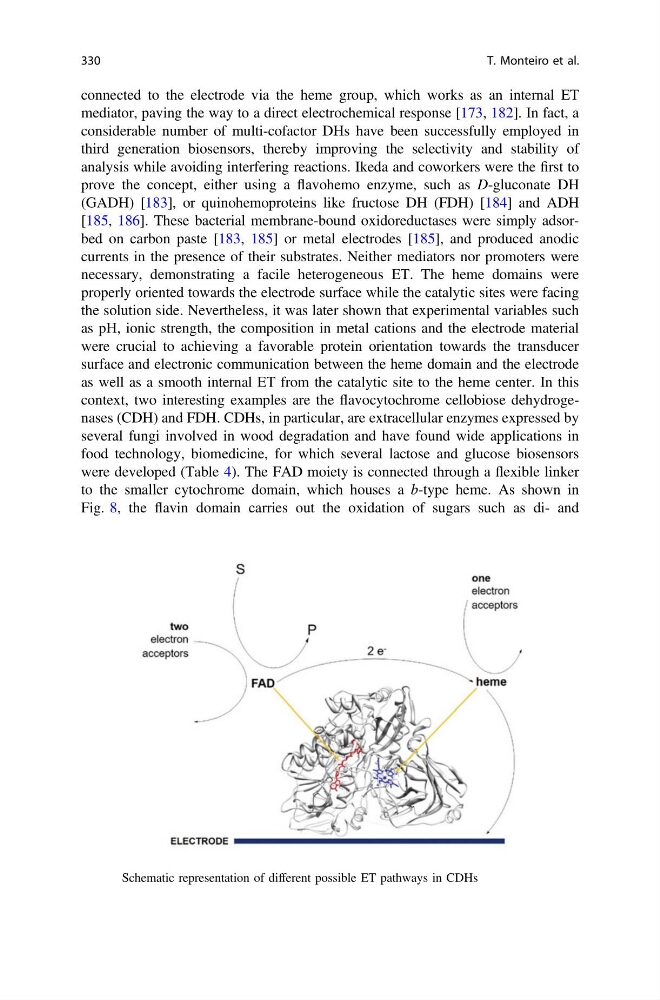
were developed (Table 4). The FAD moiety is connected through a flexible linker
to the smaller cytochrome domain, which houses a b-type heme. As shown in
Fig. 8, the flavin domain carries out the oxidation of sugars such as di- and
Fig. 8 Schematic representation of different possible ET pathways in CDHs
330
T. Monteiro et al.
mediator, paving the way to a direct electrochemical response [173, 182]. In fact, a
considerable number of multi-cofactor DHs have been successfully employed in
third generation biosensors, thereby improving the selectivity and stability of
analysis while avoiding interfering reactions. Ikeda and coworkers were the first to
prove the concept, either using a flavohemo enzyme, such as D-gluconate DH
(GADH) [183], or quinohemoproteins like fructose DH (FDH) [184] and ADH
[185, 186]. These bacterial membrane-bound oxidoreductases were simply adsorbed on carbon paste [183, 185] or metal electrodes [185], and produced anodic
currents in the presence of their substrates. Neither mediators nor promoters were
necessary, demonstrating a facile heterogeneous ET. The heme domains were
properly oriented towards the electrode surface while the catalytic sites were facing
the solution side. Nevertheless, it was later shown that experimental variables such
as pH, ionic strength, the composition in metal cations and the electrode material
were crucial to achieving a favorable protein orientation towards the transducer
surface and electronic communication between the heme domain and the electrode
as well as a smooth internal ET from the catalytic site to the heme center. In this
context, two interesting examples are the flavocytochrome cellobiose dehydrogenases (CDH) and FDH. CDHs, in particular, are extracellular enzymes expressed by
several fungi involved in wood degradation and have found wide applications in
food technology, biomedicine, for which several lactose and glucose biosensors
were developed (Table 4). The FAD moiety is connected through a flexible linker
to the smaller cytochrome domain, which houses a b-type heme. As shown in
Fig. 8, the flavin domain carries out the oxidation of sugars such as di- and
Fig. 8 Schematic representation of different possible ET pathways in CDHs
330
T. Monteiro et al.