

biocatalytic O 2 reduction [117, 122, 123], the mediated biocatalytic bilirubin oxidation [116, 142], and the localized consumption of O 2 [141].
3 Dehydrogenases
Dehydrogenases (DHs) form the largest group of enzymes currently known and are
represented in all living tissues. They have in common the ability to oxidize a
substrate (e.g., monosaccharides, aldehydes, alcohols, ketones) while transferring
two hydrogen atoms to a suitable electron acceptor, without O 2 involvement [148].
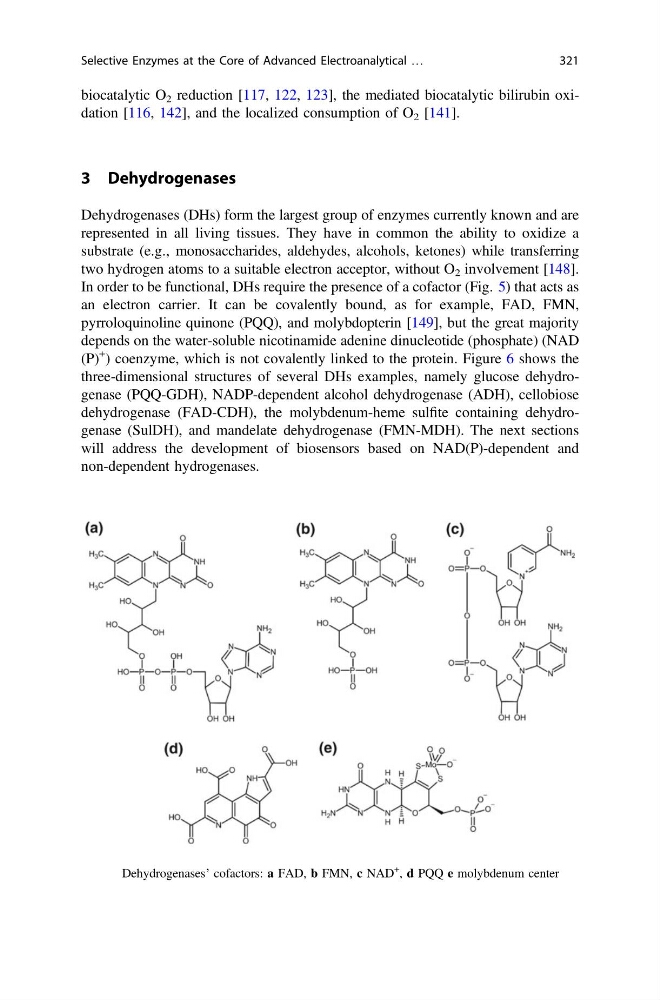
In order to be functional, DHs require the presence of a cofactor (Fig. 5) that acts as
an electron carrier. It can be covalently bound, as for example, FAD, FMN,
pyrroloquinoline quinone (PQQ), and molybdopterin [149], but the great majority
depends on the water-soluble nicotinamide adenine dinucleotide (phosphate) (NAD
(P)
+
) coenzyme, which is not covalently linked to the protein. Figure 6 shows the
three-dimensional structures of several DHs examples, namely glucose dehydrogenase (PQQ-GDH), NADP-dependent alcohol dehydrogenase (ADH), cellobiose
dehydrogenase (FAD-CDH), the molybdenum-heme sulfite containing dehydrogenase (SulDH), and mandelate dehydrogenase (FMN-MDH). The next sections
will address the development of biosensors based on NAD(P)-dependent and
non-dependent hydrogenases.
Fig. 5 Dehydrogenases’ cofactors: a FAD, b FMN, c NAD
+ , d PQQ e molybdenum center
Selective Enzymes at the Core of Advanced Electroanalytical …
321
3 Dehydrogenases
Dehydrogenases (DHs) form the largest group of enzymes currently known and are
represented in all living tissues. They have in common the ability to oxidize a
substrate (e.g., monosaccharides, aldehydes, alcohols, ketones) while transferring
two hydrogen atoms to a suitable electron acceptor, without O 2 involvement [148].
In order to be functional, DHs require the presence of a cofactor (Fig. 5) that acts as
an electron carrier. It can be covalently bound, as for example, FAD, FMN,
pyrroloquinoline quinone (PQQ), and molybdopterin [149], but the great majority
depends on the water-soluble nicotinamide adenine dinucleotide (phosphate) (NAD
(P)
+
) coenzyme, which is not covalently linked to the protein. Figure 6 shows the
three-dimensional structures of several DHs examples, namely glucose dehydrogenase (PQQ-GDH), NADP-dependent alcohol dehydrogenase (ADH), cellobiose
dehydrogenase (FAD-CDH), the molybdenum-heme sulfite containing dehydrogenase (SulDH), and mandelate dehydrogenase (FMN-MDH). The next sections
will address the development of biosensors based on NAD(P)-dependent and
non-dependent hydrogenases.
Fig. 5 Dehydrogenases’ cofactors: a FAD, b FMN, c NAD
+ , d PQQ e molybdenum center
Selective Enzymes at the Core of Advanced Electroanalytical …
321