

electron access to the active sites, and account for the remarkable activity (with
turnover frequencies as much as 9000 s
−1 ). Nevertheless the confluence of
understanding of organometallic structure and bonding in the first coordination
spheres of Ni and Fe, and the structural elements themselves, have propelled this
area forward. Yet another factor, the promise of delivering molecular catalysts
prepared from abundant, cheap metals (rather than Platinum) for conversion of
sustainable energy sources (such as solar) to H 2 for energy storage [36–38] has
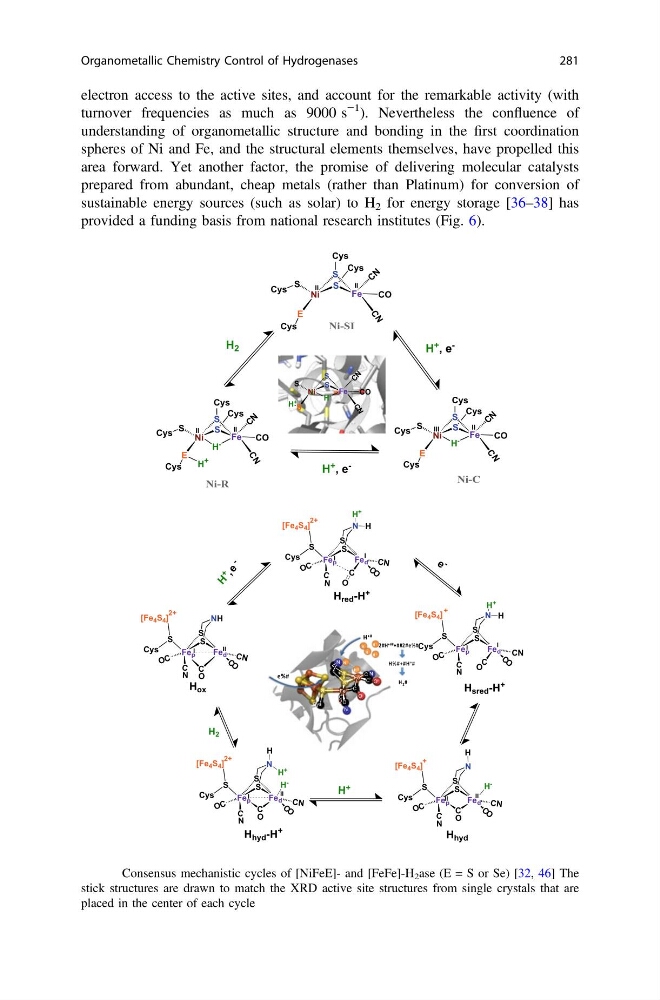
provided a funding basis from national research institutes (Fig. 6).
H +#
e%̄ #
2#H +## +##2#e%#
H2#
H+
H((
H%#+#H + #
H
H
H+
H+
H +
, e -
Fe p
S
Cys
[Fe 4 S 4 ]
O C
C
N
S
S
N
Fe d
C
CN
C O
2+
H red -H +
H +
H
I
I
O
H sred -H +
e -
Fe p
S
Cys
[Fe 4 S 4 ]
O C
C
N
S
S
N
Fe d
C
CN
C O
+
H +
H
I
I
O
H hyd
Fe p
S
Cys
[Fe 4 S 4 ]
O C
C
N
S
S
N
Fe d
C
CN
C O
+
H
II
II
O
H +
H hyd -H
Fe p
S
Cys
[Fe 4 S 4 ]
O C
C
N
S
S
N
Fe d
C
CN
C O
2+
H +
H
I
O
H -
H -
II
H 2
Fe p
S
Cys
[Fe 4 S 4 ]
O C
C
N
S
S
NH
Fe d
C
O
CN
C O
2+
H ox
I
II
Ni
Fe
S
S
S
S
C
N
CO
C
N
H -
H +
Ni
Fe
S
S
S
E
Cys
Cys
Cys
Cys
C N
CO
C
N
III
II
H -
Ni
Fe
S
S
S
E
Cys
Cys
Cys
Cys
C N
CO
C
N
II
II
H -
H +
H 2
H + , e -
H + , e -
Ni
Fe
S
S
S
E
Cys
Cys
Cys
Cys
C N
CO
C N
II
II
Ni-SI
Ni-R
Ni-C
+
Fig. 6 Consensus mechanistic cycles of [NiFeE]- and [FeFe]-H 2 ase (E = S or Se) [32, 46] The
stick structures are drawn to match the XRD active site structures from single crystals that are
placed in the center of each cycle
Organometallic Chemistry Control of Hydrogenases
281
turnover frequencies as much as 9000 s
−1 ). Nevertheless the confluence of
understanding of organometallic structure and bonding in the first coordination
spheres of Ni and Fe, and the structural elements themselves, have propelled this
area forward. Yet another factor, the promise of delivering molecular catalysts
prepared from abundant, cheap metals (rather than Platinum) for conversion of
sustainable energy sources (such as solar) to H 2 for energy storage [36–38] has
provided a funding basis from national research institutes (Fig. 6).
H +#
e%̄ #
2#H +## +##2#e%#
H2#
H+
H((
H%#+#H + #
H
H
H+
H+
H +
, e -
Fe p
S
Cys
[Fe 4 S 4 ]
O C
C
N
S
S
N
Fe d
C
CN
C O
2+
H red -H +
H +
H
I
I
O
H sred -H +
e -
Fe p
S
Cys
[Fe 4 S 4 ]
O C
C
N
S
S
N
Fe d
C
CN
C O
+
H +
H
I
I
O
H hyd
Fe p
S
Cys
[Fe 4 S 4 ]
O C
C
N
S
S
N
Fe d
C
CN
C O
+
H
II
II
O
H +
H hyd -H
Fe p
S
Cys
[Fe 4 S 4 ]
O C
C
N
S
S
N
Fe d
C
CN
C O
2+
H +
H
I
O
H -
H -
II
H 2
Fe p
S
Cys
[Fe 4 S 4 ]
O C
C
N
S
S
NH
Fe d
C
O
CN
C O
2+
H ox
I
II
Ni
Fe
S
S
S
S
C
N
CO
C
N
H -
H +
Ni
Fe
S
S
S
E
Cys
Cys
Cys
Cys
C N
CO
C
N
III
II
H -
Ni
Fe
S
S
S
E
Cys
Cys
Cys
Cys
C N
CO
C
N
II
II
H -
H +
H 2
H + , e -
H + , e -
Ni
Fe
S
S
S
E
Cys
Cys
Cys
Cys
C N
CO
C N
II
II
Ni-SI
Ni-R
Ni-C
+
Fig. 6 Consensus mechanistic cycles of [NiFeE]- and [FeFe]-H 2 ase (E = S or Se) [32, 46] The
stick structures are drawn to match the XRD active site structures from single crystals that are
placed in the center of each cycle
Organometallic Chemistry Control of Hydrogenases
281