

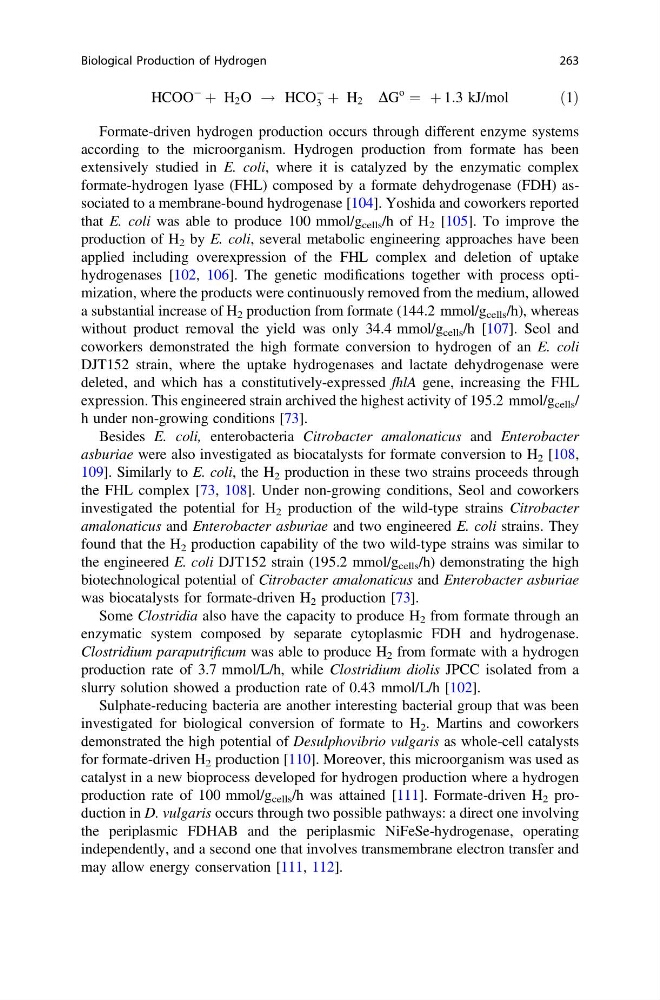
HCOO
À
þ H 2 O ! HCO
À
3 þ H 2 DG
o
¼ þ 1:3 kJ/mol
ð1Þ
Formate-driven hydrogen production occurs through different enzyme systems
according to the microorganism. Hydrogen production from formate has been
extensively studied in E. coli, where it is catalyzed by the enzymatic complex
formate-hydrogen lyase (FHL) composed by a formate dehydrogenase (FDH) associated to a membrane-bound hydrogenase [104]. Yoshida and coworkers reported
that E. coli was able to produce 100 mmol/g cells /h of H 2 [105]. To improve the
production of H 2 by E. coli, several metabolic engineering approaches have been
applied including overexpression of the FHL complex and deletion of uptake
hydrogenases [102, 106]. The genetic modifications together with process optimization, where the products were continuously removed from the medium, allowed
a substantial increase of H 2 production from formate (144.2 mmol/g cells /h), whereas
without product removal the yield was only 34.4 mmol/g cells /h [107]. Seol and
coworkers demonstrated the high formate conversion to hydrogen of an E. coli
DJT152 strain, where the uptake hydrogenases and lactate dehydrogenase were
deleted, and which has a constitutively-expressed fhlA gene, increasing the FHL
expression. This engineered strain archived the highest activity of 195.2 mmol/g cells /
h under non-growing conditions [73].
Besides E. coli, enterobacteria Citrobacter amalonaticus and Enterobacter
asburiae were also investigated as biocatalysts for formate conversion to H 2 [108,
109]. Similarly to E. coli, the H 2 production in these two strains proceeds through
the FHL complex [73, 108]. Under non-growing conditions, Seol and coworkers
investigated the potential for H 2 production of the wild-type strains Citrobacter
amalonaticus and Enterobacter asburiae and two engineered E. coli strains. They
found that the H 2 production capability of the two wild-type strains was similar to
the engineered E. coli DJT152 strain (195.2 mmol/g cells /h) demonstrating the high
biotechnological potential of Citrobacter amalonaticus and Enterobacter asburiae
was biocatalysts for formate-driven H 2 production [73].
Some Clostridia also have the capacity to produce H 2 from formate through an
enzymatic system composed by separate cytoplasmic FDH and hydrogenase.
Clostridium paraputrificum was able to produce H 2 from formate with a hydrogen
production rate of 3.7 mmol/L/h, while Clostridium diolis JPCC isolated from a
slurry solution showed a production rate of 0.43 mmol/L/h [102].
Sulphate-reducing bacteria are another interesting bacterial group that was been
investigated for biological conversion of formate to H 2 . Martins and coworkers
demonstrated the high potential of Desulphovibrio vulgaris as whole-cell catalysts
for formate-driven H 2 production [110]. Moreover, this microorganism was used as
catalyst in a new bioprocess developed for hydrogen production where a hydrogen
production rate of 100 mmol/g cells /h was attained [111]. Formate-driven H 2 production in D. vulgaris occurs through two possible pathways: a direct one involving
the periplasmic FDHAB and the periplasmic NiFeSe-hydrogenase, operating
independently, and a second one that involves transmembrane electron transfer and
may allow energy conservation [111, 112].
Biological Production of Hydrogen
263
À
þ H 2 O ! HCO
À
3 þ H 2 DG
o
¼ þ 1:3 kJ/mol
ð1Þ
Formate-driven hydrogen production occurs through different enzyme systems
according to the microorganism. Hydrogen production from formate has been
extensively studied in E. coli, where it is catalyzed by the enzymatic complex
formate-hydrogen lyase (FHL) composed by a formate dehydrogenase (FDH) associated to a membrane-bound hydrogenase [104]. Yoshida and coworkers reported
that E. coli was able to produce 100 mmol/g cells /h of H 2 [105]. To improve the
production of H 2 by E. coli, several metabolic engineering approaches have been
applied including overexpression of the FHL complex and deletion of uptake
hydrogenases [102, 106]. The genetic modifications together with process optimization, where the products were continuously removed from the medium, allowed
a substantial increase of H 2 production from formate (144.2 mmol/g cells /h), whereas
without product removal the yield was only 34.4 mmol/g cells /h [107]. Seol and
coworkers demonstrated the high formate conversion to hydrogen of an E. coli
DJT152 strain, where the uptake hydrogenases and lactate dehydrogenase were
deleted, and which has a constitutively-expressed fhlA gene, increasing the FHL
expression. This engineered strain archived the highest activity of 195.2 mmol/g cells /
h under non-growing conditions [73].
Besides E. coli, enterobacteria Citrobacter amalonaticus and Enterobacter
asburiae were also investigated as biocatalysts for formate conversion to H 2 [108,
109]. Similarly to E. coli, the H 2 production in these two strains proceeds through
the FHL complex [73, 108]. Under non-growing conditions, Seol and coworkers
investigated the potential for H 2 production of the wild-type strains Citrobacter
amalonaticus and Enterobacter asburiae and two engineered E. coli strains. They
found that the H 2 production capability of the two wild-type strains was similar to
the engineered E. coli DJT152 strain (195.2 mmol/g cells /h) demonstrating the high
biotechnological potential of Citrobacter amalonaticus and Enterobacter asburiae
was biocatalysts for formate-driven H 2 production [73].
Some Clostridia also have the capacity to produce H 2 from formate through an
enzymatic system composed by separate cytoplasmic FDH and hydrogenase.
Clostridium paraputrificum was able to produce H 2 from formate with a hydrogen
production rate of 3.7 mmol/L/h, while Clostridium diolis JPCC isolated from a
slurry solution showed a production rate of 0.43 mmol/L/h [102].
Sulphate-reducing bacteria are another interesting bacterial group that was been
investigated for biological conversion of formate to H 2 . Martins and coworkers
demonstrated the high potential of Desulphovibrio vulgaris as whole-cell catalysts
for formate-driven H 2 production [110]. Moreover, this microorganism was used as
catalyst in a new bioprocess developed for hydrogen production where a hydrogen
production rate of 100 mmol/g cells /h was attained [111]. Formate-driven H 2 production in D. vulgaris occurs through two possible pathways: a direct one involving
the periplasmic FDHAB and the periplasmic NiFeSe-hydrogenase, operating
independently, and a second one that involves transmembrane electron transfer and
may allow energy conservation [111, 112].
Biological Production of Hydrogen
263