

thermodynamically favourable at low partial pressure of H 2 and product accumulation quickly stops or reverts the reaction after a few hours. Continuous recycling
of the NAD(P)H cofactor by adding glucose dehydrogenase to the system under
anaerobic conditions has allowed increasing the duration of H 2 evolution using
glucose as electron donor (Fig. 2) and thus the amount of accumulated H 2 (up to 10
µmoles) with the same hydrogenase [12]. The Adams group has reported using the
NAD(P)H-dependent hydrogenase from the anaerobic thermophilic archaeon
Pyrococcus furiosus in combination with other 12 enzymes to form an unnatural
enzymatic pathway of H 2 production. In this way, a high yield of H 2 production
from starch and water was obtained based on the principles of synthetic biology
[13]. The overall thermodynamically favourable process and the separation of the
gaseous products allowed measuring a maximum rate of H 2 production rate 0.5
mmoles  L
−1
 h
−1 . More than one order of magnitude, higher rates of H 2
production from glucose were measured by using a FeFe-hydrogenase [14, 15]. In
this case, ferredoxin had to be added to shuttle electrons from NADPH to the
enzyme because, as most hydrogenases, it only has iron-sulphur clusters as redox
relay, which are one-electron acceptors. The increased rate of H 2 production was
attributed to the higher turnover of FeFe-hydrogenases for H 2 production compared
to NiFe-hydrogenases.
The use of reduced methyl viologen (MV) as electron donor for enzymatic
hydrogen production has the advantage of its pH-independent low redox potential
(−450 mV vs. NHE), thus favouring thermodynamically the reduction of protons to
H 2 , especially at acidic pH values. Another improvement is the immobilization of
the hydrogenase, as immobilization of enzymes on supports is an efficient strategy
used in biocatalysis in order to increase the operational stability and the reaction
yield [16]. Zadvorny et al. reported the encapsulation of the NiFe-hydrogenase from
Thiocapsa roseopersecina in a sol–gel material with multi-walled carbon nanotubes
(MWCNTs), polyethylene glycol (PEG) and MV. The addition of PEG into the
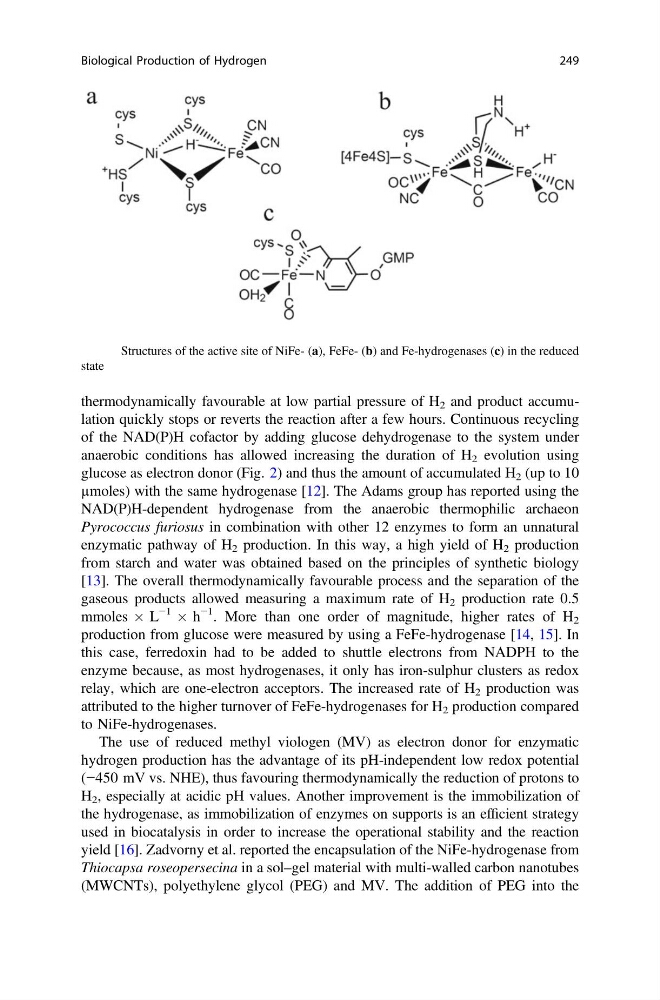
Fig. 1 Structures of the active site of NiFe- (a), FeFe- (b) and Fe-hydrogenases (c) in the reduced
state
Biological Production of Hydrogen
249
of the NAD(P)H cofactor by adding glucose dehydrogenase to the system under
anaerobic conditions has allowed increasing the duration of H 2 evolution using
glucose as electron donor (Fig. 2) and thus the amount of accumulated H 2 (up to 10
µmoles) with the same hydrogenase [12]. The Adams group has reported using the
NAD(P)H-dependent hydrogenase from the anaerobic thermophilic archaeon
Pyrococcus furiosus in combination with other 12 enzymes to form an unnatural
enzymatic pathway of H 2 production. In this way, a high yield of H 2 production
from starch and water was obtained based on the principles of synthetic biology
[13]. The overall thermodynamically favourable process and the separation of the
gaseous products allowed measuring a maximum rate of H 2 production rate 0.5
mmoles  L
−1
 h
−1 . More than one order of magnitude, higher rates of H 2
production from glucose were measured by using a FeFe-hydrogenase [14, 15]. In
this case, ferredoxin had to be added to shuttle electrons from NADPH to the
enzyme because, as most hydrogenases, it only has iron-sulphur clusters as redox
relay, which are one-electron acceptors. The increased rate of H 2 production was
attributed to the higher turnover of FeFe-hydrogenases for H 2 production compared
to NiFe-hydrogenases.
The use of reduced methyl viologen (MV) as electron donor for enzymatic
hydrogen production has the advantage of its pH-independent low redox potential
(−450 mV vs. NHE), thus favouring thermodynamically the reduction of protons to
H 2 , especially at acidic pH values. Another improvement is the immobilization of
the hydrogenase, as immobilization of enzymes on supports is an efficient strategy
used in biocatalysis in order to increase the operational stability and the reaction
yield [16]. Zadvorny et al. reported the encapsulation of the NiFe-hydrogenase from
Thiocapsa roseopersecina in a sol–gel material with multi-walled carbon nanotubes
(MWCNTs), polyethylene glycol (PEG) and MV. The addition of PEG into the
Fig. 1 Structures of the active site of NiFe- (a), FeFe- (b) and Fe-hydrogenases (c) in the reduced
state
Biological Production of Hydrogen
249