

achieve the balance between anthropogenic emissions by sources and removals by
sinks of greenhouse gases, also referred as carbon neutrality.
Under the Paris Agreement, a particular IPCC report was scheduled for 2018 to
answer if it was still viable to engage in a scenario where a limit of 1.5 °C warming
compared with pre-industrial temperature level and what policies and measures
would have to be applied. Four scenarios were developed showing that it is still
possible to fulfil the Paris Agreement goal and that the costs of early action would
pay off the costs of inaction, particularly when the costs for developing countries
are considered. Also, a comparison between a 2 °C and a 1.5 °C warming impact
scenarios was performed, with a clear social and economic benefit for the lower
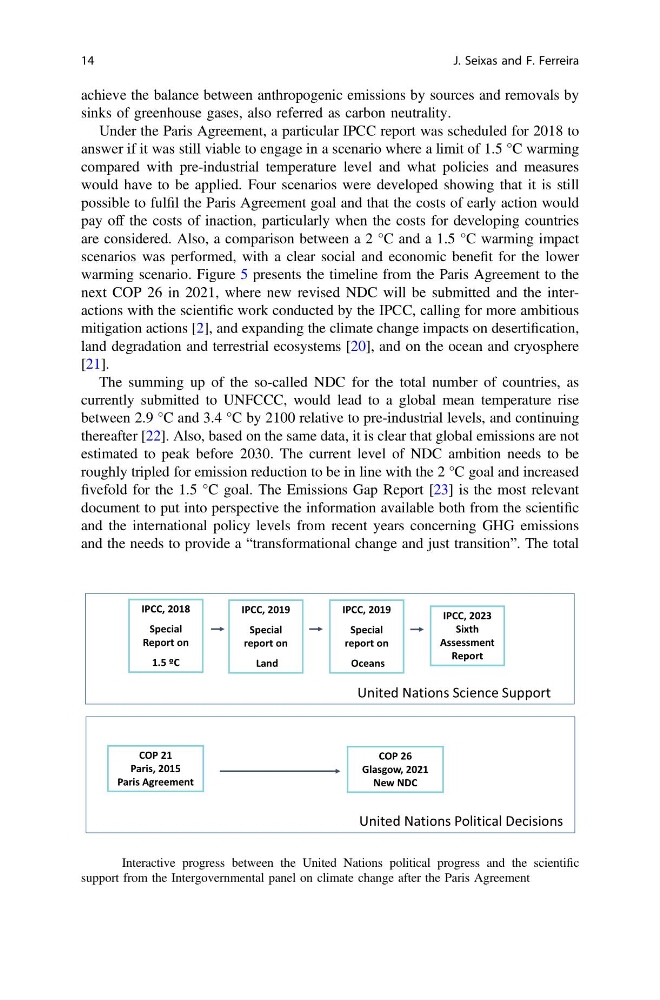
warming scenario. Figure 5 presents the timeline from the Paris Agreement to the
next COP 26 in 2021, where new revised NDC will be submitted and the interactions with the scientific work conducted by the IPCC, calling for more ambitious
mitigation actions [2], and expanding the climate change impacts on desertification,
land degradation and terrestrial ecosystems [20], and on the ocean and cryosphere
[21].
The summing up of the so-called NDC for the total number of countries, as
currently submitted to UNFCCC, would lead to a global mean temperature rise
between 2.9 °C and 3.4 °C by 2100 relative to pre-industrial levels, and continuing
thereafter [22]. Also, based on the same data, it is clear that global emissions are not
estimated to peak before 2030. The current level of NDC ambition needs to be
roughly tripled for emission reduction to be in line with the 2 °C goal and increased
fivefold for the 1.5 °C goal. The Emissions Gap Report [23] is the most relevant
document to put into perspective the information available both from the scientific
and the international policy levels from recent years concerning GHG emissions
and the needs to provide a “transformational change and just transition”. The total
IPCC, 2018
Special
Report on
1.5 ºC
IPCC, 2019
Special
report on
Land
IPCC, 2019
Special
report on
Oceans
COP 21
Paris, 2015
Paris Agreement
United Nations Science Support
United Nations Political Decisions
IPCC, 2023
Sixth
Assessment
Report
COP 26
Glasgow, 2021
New NDC
Fig. 5 Interactive progress between the United Nations political progress and the scientific
support from the Intergovernmental panel on climate change after the Paris Agreement
14
J. Seixas and F. Ferreira
sinks of greenhouse gases, also referred as carbon neutrality.
Under the Paris Agreement, a particular IPCC report was scheduled for 2018 to
answer if it was still viable to engage in a scenario where a limit of 1.5 °C warming
compared with pre-industrial temperature level and what policies and measures
would have to be applied. Four scenarios were developed showing that it is still
possible to fulfil the Paris Agreement goal and that the costs of early action would
pay off the costs of inaction, particularly when the costs for developing countries
are considered. Also, a comparison between a 2 °C and a 1.5 °C warming impact
scenarios was performed, with a clear social and economic benefit for the lower
warming scenario. Figure 5 presents the timeline from the Paris Agreement to the
next COP 26 in 2021, where new revised NDC will be submitted and the interactions with the scientific work conducted by the IPCC, calling for more ambitious
mitigation actions [2], and expanding the climate change impacts on desertification,
land degradation and terrestrial ecosystems [20], and on the ocean and cryosphere
[21].
The summing up of the so-called NDC for the total number of countries, as
currently submitted to UNFCCC, would lead to a global mean temperature rise
between 2.9 °C and 3.4 °C by 2100 relative to pre-industrial levels, and continuing
thereafter [22]. Also, based on the same data, it is clear that global emissions are not
estimated to peak before 2030. The current level of NDC ambition needs to be
roughly tripled for emission reduction to be in line with the 2 °C goal and increased
fivefold for the 1.5 °C goal. The Emissions Gap Report [23] is the most relevant
document to put into perspective the information available both from the scientific
and the international policy levels from recent years concerning GHG emissions
and the needs to provide a “transformational change and just transition”. The total
IPCC, 2018
Special
Report on
1.5 ºC
IPCC, 2019
Special
report on
Land
IPCC, 2019
Special
report on
Oceans
COP 21
Paris, 2015
Paris Agreement
United Nations Science Support
United Nations Political Decisions
IPCC, 2023
Sixth
Assessment
Report
COP 26
Glasgow, 2021
New NDC
Fig. 5 Interactive progress between the United Nations political progress and the scientific
support from the Intergovernmental panel on climate change after the Paris Agreement
14
J. Seixas and F. Ferreira