

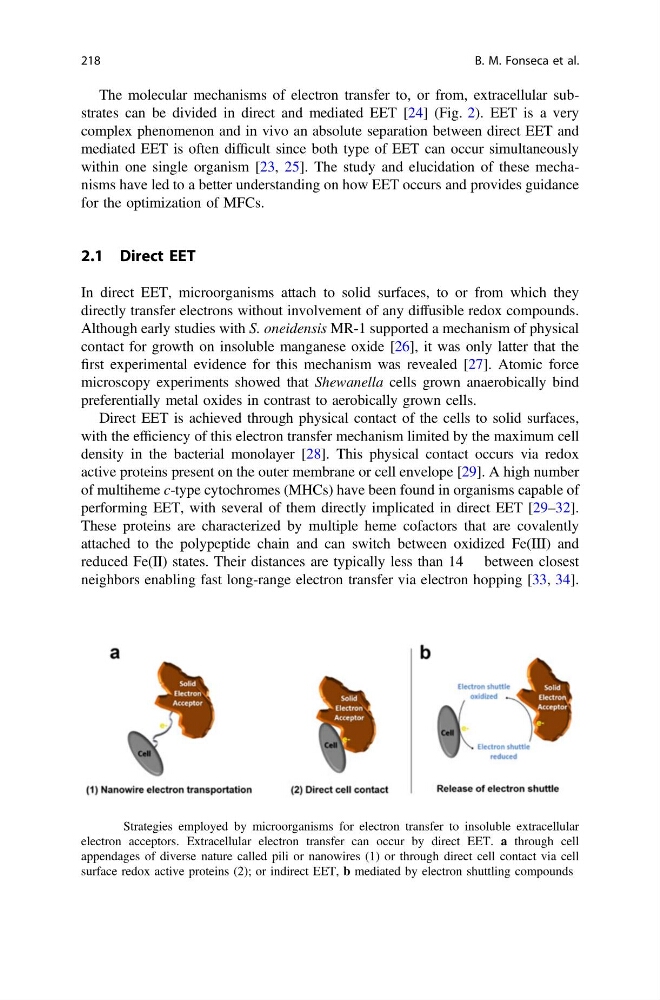
The molecular mechanisms of electron transfer to, or from, extracellular substrates can be divided in direct and mediated EET [24] (Fig. 2). EET is a very
complex phenomenon and in vivo an absolute separation between direct EET and
mediated EET is often difficult since both type of EET can occur simultaneously
within one single organism [23, 25]. The study and elucidation of these mechanisms have led to a better understanding on how EET occurs and provides guidance
for the optimization of MFCs.
2.1 Direct EET
In direct EET, microorganisms attach to solid surfaces, to or from which they
directly transfer electrons without involvement of any diffusible redox compounds.
Although early studies with S. oneidensis MR-1 supported a mechanism of physical
contact for growth on insoluble manganese oxide [26], it was only latter that the
first experimental evidence for this mechanism was revealed [27]. Atomic force
microscopy experiments showed that Shewanella cells grown anaerobically bind
preferentially metal oxides in contrast to aerobically grown cells.
Direct EET is achieved through physical contact of the cells to solid surfaces,
with the efficiency of this electron transfer mechanism limited by the maximum cell
density in the bacterial monolayer [28]. This physical contact occurs via redox
active proteins present on the outer membrane or cell envelope [29]. A high number
of multiheme c-type cytochromes (MHCs) have been found in organisms capable of
performing EET, with several of them directly implicated in direct EET [29–32].
These proteins are characterized by multiple heme cofactors that are covalently
attached to the polypeptide chain and can switch between oxidized Fe(III) and
reduced Fe(II) states. Their distances are typically less than 14 between closest
neighbors enabling fast long-range electron transfer via electron hopping [33, 34].
Fig. 2 Strategies employed by microorganisms for electron transfer to insoluble extracellular
electron acceptors. Extracellular electron transfer can occur by direct EET. a through cell
appendages of diverse nature called pili or nanowires (1) or through direct cell contact via cell
surface redox active proteins (2); or indirect EET, b mediated by electron shuttling compounds
218
B. M. Fonseca et al.
complex phenomenon and in vivo an absolute separation between direct EET and
mediated EET is often difficult since both type of EET can occur simultaneously
within one single organism [23, 25]. The study and elucidation of these mechanisms have led to a better understanding on how EET occurs and provides guidance
for the optimization of MFCs.
2.1 Direct EET
In direct EET, microorganisms attach to solid surfaces, to or from which they
directly transfer electrons without involvement of any diffusible redox compounds.
Although early studies with S. oneidensis MR-1 supported a mechanism of physical
contact for growth on insoluble manganese oxide [26], it was only latter that the
first experimental evidence for this mechanism was revealed [27]. Atomic force
microscopy experiments showed that Shewanella cells grown anaerobically bind
preferentially metal oxides in contrast to aerobically grown cells.
Direct EET is achieved through physical contact of the cells to solid surfaces,
with the efficiency of this electron transfer mechanism limited by the maximum cell
density in the bacterial monolayer [28]. This physical contact occurs via redox
active proteins present on the outer membrane or cell envelope [29]. A high number
of multiheme c-type cytochromes (MHCs) have been found in organisms capable of
performing EET, with several of them directly implicated in direct EET [29–32].
These proteins are characterized by multiple heme cofactors that are covalently
attached to the polypeptide chain and can switch between oxidized Fe(III) and
reduced Fe(II) states. Their distances are typically less than 14 between closest
neighbors enabling fast long-range electron transfer via electron hopping [33, 34].
Fig. 2 Strategies employed by microorganisms for electron transfer to insoluble extracellular
electron acceptors. Extracellular electron transfer can occur by direct EET. a through cell
appendages of diverse nature called pili or nanowires (1) or through direct cell contact via cell
surface redox active proteins (2); or indirect EET, b mediated by electron shuttling compounds
218
B. M. Fonseca et al.