

2 The Organismic Level: Physiology of Nitrous
Oxide-Respiring Bacteria
By definition, laboratory cultures of axenic NRBs will grow at the expense of
exogenous N 2 O as (sole) electron acceptor. With formate, hydrogen gas or NADH
(i.e. reducing equivalents derived from degraded carbohydrates or proteins) as
exemplary electron donors, an NRB will catalyse one or more of the following
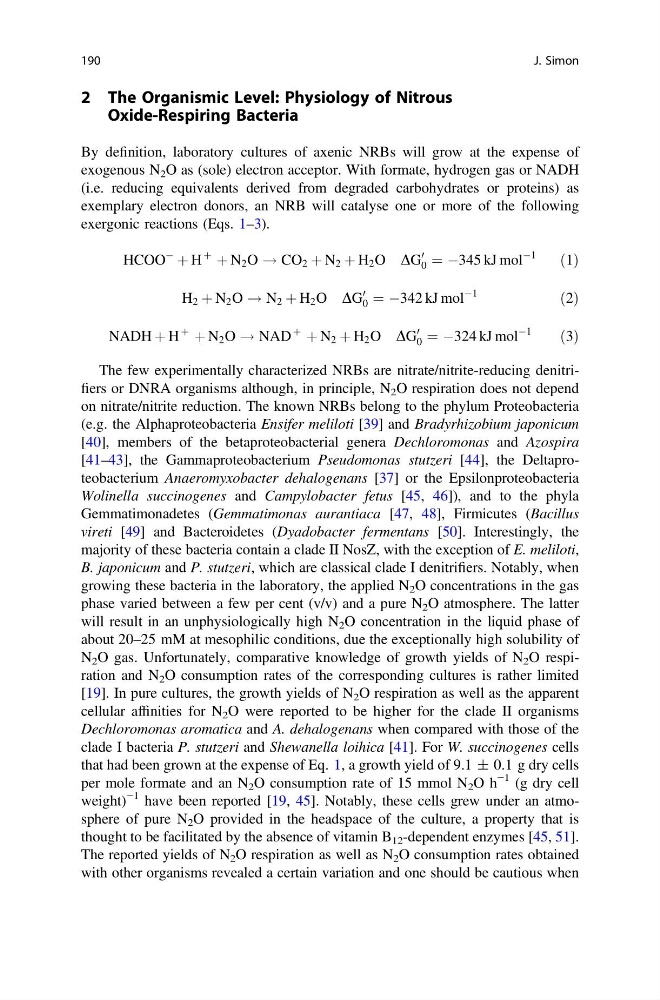
exergonic reactions (Eqs. 1–3).
HCOO
À
þ H
þ
þ N 2 O ! CO 2 þ N 2 þ H 2 O DG
0
0 ¼ À345 kJ mol
À1
ð1Þ
H 2 þ N 2 O ! N 2 þ H 2 O DG
0
0 ¼ À342 kJ mol
À1
ð2Þ
NADH þ H
þ
þ N 2 O ! NAD
þ
þ N 2 þ H 2 O DG
0
0 ¼ À324 kJ mol
À1
ð3Þ
The few experimentally characterized NRBs are nitrate/nitrite-reducing denitrifiers or DNRA organisms although, in principle, N 2 O respiration does not depend
on nitrate/nitrite reduction. The known NRBs belong to the phylum Proteobacteria
(e.g. the Alphaproteobacteria Ensifer meliloti [39] and Bradyrhizobium japonicum
[40], members of the betaproteobacterial genera Dechloromonas and Azospira
[41–43], the Gammaproteobacterium Pseudomonas stutzeri [44], the Deltaproteobacterium Anaeromyxobacter dehalogenans [37] or the Epsilonproteobacteria
Wolinella succinogenes and Campylobacter fetus [45, 46]), and to the phyla
Gemmatimonadetes (Gemmatimonas aurantiaca [47, 48], Firmicutes (Bacillus
vireti [49] and Bacteroidetes (Dyadobacter fermentans [50]. Interestingly, the
majority of these bacteria contain a clade II NosZ, with the exception of E. meliloti,
B. japonicum and P. stutzeri, which are classical clade I denitrifiers. Notably, when
growing these bacteria in the laboratory, the applied N 2 O concentrations in the gas
phase varied between a few per cent (v/v) and a pure N 2 O atmosphere. The latter
will result in an unphysiologically high N 2 O concentration in the liquid phase of
about 20–25 mM at mesophilic conditions, due the exceptionally high solubility of
N 2 O gas. Unfortunately, comparative knowledge of growth yields of N 2 O respiration and N 2 O consumption rates of the corresponding cultures is rather limited
[19]. In pure cultures, the growth yields of N 2 O respiration as well as the apparent
cellular affinities for N 2 O were reported to be higher for the clade II organisms
Dechloromonas aromatica and A. dehalogenans when compared with those of the
clade I bacteria P. stutzeri and Shewanella loihica [41]. For W. succinogenes cells
that had been grown at the expense of Eq. 1, a growth yield of 9.1 ± 0.1 g dry cells
per mole formate and an N 2 O consumption rate of 15 mmol N 2 O h
−1 (g dry cell
weight)
−1 have been reported [19, 45]. Notably, these cells grew under an atmosphere of pure N 2 O provided in the headspace of the culture, a property that is
thought to be facilitated by the absence of vitamin B 12 -dependent enzymes [45, 51].
The reported yields of N 2 O respiration as well as N 2 O consumption rates obtained
with other organisms revealed a certain variation and one should be cautious when
190
J. Simon
Oxide-Respiring Bacteria
By definition, laboratory cultures of axenic NRBs will grow at the expense of
exogenous N 2 O as (sole) electron acceptor. With formate, hydrogen gas or NADH
(i.e. reducing equivalents derived from degraded carbohydrates or proteins) as
exemplary electron donors, an NRB will catalyse one or more of the following
exergonic reactions (Eqs. 1–3).
HCOO
À
þ H
þ
þ N 2 O ! CO 2 þ N 2 þ H 2 O DG
0
0 ¼ À345 kJ mol
À1
ð1Þ
H 2 þ N 2 O ! N 2 þ H 2 O DG
0
0 ¼ À342 kJ mol
À1
ð2Þ
NADH þ H
þ
þ N 2 O ! NAD
þ
þ N 2 þ H 2 O DG
0
0 ¼ À324 kJ mol
À1
ð3Þ
The few experimentally characterized NRBs are nitrate/nitrite-reducing denitrifiers or DNRA organisms although, in principle, N 2 O respiration does not depend
on nitrate/nitrite reduction. The known NRBs belong to the phylum Proteobacteria
(e.g. the Alphaproteobacteria Ensifer meliloti [39] and Bradyrhizobium japonicum
[40], members of the betaproteobacterial genera Dechloromonas and Azospira
[41–43], the Gammaproteobacterium Pseudomonas stutzeri [44], the Deltaproteobacterium Anaeromyxobacter dehalogenans [37] or the Epsilonproteobacteria
Wolinella succinogenes and Campylobacter fetus [45, 46]), and to the phyla
Gemmatimonadetes (Gemmatimonas aurantiaca [47, 48], Firmicutes (Bacillus
vireti [49] and Bacteroidetes (Dyadobacter fermentans [50]. Interestingly, the
majority of these bacteria contain a clade II NosZ, with the exception of E. meliloti,
B. japonicum and P. stutzeri, which are classical clade I denitrifiers. Notably, when
growing these bacteria in the laboratory, the applied N 2 O concentrations in the gas
phase varied between a few per cent (v/v) and a pure N 2 O atmosphere. The latter
will result in an unphysiologically high N 2 O concentration in the liquid phase of
about 20–25 mM at mesophilic conditions, due the exceptionally high solubility of
N 2 O gas. Unfortunately, comparative knowledge of growth yields of N 2 O respiration and N 2 O consumption rates of the corresponding cultures is rather limited
[19]. In pure cultures, the growth yields of N 2 O respiration as well as the apparent
cellular affinities for N 2 O were reported to be higher for the clade II organisms
Dechloromonas aromatica and A. dehalogenans when compared with those of the
clade I bacteria P. stutzeri and Shewanella loihica [41]. For W. succinogenes cells
that had been grown at the expense of Eq. 1, a growth yield of 9.1 ± 0.1 g dry cells
per mole formate and an N 2 O consumption rate of 15 mmol N 2 O h
−1 (g dry cell
weight)
−1 have been reported [19, 45]. Notably, these cells grew under an atmosphere of pure N 2 O provided in the headspace of the culture, a property that is
thought to be facilitated by the absence of vitamin B 12 -dependent enzymes [45, 51].
The reported yields of N 2 O respiration as well as N 2 O consumption rates obtained
with other organisms revealed a certain variation and one should be cautious when
190
J. Simon