

• To what extent is N 2 O reduction/respiration understood at the physiological
and/or molecular level?
• From the anthropocentric view: what are the best-suited N 2 O-reducing/-respiring
microorganisms nature has to offer to mitigate N 2 O emissions?
• Is there potential to ‘optimize’ the physiology of NRBs and what knowledge is
mandatory to do so successfully?
• Will this sort of research eventually help to mitigate N 2 O emissions from different environments?
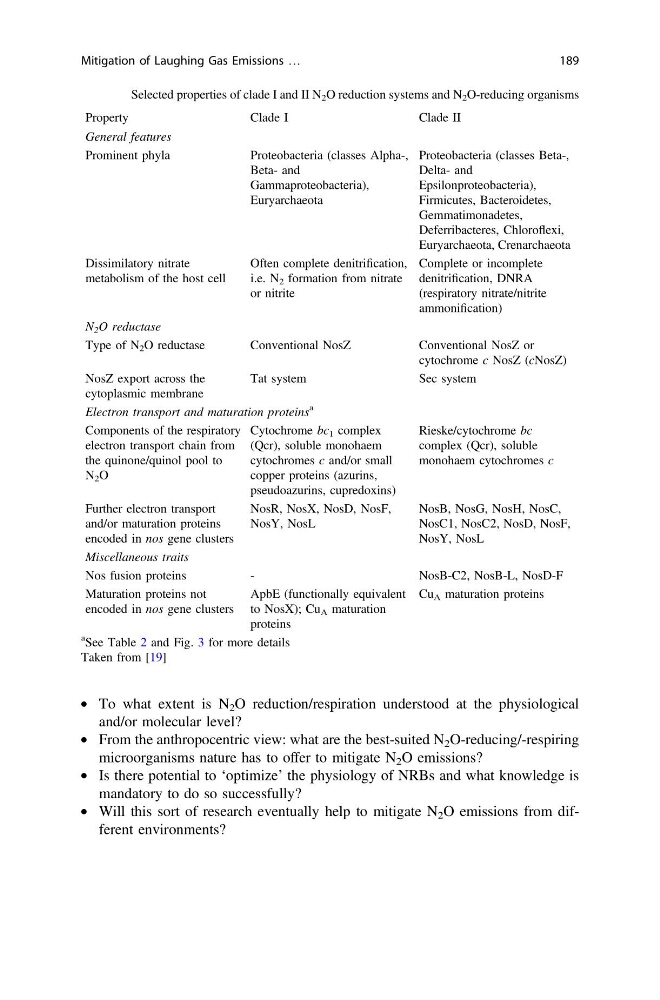
Table 1 Selected properties of clade I and II N 2 O reduction systems and N 2 O-reducing organisms
Property
Clade I
Clade II
General features
Prominent phyla
Proteobacteria (classes Alpha-,
Beta- and
Gammaproteobacteria),
Euryarchaeota
Proteobacteria (classes Beta-,
Delta- and
Epsilonproteobacteria),
Firmicutes, Bacteroidetes,
Gemmatimonadetes,
Deferribacteres, Chloroflexi,
Euryarchaeota, Crenarchaeota
Dissimilatory nitrate
metabolism of the host cell
Often complete denitrification,
i.e. N 2 formation from nitrate
or nitrite
Complete or incomplete
denitrification, DNRA
(respiratory nitrate/nitrite
ammonification)
N 2 O reductase
Type of N 2 O reductase
Conventional NosZ
Conventional NosZ or
cytochrome c NosZ (cNosZ)
NosZ export across the
cytoplasmic membrane
Tat system
Sec system
Electron transport and maturation proteins
a
Components of the respiratory
electron transport chain from
the quinone/quinol pool to
N 2 O
Cytochrome bc 1 complex
(Qcr), soluble monohaem
cytochromes c and/or small
copper proteins (azurins,
pseudoazurins, cupredoxins)
Rieske/cytochrome bc
complex (Qcr), soluble
monohaem cytochromes c
Further electron transport
and/or maturation proteins
encoded in nos gene clusters
NosR, NosX, NosD, NosF,
NosY, NosL
NosB, NosG, NosH, NosC,
NosC1, NosC2, NosD, NosF,
NosY, NosL
Miscellaneous traits
Nos fusion proteins
-
NosB-C2, NosB-L, NosD-F
Maturation proteins not
encoded in nos gene clusters
ApbE (functionally equivalent
to NosX); Cu A maturation
proteins
Cu A maturation proteins
a See Table 2 and Fig. 3 for more details
Taken from [19]
Mitigation of Laughing Gas Emissions …
189
and/or molecular level?
• From the anthropocentric view: what are the best-suited N 2 O-reducing/-respiring
microorganisms nature has to offer to mitigate N 2 O emissions?
• Is there potential to ‘optimize’ the physiology of NRBs and what knowledge is
mandatory to do so successfully?
• Will this sort of research eventually help to mitigate N 2 O emissions from different environments?
Table 1 Selected properties of clade I and II N 2 O reduction systems and N 2 O-reducing organisms
Property
Clade I
Clade II
General features
Prominent phyla
Proteobacteria (classes Alpha-,
Beta- and
Gammaproteobacteria),
Euryarchaeota
Proteobacteria (classes Beta-,
Delta- and
Epsilonproteobacteria),
Firmicutes, Bacteroidetes,
Gemmatimonadetes,
Deferribacteres, Chloroflexi,
Euryarchaeota, Crenarchaeota
Dissimilatory nitrate
metabolism of the host cell
Often complete denitrification,
i.e. N 2 formation from nitrate
or nitrite
Complete or incomplete
denitrification, DNRA
(respiratory nitrate/nitrite
ammonification)
N 2 O reductase
Type of N 2 O reductase
Conventional NosZ
Conventional NosZ or
cytochrome c NosZ (cNosZ)
NosZ export across the
cytoplasmic membrane
Tat system
Sec system
Electron transport and maturation proteins
a
Components of the respiratory
electron transport chain from
the quinone/quinol pool to
N 2 O
Cytochrome bc 1 complex
(Qcr), soluble monohaem
cytochromes c and/or small
copper proteins (azurins,
pseudoazurins, cupredoxins)
Rieske/cytochrome bc
complex (Qcr), soluble
monohaem cytochromes c
Further electron transport
and/or maturation proteins
encoded in nos gene clusters
NosR, NosX, NosD, NosF,
NosY, NosL
NosB, NosG, NosH, NosC,
NosC1, NosC2, NosD, NosF,
NosY, NosL
Miscellaneous traits
Nos fusion proteins
-
NosB-C2, NosB-L, NosD-F
Maturation proteins not
encoded in nos gene clusters
ApbE (functionally equivalent
to NosX); Cu A maturation
proteins
Cu A maturation proteins
a See Table 2 and Fig. 3 for more details
Taken from [19]
Mitigation of Laughing Gas Emissions …
189