

but instead a S = 1/2 signal in the perpendicular mode was observed [41, 43]. This
suggested the presence of [Fe 4 S 4 ] cluster(s) in the +1 oxidation state in place of the
P-cluster. This assignment was confirmed by Fe K-edge XAS/EXAFS studies
which demonstrated the presence of a typical [Fe 4 S 4 ] and an atypical [Fe 4 S 4 ] cluster
that is coordinated by a light atom (N or O) [41]. In addition, magnetic circular
dichroism (MCD) spectra of DnifH NifDK suggested the existence of an unbridged
pair of 4Fe subclusters, with one ferredoxin-type [Fe 4 S 4 ]
1+ cluster and one [Fe 4 S 4 ]like cluster [44, 45]. The latter was found to display an unusual paramagnetism in
the +2 oxidation state, in which [Fe 4 S 4 ] clusters are typically diamagnetic [45].
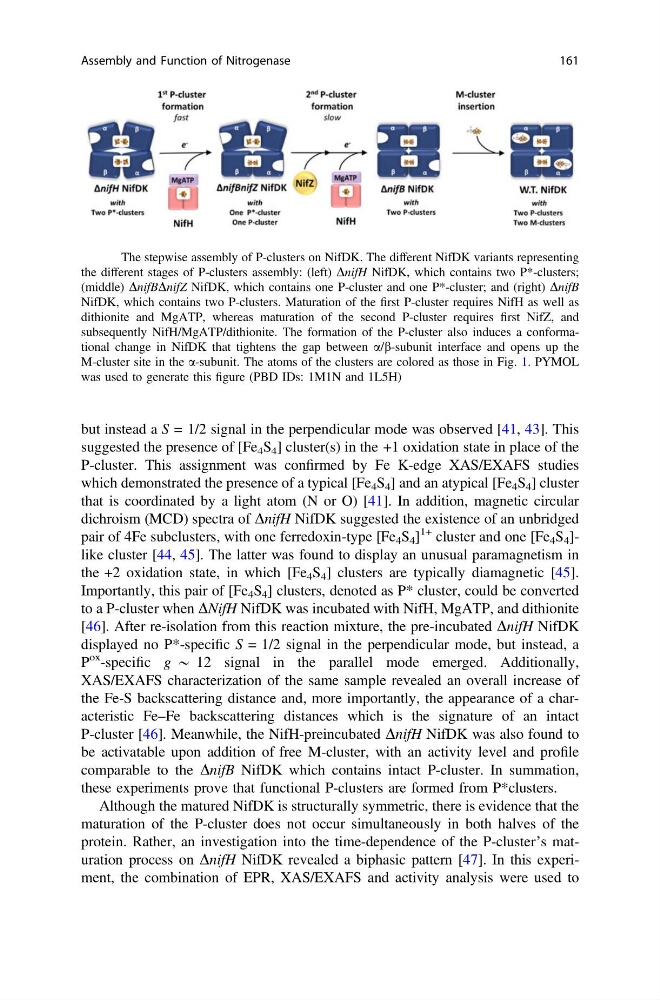
Importantly, this pair of [Fe 4 S 4 ] clusters, denoted as P* cluster, could be converted
to a P-cluster when DNifH NifDK was incubated with NifH, MgATP, and dithionite
[46]. After re-isolation from this reaction mixture, the pre-incubated DnifH NifDK
displayed no P*-specific S = 1/2 signal in the perpendicular mode, but instead, a
P
ox -specific g * 12 signal in the parallel mode emerged. Additionally,
XAS/EXAFS characterization of the same sample revealed an overall increase of
the Fe-S backscattering distance and, more importantly, the appearance of a characteristic Fe–Fe backscattering distances which is the signature of an intact
P-cluster [46]. Meanwhile, the NifH-preincubated DnifH NifDK was also found to
be activatable upon addition of free M-cluster, with an activity level and profile
comparable to the DnifB NifDK which contains intact P-cluster. In summation,
these experiments prove that functional P-clusters are formed from P*clusters.
Although the matured NifDK is structurally symmetric, there is evidence that the
maturation of the P-cluster does not occur simultaneously in both halves of the
protein. Rather, an investigation into the time-dependence of the P-cluster’s maturation process on DnifH NifDK revealed a biphasic pattern [47]. In this experiment, the combination of EPR, XAS/EXAFS and activity analysis were used to
Fig. 3 The stepwise assembly of P-clusters on NifDK. The different NifDK variants representing
the different stages of P-clusters assembly: (left) DnifH NifDK, which contains two P*-clusters;
(middle) DnifBDnifZ NifDK, which contains one P-cluster and one P*-cluster; and (right) DnifB
NifDK, which contains two P-clusters. Maturation of the first P-cluster requires NifH as well as
dithionite and MgATP, whereas maturation of the second P-cluster requires first NifZ, and
subsequently NifH/MgATP/dithionite. The formation of the P-cluster also induces a conformational change in NifDK that tightens the gap between a/b-subunit interface and opens up the
M-cluster site in the a-subunit. The atoms of the clusters are colored as those in Fig. 1. PYMOL
was used to generate this figure (PBD IDs: 1M1N and 1L5H)
Assembly and Function of Nitrogenase
161
suggested the presence of [Fe 4 S 4 ] cluster(s) in the +1 oxidation state in place of the
P-cluster. This assignment was confirmed by Fe K-edge XAS/EXAFS studies
which demonstrated the presence of a typical [Fe 4 S 4 ] and an atypical [Fe 4 S 4 ] cluster
that is coordinated by a light atom (N or O) [41]. In addition, magnetic circular
dichroism (MCD) spectra of DnifH NifDK suggested the existence of an unbridged
pair of 4Fe subclusters, with one ferredoxin-type [Fe 4 S 4 ]
1+ cluster and one [Fe 4 S 4 ]like cluster [44, 45]. The latter was found to display an unusual paramagnetism in
the +2 oxidation state, in which [Fe 4 S 4 ] clusters are typically diamagnetic [45].
Importantly, this pair of [Fe 4 S 4 ] clusters, denoted as P* cluster, could be converted
to a P-cluster when DNifH NifDK was incubated with NifH, MgATP, and dithionite
[46]. After re-isolation from this reaction mixture, the pre-incubated DnifH NifDK
displayed no P*-specific S = 1/2 signal in the perpendicular mode, but instead, a
P
ox -specific g * 12 signal in the parallel mode emerged. Additionally,
XAS/EXAFS characterization of the same sample revealed an overall increase of
the Fe-S backscattering distance and, more importantly, the appearance of a characteristic Fe–Fe backscattering distances which is the signature of an intact
P-cluster [46]. Meanwhile, the NifH-preincubated DnifH NifDK was also found to
be activatable upon addition of free M-cluster, with an activity level and profile
comparable to the DnifB NifDK which contains intact P-cluster. In summation,
these experiments prove that functional P-clusters are formed from P*clusters.
Although the matured NifDK is structurally symmetric, there is evidence that the
maturation of the P-cluster does not occur simultaneously in both halves of the
protein. Rather, an investigation into the time-dependence of the P-cluster’s maturation process on DnifH NifDK revealed a biphasic pattern [47]. In this experiment, the combination of EPR, XAS/EXAFS and activity analysis were used to
Fig. 3 The stepwise assembly of P-clusters on NifDK. The different NifDK variants representing
the different stages of P-clusters assembly: (left) DnifH NifDK, which contains two P*-clusters;
(middle) DnifBDnifZ NifDK, which contains one P-cluster and one P*-cluster; and (right) DnifB
NifDK, which contains two P-clusters. Maturation of the first P-cluster requires NifH as well as
dithionite and MgATP, whereas maturation of the second P-cluster requires first NifZ, and
subsequently NifH/MgATP/dithionite. The formation of the P-cluster also induces a conformational change in NifDK that tightens the gap between a/b-subunit interface and opens up the
M-cluster site in the a-subunit. The atoms of the clusters are colored as those in Fig. 1. PYMOL
was used to generate this figure (PBD IDs: 1M1N and 1L5H)
Assembly and Function of Nitrogenase
161