

(which is referred to as DnifBnifZ NifDK) (Fig. 3) [41, 42]. It should be noted that
both of these NifDK variants lack the M-cluster because NifH and NifB are both
necessary for its biosynthesis, thereby allowing for the unambiguous assignment of
spectroscopic features to the P-cluster and its precursor. EPR analysis of DnifH
NifDK revealed the absence of the P
ox -specific g * 12 signal in the parallel mode,
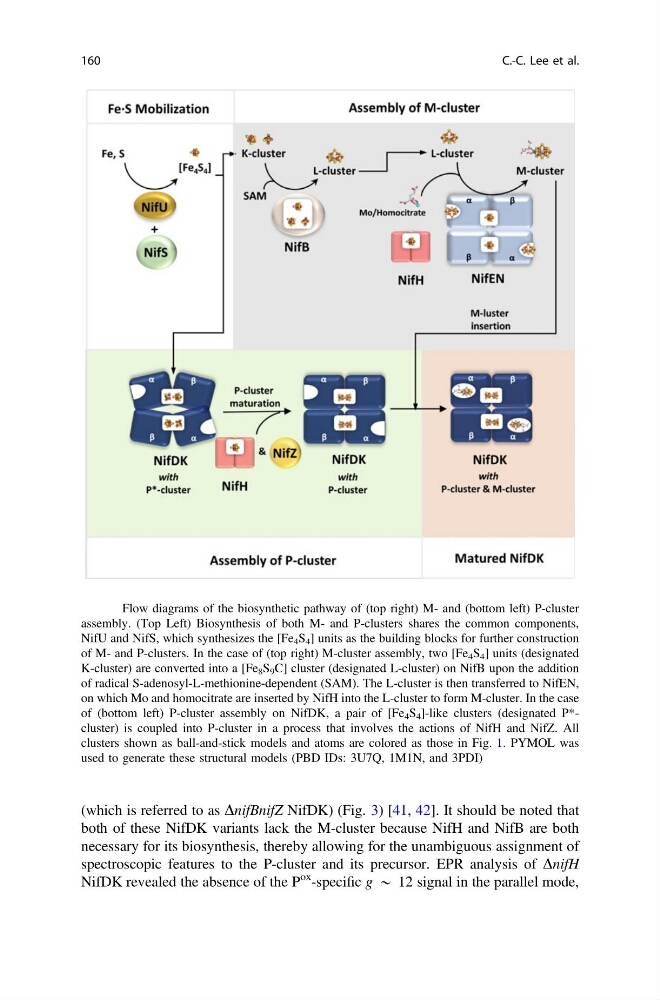
Fig. 2 Flow diagrams of the biosynthetic pathway of (top right) M- and (bottom left) P-cluster
assembly. (Top Left) Biosynthesis of both M- and P-clusters shares the common components,
NifU and NifS, which synthesizes the [Fe 4 S 4 ] units as the building blocks for further construction
of M- and P-clusters. In the case of (top right) M-cluster assembly, two [Fe 4 S 4 ] units (designated
K-cluster) are converted into a [Fe 8 S 9 C] cluster (designated L-cluster) on NifB upon the addition
of radical S-adenosyl-L-methionine-dependent (SAM). The L-cluster is then transferred to NifEN,
on which Mo and homocitrate are inserted by NifH into the L-cluster to form M-cluster. In the case
of (bottom left) P-cluster assembly on NifDK, a pair of [Fe 4 S 4 ]-like clusters (designated P*cluster) is coupled into P-cluster in a process that involves the actions of NifH and NifZ. All
clusters shown as ball-and-stick models and atoms are colored as those in Fig. 1. PYMOL was
used to generate these structural models (PBD IDs: 3U7Q, 1M1N, and 3PDI)
160
C.-C. Lee et al.
both of these NifDK variants lack the M-cluster because NifH and NifB are both
necessary for its biosynthesis, thereby allowing for the unambiguous assignment of
spectroscopic features to the P-cluster and its precursor. EPR analysis of DnifH
NifDK revealed the absence of the P
ox -specific g * 12 signal in the parallel mode,
Fig. 2 Flow diagrams of the biosynthetic pathway of (top right) M- and (bottom left) P-cluster
assembly. (Top Left) Biosynthesis of both M- and P-clusters shares the common components,
NifU and NifS, which synthesizes the [Fe 4 S 4 ] units as the building blocks for further construction
of M- and P-clusters. In the case of (top right) M-cluster assembly, two [Fe 4 S 4 ] units (designated
K-cluster) are converted into a [Fe 8 S 9 C] cluster (designated L-cluster) on NifB upon the addition
of radical S-adenosyl-L-methionine-dependent (SAM). The L-cluster is then transferred to NifEN,
on which Mo and homocitrate are inserted by NifH into the L-cluster to form M-cluster. In the case
of (bottom left) P-cluster assembly on NifDK, a pair of [Fe 4 S 4 ]-like clusters (designated P*cluster) is coupled into P-cluster in a process that involves the actions of NifH and NifZ. All
clusters shown as ball-and-stick models and atoms are colored as those in Fig. 1. PYMOL was
used to generate these structural models (PBD IDs: 3U7Q, 1M1N, and 3PDI)
160
C.-C. Lee et al.