

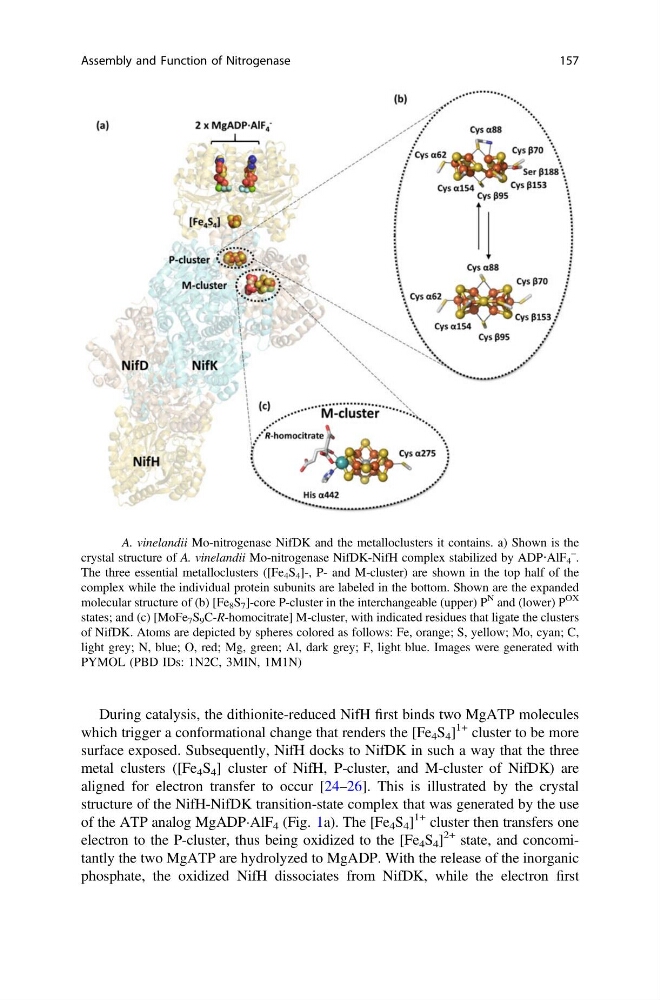
During catalysis, the dithionite-reduced NifH first binds two MgATP molecules
which trigger a conformational change that renders the [Fe 4 S 4 ]
1+ cluster to be more
surface exposed. Subsequently, NifH docks to NifDK in such a way that the three
metal clusters ([Fe 4 S 4 ] cluster of NifH, P-cluster, and M-cluster of NifDK) are
aligned for electron transfer to occur [24–26]. This is illustrated by the crystal
structure of the NifH-NifDK transition-state complex that was generated by the use
of the ATP analog MgADPÁAlF 4 (Fig. 1a). The [Fe 4 S 4 ]
1+ cluster then transfers one
electron to the P-cluster, thus being oxidized to the [Fe 4 S 4 ]
2+ state, and concomitantly the two MgATP are hydrolyzed to MgADP. With the release of the inorganic
phosphate, the oxidized NifH dissociates from NifDK, while the electron first
Fig. 1 A. vinelandii Mo-nitrogenase NifDK and the metalloclusters it contains. a) Shown is the
crystal structure of A. vinelandii Mo-nitrogenase NifDK-NifH complex stabilized by ADP⋅AlF 4
–
.
The three essential metalloclusters ([Fe 4 S 4 ]-, P- and M-cluster) are shown in the top half of the
complex while the individual protein subunits are labeled in the bottom. Shown are the expanded
molecular structure of (b) [Fe 8 S 7 ]-core P-cluster in the interchangeable (upper) P
N and (lower) P
OX
states; and (c) [MoFe 7 S 9 C-R-homocitrate] M-cluster, with indicated residues that ligate the clusters
of NifDK. Atoms are depicted by spheres colored as follows: Fe, orange; S, yellow; Mo, cyan; C,
light grey; N, blue; O, red; Mg, green; Al, dark grey; F, light blue. Images were generated with
PYMOL (PBD IDs: 1N2C, 3MIN, 1M1N)
Assembly and Function of Nitrogenase
157
which trigger a conformational change that renders the [Fe 4 S 4 ]
1+ cluster to be more
surface exposed. Subsequently, NifH docks to NifDK in such a way that the three
metal clusters ([Fe 4 S 4 ] cluster of NifH, P-cluster, and M-cluster of NifDK) are
aligned for electron transfer to occur [24–26]. This is illustrated by the crystal
structure of the NifH-NifDK transition-state complex that was generated by the use
of the ATP analog MgADPÁAlF 4 (Fig. 1a). The [Fe 4 S 4 ]
1+ cluster then transfers one
electron to the P-cluster, thus being oxidized to the [Fe 4 S 4 ]
2+ state, and concomitantly the two MgATP are hydrolyzed to MgADP. With the release of the inorganic
phosphate, the oxidized NifH dissociates from NifDK, while the electron first
Fig. 1 A. vinelandii Mo-nitrogenase NifDK and the metalloclusters it contains. a) Shown is the
crystal structure of A. vinelandii Mo-nitrogenase NifDK-NifH complex stabilized by ADP⋅AlF 4
–
.
The three essential metalloclusters ([Fe 4 S 4 ]-, P- and M-cluster) are shown in the top half of the
complex while the individual protein subunits are labeled in the bottom. Shown are the expanded
molecular structure of (b) [Fe 8 S 7 ]-core P-cluster in the interchangeable (upper) P
N and (lower) P
OX
states; and (c) [MoFe 7 S 9 C-R-homocitrate] M-cluster, with indicated residues that ligate the clusters
of NifDK. Atoms are depicted by spheres colored as follows: Fe, orange; S, yellow; Mo, cyan; C,
light grey; N, blue; O, red; Mg, green; Al, dark grey; F, light blue. Images were generated with
PYMOL (PBD IDs: 1N2C, 3MIN, 1M1N)
Assembly and Function of Nitrogenase
157