

1 Introduction
Biological nitrogen fixation represents the conversion of atmospheric dinitrogen
(N 2 ) into bioavailable ammonia (NH 3 ). It is a critical entry step in the global
nitrogen cycle and is responsible for roughly half of the fixed nitrogen in our body
[1–3]. This process also involves the breaking of the triple bond of N 2 , one of the
strongest bonds in nature, under ambient conditions and requires the highly
sophisticated metalloenzyme known as nitrogenase. The most studied Modependent nitrogenase (Mo-nitrogenase) catalyzes the reduction of N 2 to NH 3
using protons and electrons in an ATP-dependent manner. The reaction can be
written as follows [4, 5]:
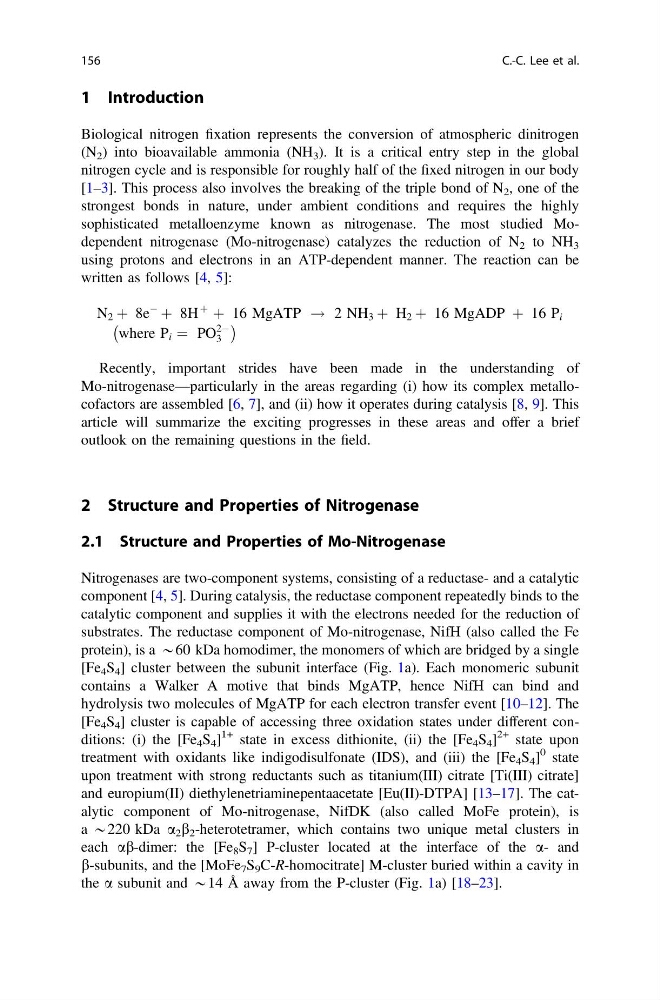
N 2 þ 8e
À
þ 8H
þ
þ 16 MgATP ! 2 NH 3 þ H 2 þ 16 MgADP þ 16 P i
where P i ¼ PO
2À
3
À
Á
Recently, important strides have been made in the understanding of
Mo-nitrogenase—particularly in the areas regarding (i) how its complex metallocofactors are assembled [6, 7], and (ii) how it operates during catalysis [8, 9]. This
article will summarize the exciting progresses in these areas and offer a brief
outlook on the remaining questions in the field.
2 Structure and Properties of Nitrogenase
2.1 Structure and Properties of Mo-Nitrogenase
Nitrogenases are two-component systems, consisting of a reductase- and a catalytic
component [4, 5]. During catalysis, the reductase component repeatedly binds to the
catalytic component and supplies it with the electrons needed for the reduction of
substrates. The reductase component of Mo-nitrogenase, NifH (also called the Fe
protein), is a *60 kDa homodimer, the monomers of which are bridged by a single
[Fe 4 S 4 ] cluster between the subunit interface (Fig. 1a). Each monomeric subunit
contains a Walker A motive that binds MgATP, hence NifH can bind and
hydrolysis two molecules of MgATP for each electron transfer event [10–12]. The
[Fe 4 S 4 ] cluster is capable of accessing three oxidation states under different conditions: (i) the [Fe 4 S 4 ]
1+ state in excess dithionite, (ii) the [Fe 4 S 4 ]
2+ state upon
treatment with oxidants like indigodisulfonate (IDS), and (iii) the [Fe 4 S 4 ]
0 state
upon treatment with strong reductants such as titanium(III) citrate [Ti(III) citrate]
and europium(II) diethylenetriaminepentaacetate [Eu(II)-DTPA] [13–17]. The catalytic component of Mo-nitrogenase, NifDK (also called MoFe protein), is
a *220 kDa a 2 b 2 -heterotetramer, which contains two unique metal clusters in
each ab-dimer: the [Fe 8 S 7 ] P-cluster located at the interface of the a- and
b-subunits, and the [MoFe 7 S 9 C-R-homocitrate] M-cluster buried within a cavity in
the a subunit and *14 Å away from the P-cluster (Fig. 1a) [18–23].
156
C.-C. Lee et al.
Biological nitrogen fixation represents the conversion of atmospheric dinitrogen
(N 2 ) into bioavailable ammonia (NH 3 ). It is a critical entry step in the global
nitrogen cycle and is responsible for roughly half of the fixed nitrogen in our body
[1–3]. This process also involves the breaking of the triple bond of N 2 , one of the
strongest bonds in nature, under ambient conditions and requires the highly
sophisticated metalloenzyme known as nitrogenase. The most studied Modependent nitrogenase (Mo-nitrogenase) catalyzes the reduction of N 2 to NH 3
using protons and electrons in an ATP-dependent manner. The reaction can be
written as follows [4, 5]:
N 2 þ 8e
À
þ 8H
þ
þ 16 MgATP ! 2 NH 3 þ H 2 þ 16 MgADP þ 16 P i
where P i ¼ PO
2À
3
À
Á
Recently, important strides have been made in the understanding of
Mo-nitrogenase—particularly in the areas regarding (i) how its complex metallocofactors are assembled [6, 7], and (ii) how it operates during catalysis [8, 9]. This
article will summarize the exciting progresses in these areas and offer a brief
outlook on the remaining questions in the field.
2 Structure and Properties of Nitrogenase
2.1 Structure and Properties of Mo-Nitrogenase
Nitrogenases are two-component systems, consisting of a reductase- and a catalytic
component [4, 5]. During catalysis, the reductase component repeatedly binds to the
catalytic component and supplies it with the electrons needed for the reduction of
substrates. The reductase component of Mo-nitrogenase, NifH (also called the Fe
protein), is a *60 kDa homodimer, the monomers of which are bridged by a single
[Fe 4 S 4 ] cluster between the subunit interface (Fig. 1a). Each monomeric subunit
contains a Walker A motive that binds MgATP, hence NifH can bind and
hydrolysis two molecules of MgATP for each electron transfer event [10–12]. The
[Fe 4 S 4 ] cluster is capable of accessing three oxidation states under different conditions: (i) the [Fe 4 S 4 ]
1+ state in excess dithionite, (ii) the [Fe 4 S 4 ]
2+ state upon
treatment with oxidants like indigodisulfonate (IDS), and (iii) the [Fe 4 S 4 ]
0 state
upon treatment with strong reductants such as titanium(III) citrate [Ti(III) citrate]
and europium(II) diethylenetriaminepentaacetate [Eu(II)-DTPA] [13–17]. The catalytic component of Mo-nitrogenase, NifDK (also called MoFe protein), is
a *220 kDa a 2 b 2 -heterotetramer, which contains two unique metal clusters in
each ab-dimer: the [Fe 8 S 7 ] P-cluster located at the interface of the a- and
b-subunits, and the [MoFe 7 S 9 C-R-homocitrate] M-cluster buried within a cavity in
the a subunit and *14 Å away from the P-cluster (Fig. 1a) [18–23].
156
C.-C. Lee et al.