

over a range of interparticle distances, the magnitude increasing with fall in distance. There could be a range of interparticle distances where the attractive energy
from the van der Waals term exceeds the repulsive energy due to the steric factor,
giving rise to net stabilization of the two-particle system. This is illustrated in Figure 4.18 in the case of 4.5 nm Pd particles. Stabilization energies of 17 and 2 meV
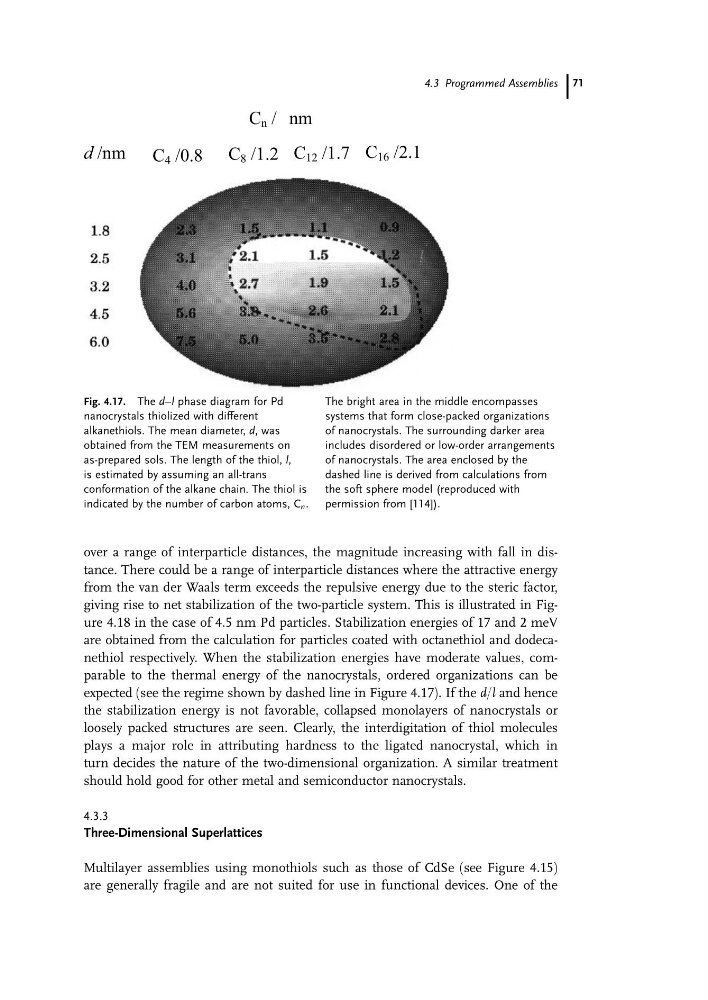
are obtained from the calculation for particles coated with octanethiol and dodecanethiol respectively. When the stabilization energies have moderate values, comparable to the thermal energy of the nanocrystals, ordered organizations can be
expected (see the regime shown by dashed line in Figure 4.17). If the d/l and hence
the stabilization energy is not favorable, collapsed monolayers of nanocrystals or
loosely packed structures are seen. Clearly, the interdigitation of thiol molecules
plays a major role in attributing hardness to the ligated nanocrystal, which in
turn decides the nature of the two-dimensional organization. A similar treatment
should hold good for other metal and semiconductor nanocrystals.
4.3.3
Three-Dimensional Superlattices
Multilayer assemblies using monothiols such as those of CdSe (see Figure 4.15)
are generally fragile and are not suited for use in functional devices. One of the
d /nm
C n / nm
C 4 /0.8 C 8 /1.2 C 12 /1.7 C 16 /2.1
Fig. 4.17. The d–l phase diagram for Pd
nanocrystals thiolized with different
alkanethiols. The mean diameter, d, was
obtained from the TEM measurements on
as-prepared sols. The length of the thiol, l,
is estimated by assuming an all-trans
conformation of the alkane chain. The thiol is
indicated by the number of carbon atoms, C n .
The bright area in the middle encompasses
systems that form close-packed organizations
of nanocrystals. The surrounding darker area
includes disordered or low-order arrangements
of nanocrystals. The area enclosed by the
dashed line is derived from calculations from
the soft sphere model (reproduced with
permission from [114]).
4.3 Programmed Assemblies 71
from the van der Waals term exceeds the repulsive energy due to the steric factor,
giving rise to net stabilization of the two-particle system. This is illustrated in Figure 4.18 in the case of 4.5 nm Pd particles. Stabilization energies of 17 and 2 meV
are obtained from the calculation for particles coated with octanethiol and dodecanethiol respectively. When the stabilization energies have moderate values, comparable to the thermal energy of the nanocrystals, ordered organizations can be
expected (see the regime shown by dashed line in Figure 4.17). If the d/l and hence
the stabilization energy is not favorable, collapsed monolayers of nanocrystals or
loosely packed structures are seen. Clearly, the interdigitation of thiol molecules
plays a major role in attributing hardness to the ligated nanocrystal, which in
turn decides the nature of the two-dimensional organization. A similar treatment
should hold good for other metal and semiconductor nanocrystals.
4.3.3
Three-Dimensional Superlattices
Multilayer assemblies using monothiols such as those of CdSe (see Figure 4.15)
are generally fragile and are not suited for use in functional devices. One of the
d /nm
C n / nm
C 4 /0.8 C 8 /1.2 C 12 /1.7 C 16 /2.1
Fig. 4.17. The d–l phase diagram for Pd
nanocrystals thiolized with different
alkanethiols. The mean diameter, d, was
obtained from the TEM measurements on
as-prepared sols. The length of the thiol, l,
is estimated by assuming an all-trans
conformation of the alkane chain. The thiol is
indicated by the number of carbon atoms, C n .
The bright area in the middle encompasses
systems that form close-packed organizations
of nanocrystals. The surrounding darker area
includes disordered or low-order arrangements
of nanocrystals. The area enclosed by the
dashed line is derived from calculations from
the soft sphere model (reproduced with
permission from [114]).
4.3 Programmed Assemblies 71