

mixed arrays were obtained by evaporating a binary mixture of the metal oxide
organosols.
4.3.2.4 Other Two-Dimensional Arrangements
It is possible to obtain micrometer-sized rings of monodisperse nanocrystals, such
as Ag 2 S, Ag, instead of extended arrays, by varying the solvent evaporation rate and
exploiting the resulting fluid instabilities (the Marangoni effect) that occurs during evaporation [134–138]. Neat Au nanocrystals as well as CdSeaZnS core–shell
nanocrystals of various sizes have been organized into two-dimensional lattices
using a protein (chaperonin) template [139].
4.3.2.5 Stability and Phase Behaviour of Two-Dimensional Arrays
The nanocrystal organizations mentioned above are mainly entropy-driven. The
two lengths involved, the nanocrystal diameter (d) and the ligand chain length (l)
play an important role in deciding the nature of the organization i.e., its orderliness. It has been observed experimentally that for a given diameter of the nanocrystal, the packing changes swiftly as the length of the thiol ligand is increased.
The stability diagram in terms of d and l shown in Figure 4.17 illustrates that extended close-packed organizations of nanocrystals are found for d/l values of @2.
Although entropy driven, the above cannot be treated as hard sphere organizations.
Based on a study of the effect of the solvent polarity on the self-assembly of ligated
metal nanocrystals, Korgel et al. [101, 112] proposed a soft sphere model taking the
interparticle interaction into consideration. Accordingly, a ligated nanocrystal allows for penetration of the ligand shell up to its hard sphere limit. In this model,
the total potential energy, E, is considered to be a result of two types of forces between the nanocrystals,
E ¼ E steric þ E vdW
ð1Þ
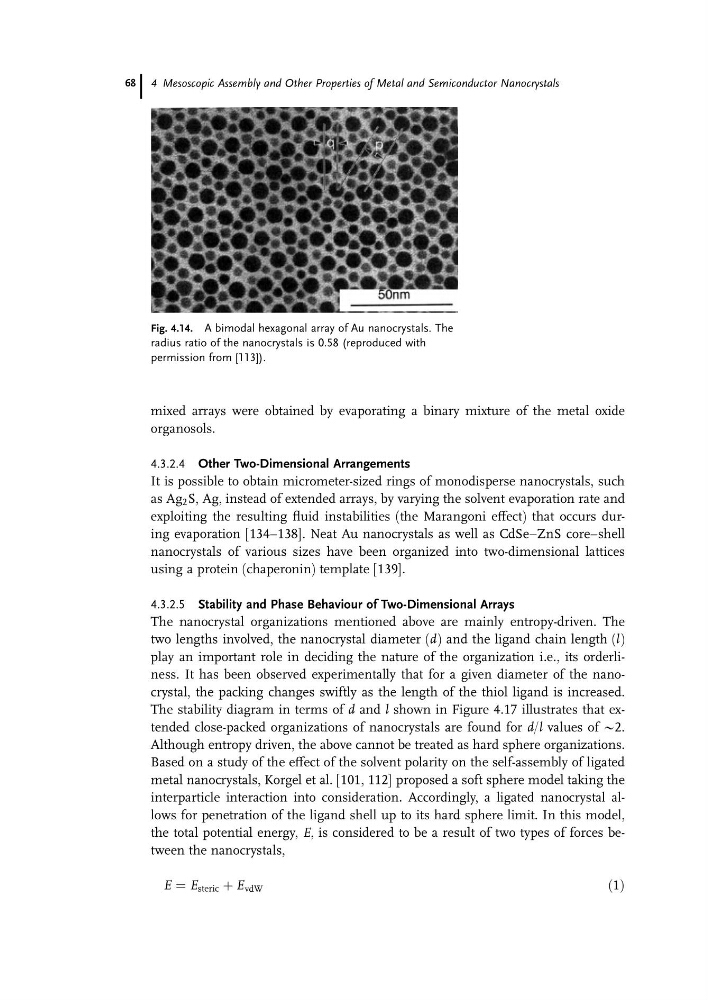
Fig. 4.14. A bimodal hexagonal array of Au nanocrystals. The
radius ratio of the nanocrystals is 0.58 (reproduced with
permission from [113]).
4 Mesoscopic Assembly and Other Properties of Metal and Semiconductor Nanocrystals
68
organosols.
4.3.2.4 Other Two-Dimensional Arrangements
It is possible to obtain micrometer-sized rings of monodisperse nanocrystals, such
as Ag 2 S, Ag, instead of extended arrays, by varying the solvent evaporation rate and
exploiting the resulting fluid instabilities (the Marangoni effect) that occurs during evaporation [134–138]. Neat Au nanocrystals as well as CdSeaZnS core–shell
nanocrystals of various sizes have been organized into two-dimensional lattices
using a protein (chaperonin) template [139].
4.3.2.5 Stability and Phase Behaviour of Two-Dimensional Arrays
The nanocrystal organizations mentioned above are mainly entropy-driven. The
two lengths involved, the nanocrystal diameter (d) and the ligand chain length (l)
play an important role in deciding the nature of the organization i.e., its orderliness. It has been observed experimentally that for a given diameter of the nanocrystal, the packing changes swiftly as the length of the thiol ligand is increased.
The stability diagram in terms of d and l shown in Figure 4.17 illustrates that extended close-packed organizations of nanocrystals are found for d/l values of @2.
Although entropy driven, the above cannot be treated as hard sphere organizations.
Based on a study of the effect of the solvent polarity on the self-assembly of ligated
metal nanocrystals, Korgel et al. [101, 112] proposed a soft sphere model taking the
interparticle interaction into consideration. Accordingly, a ligated nanocrystal allows for penetration of the ligand shell up to its hard sphere limit. In this model,
the total potential energy, E, is considered to be a result of two types of forces between the nanocrystals,
E ¼ E steric þ E vdW
ð1Þ
Fig. 4.14. A bimodal hexagonal array of Au nanocrystals. The
radius ratio of the nanocrystals is 0.58 (reproduced with
permission from [113]).
4 Mesoscopic Assembly and Other Properties of Metal and Semiconductor Nanocrystals
68