

DMF 4 [69], Cd 17 S 4 (SCH 2 CH 2 OH) 26 [69], Cd 32 S 14 (SCH 2 CH(CH 3 )OH) 36 [70],
Hg 32 Se 14 (SeC 6 H 5 ) 36 [71] have been obtained. Solutions of such clusters possess
optical properties similar to those of the sols. Schmid [72] and Zamaraev [73] succeeded in preparing truly monodisperse nanocrystals which they called ‘‘cluster
compounds’’. These cluster compounds are like macromolecules with a core containing metal–metal bonds yet are obtainable in definite stoichiometries, typical
examples being [Pt 38 (CO) 44 H 2 ]
2À and Au 55 (PPh 3 ) 12 Cl 6 . The enhanced stability of
Au 55 was recently demonstrated clearly by Boyen et al. [74] who exposed a series
of Au n nanocrystals to oxidation. These nanocrystals have special stability because
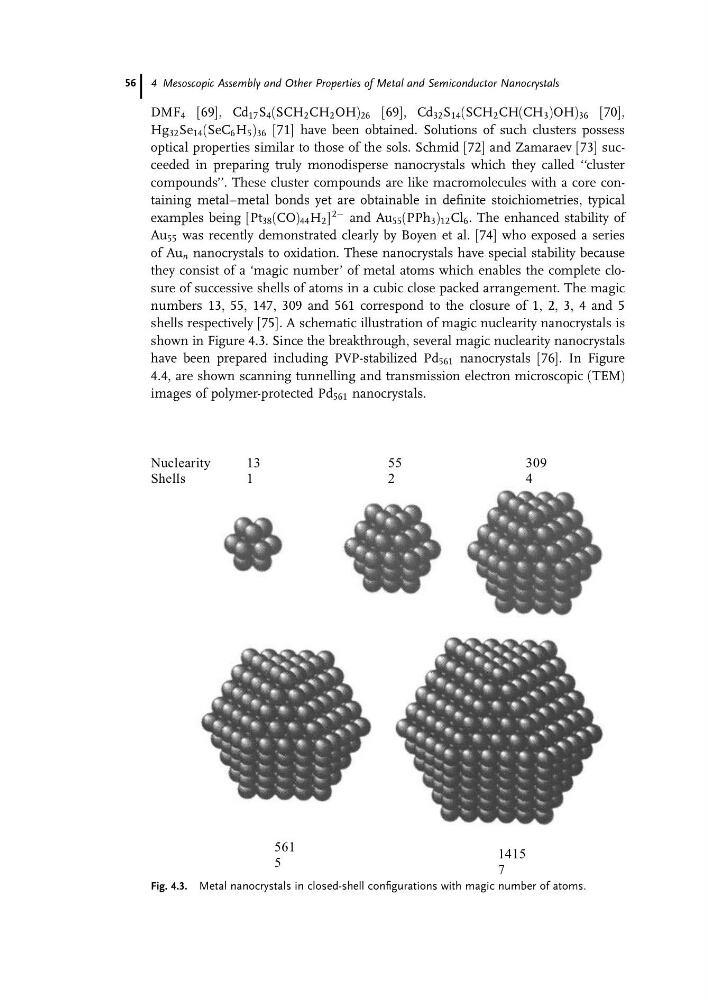
they consist of a ‘magic number’ of metal atoms which enables the complete closure of successive shells of atoms in a cubic close packed arrangement. The magic
numbers 13, 55, 147, 309 and 561 correspond to the closure of 1, 2, 3, 4 and 5
shells respectively [75]. A schematic illustration of magic nuclearity nanocrystals is
shown in Figure 4.3. Since the breakthrough, several magic nuclearity nanocrystals
have been prepared including PVP-stabilized Pd 561 nanocrystals [76]. In Figure
4.4, are shown scanning tunnelling and transmission electron microscopic (TEM)
images of polymer-protected Pd 561 nanocrystals.
Nuclearity
Shells
13
1
55
2
309
4
561
5
1415
7
Fig. 4.3. Metal nanocrystals in closed-shell configurations with magic number of atoms.
4 Mesoscopic Assembly and Other Properties of Metal and Semiconductor Nanocrystals
56
Hg 32 Se 14 (SeC 6 H 5 ) 36 [71] have been obtained. Solutions of such clusters possess
optical properties similar to those of the sols. Schmid [72] and Zamaraev [73] succeeded in preparing truly monodisperse nanocrystals which they called ‘‘cluster
compounds’’. These cluster compounds are like macromolecules with a core containing metal–metal bonds yet are obtainable in definite stoichiometries, typical
examples being [Pt 38 (CO) 44 H 2 ]
2À and Au 55 (PPh 3 ) 12 Cl 6 . The enhanced stability of
Au 55 was recently demonstrated clearly by Boyen et al. [74] who exposed a series
of Au n nanocrystals to oxidation. These nanocrystals have special stability because
they consist of a ‘magic number’ of metal atoms which enables the complete closure of successive shells of atoms in a cubic close packed arrangement. The magic
numbers 13, 55, 147, 309 and 561 correspond to the closure of 1, 2, 3, 4 and 5
shells respectively [75]. A schematic illustration of magic nuclearity nanocrystals is
shown in Figure 4.3. Since the breakthrough, several magic nuclearity nanocrystals
have been prepared including PVP-stabilized Pd 561 nanocrystals [76]. In Figure
4.4, are shown scanning tunnelling and transmission electron microscopic (TEM)
images of polymer-protected Pd 561 nanocrystals.
Nuclearity
Shells
13
1
55
2
309
4
561
5
1415
7
Fig. 4.3. Metal nanocrystals in closed-shell configurations with magic number of atoms.
4 Mesoscopic Assembly and Other Properties of Metal and Semiconductor Nanocrystals
56