

4.2.2
Size Control
The successful synthesis of nanocrystals involves three steps nucleation, growth
and termination by the capping agent or ligand [35–37]. Though the reaction temperature and reagent concentrations provide a rudimentary control of the three
steps, it is often impossible to independently control them and so the obtained
nanocrystals usually exhibit a distribution in size. Typically, the distribution is
log-normal with a standard deviation of 10% [37]. Given the fact that properties
of the nanocrystals are size-dependent, it is significant to be able to synthesize
nanocrystals of precise dimensions with minimal size-distributions. This can be
accomplished to a limited extent by size selective precipitation, either by centrifugation or by use of a miscible solvent–non-solvent liquid mixture to precipitate the nanocrystals. However, single crystals of large clusters of semiconducting
material such as Cu 147 Se 73 (PEt 3 ) 22 [68], [Cd 10 S 4 (SPh) 16 ]
4À [69], Cd 32 S 14 (SC 6 H 5 ) 36
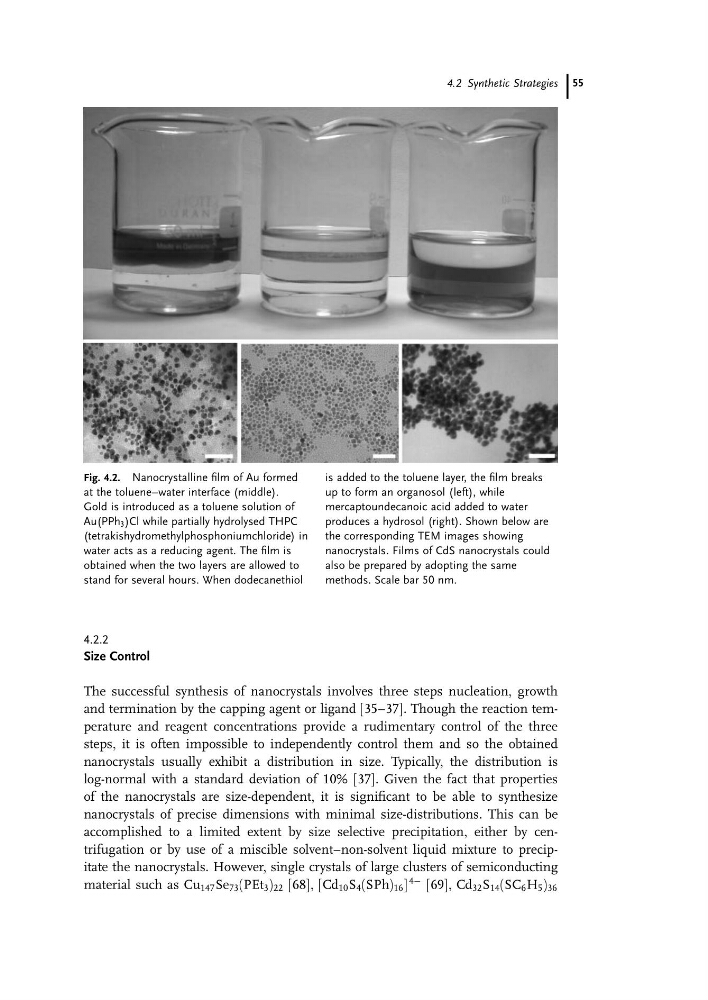
Fig. 4.2. Nanocrystalline film of Au formed
at the toluene–water interface (middle).
Gold is introduced as a toluene solution of
Au(PPh 3 )Cl while partially hydrolysed THPC
(tetrakishydromethylphosphoniumchloride) in
water acts as a reducing agent. The film is
obtained when the two layers are allowed to
stand for several hours. When dodecanethiol
is added to the toluene layer, the film breaks
up to form an organosol (left), while
mercaptoundecanoic acid added to water
produces a hydrosol (right). Shown below are
the corresponding TEM images showing
nanocrystals. Films of CdS nanocrystals could
also be prepared by adopting the same
methods. Scale bar 50 nm.
4.2 Synthetic Strategies 55
Size Control
The successful synthesis of nanocrystals involves three steps nucleation, growth
and termination by the capping agent or ligand [35–37]. Though the reaction temperature and reagent concentrations provide a rudimentary control of the three
steps, it is often impossible to independently control them and so the obtained
nanocrystals usually exhibit a distribution in size. Typically, the distribution is
log-normal with a standard deviation of 10% [37]. Given the fact that properties
of the nanocrystals are size-dependent, it is significant to be able to synthesize
nanocrystals of precise dimensions with minimal size-distributions. This can be
accomplished to a limited extent by size selective precipitation, either by centrifugation or by use of a miscible solvent–non-solvent liquid mixture to precipitate the nanocrystals. However, single crystals of large clusters of semiconducting
material such as Cu 147 Se 73 (PEt 3 ) 22 [68], [Cd 10 S 4 (SPh) 16 ]
4À [69], Cd 32 S 14 (SC 6 H 5 ) 36
Fig. 4.2. Nanocrystalline film of Au formed
at the toluene–water interface (middle).
Gold is introduced as a toluene solution of
Au(PPh 3 )Cl while partially hydrolysed THPC
(tetrakishydromethylphosphoniumchloride) in
water acts as a reducing agent. The film is
obtained when the two layers are allowed to
stand for several hours. When dodecanethiol
is added to the toluene layer, the film breaks
up to form an organosol (left), while
mercaptoundecanoic acid added to water
produces a hydrosol (right). Shown below are
the corresponding TEM images showing
nanocrystals. Films of CdS nanocrystals could
also be prepared by adopting the same
methods. Scale bar 50 nm.
4.2 Synthetic Strategies 55