

is well known that thiols bind to quantum dots of CdS and, therefore, it should
be possible to phase transfer aqueous CdS nanoparticles into organic solutions by
complexation with alkanethiols and this has been demonstrated by us [73]. The
experimental conditions for phase transfer of aqueous CdS into toluene containing
octadecanethiol were slightly more stringent than those used for phase transfer of
gold nanoparticles. It was observed that pre-formed CdS nanoparticles upon complexation with octadecanethiol molecules at the liquid–liquid interface assembled
at the interface and were not transferred to the organic phase [73]. Bubbling H 2 S
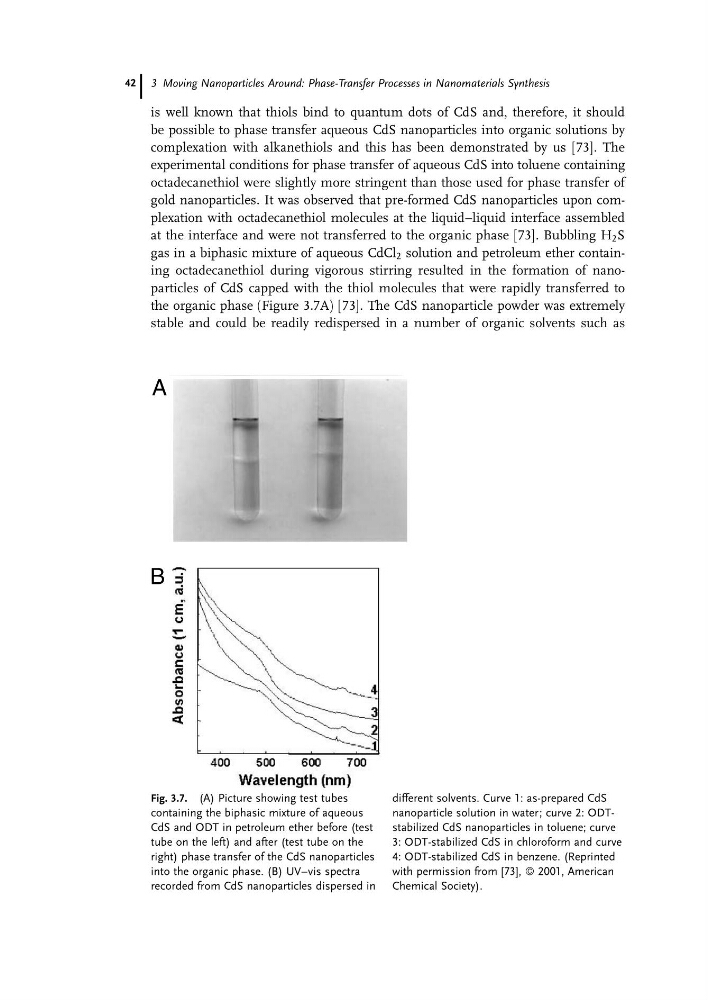
gas in a biphasic mixture of aqueous CdCl 2 solution and petroleum ether containing octadecanethiol during vigorous stirring resulted in the formation of nanoparticles of CdS capped with the thiol molecules that were rapidly transferred to
the organic phase (Figure 3.7A) [73]. The CdS nanoparticle powder was extremely
stable and could be readily redispersed in a number of organic solvents such as
B
A
Fig. 3.7. (A) Picture showing test tubes
containing the biphasic mixture of aqueous
CdS and ODT in petroleum ether before (test
tube on the left) and after (test tube on the
right) phase transfer of the CdS nanoparticles
into the organic phase. (B) UV–vis spectra
recorded from CdS nanoparticles dispersed in
different solvents. Curve 1: as-prepared CdS
nanoparticle solution in water; curve 2: ODTstabilized CdS nanoparticles in toluene; curve
3: ODT-stabilized CdS in chloroform and curve
4: ODT-stabilized CdS in benzene. (Reprinted
with permission from [73], 8 2001, American
Chemical Society).
3 Moving Nanoparticles Around: Phase-Transfer Processes in Nanomaterials Synthesis
42
be possible to phase transfer aqueous CdS nanoparticles into organic solutions by
complexation with alkanethiols and this has been demonstrated by us [73]. The
experimental conditions for phase transfer of aqueous CdS into toluene containing
octadecanethiol were slightly more stringent than those used for phase transfer of
gold nanoparticles. It was observed that pre-formed CdS nanoparticles upon complexation with octadecanethiol molecules at the liquid–liquid interface assembled
at the interface and were not transferred to the organic phase [73]. Bubbling H 2 S
gas in a biphasic mixture of aqueous CdCl 2 solution and petroleum ether containing octadecanethiol during vigorous stirring resulted in the formation of nanoparticles of CdS capped with the thiol molecules that were rapidly transferred to
the organic phase (Figure 3.7A) [73]. The CdS nanoparticle powder was extremely
stable and could be readily redispersed in a number of organic solvents such as
B
A
Fig. 3.7. (A) Picture showing test tubes
containing the biphasic mixture of aqueous
CdS and ODT in petroleum ether before (test
tube on the left) and after (test tube on the
right) phase transfer of the CdS nanoparticles
into the organic phase. (B) UV–vis spectra
recorded from CdS nanoparticles dispersed in
different solvents. Curve 1: as-prepared CdS
nanoparticle solution in water; curve 2: ODTstabilized CdS nanoparticles in toluene; curve
3: ODT-stabilized CdS in chloroform and curve
4: ODT-stabilized CdS in benzene. (Reprinted
with permission from [73], 8 2001, American
Chemical Society).
3 Moving Nanoparticles Around: Phase-Transfer Processes in Nanomaterials Synthesis
42