

electrode [36]. On the other hand, both reductive and oxidative steps can be beneficially used to degrade aromatic compounds such as trinitrophenol [39].
Obtaining insight into charge transfer processes is important in order to improve the photoconversion efficiencies in semiconductor-based nanoassemblies.
The principles and mechanism of photocatalytic reactions in advanced oxidation
processes can be found in earlier review articles [40–42]. Technological advances in
this area have already led to the product development for a variety of day-to-day
operations. Commercialization of products such as self-cleaning glass, disinfectant
tiles and filters for air purification demonstrate the initial success of nanosystems
for environmental applications [43].
19.3
Photoinduced Transformations of Metal Nanoparticles
Noble metals in bulk are photoactive only to a small extent, as in the case of photoemission from silver electrodes [44]. The nanoparticles of noble metals on the
other hand exhibit increased photochemical activity because of their high surface/
volume ratio and unusual electronic properties. For example, Henglein and coworkers [45, 46] reported photochemical dissolution of Ag colloids when photoejected electrons were scavenged by species such as N 2 O. The photochemical
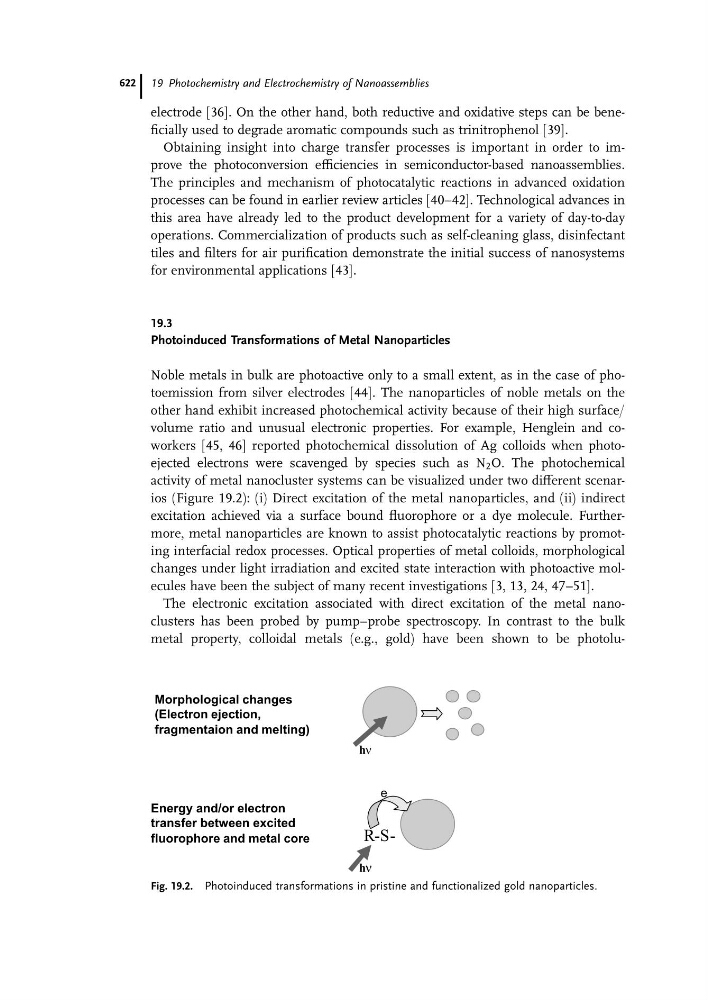
activity of metal nanocluster systems can be visualized under two different scenarios (Figure 19.2): (i) Direct excitation of the metal nanoparticles, and (ii) indirect
excitation achieved via a surface bound fluorophore or a dye molecule. Furthermore, metal nanoparticles are known to assist photocatalytic reactions by promoting interfacial redox processes. Optical properties of metal colloids, morphological
changes under light irradiation and excited state interaction with photoactive molecules have been the subject of many recent investigations [3, 13, 24, 47–51].
The electronic excitation associated with direct excitation of the metal nanoclusters has been probed by pump–probe spectroscopy. In contrast to the bulk
metal property, colloidal metals (e.g., gold) have been shown to be photoluEnergy and/or electron
transfer between excited
fluorophore and metal core
R-Shn
Morphological changes
(Electron ejection,
fragmentaion and melting)
hn
e
Fig. 19.2. Photoinduced transformations in pristine and functionalized gold nanoparticles.
19 Photochemistry and Electrochemistry of Nanoassemblies
622