

toelectrochemistry, different semiconductor nanoparticle systems have been employed in the direct conversion of light energy into chemical or electrical energy.
Basic understanding of the nanostructured semiconductor systems is important
for establishing their practical use in photochemical solar cells, electrochromic
devices, sensors, and photocatalytic degradation of organic contaminants.
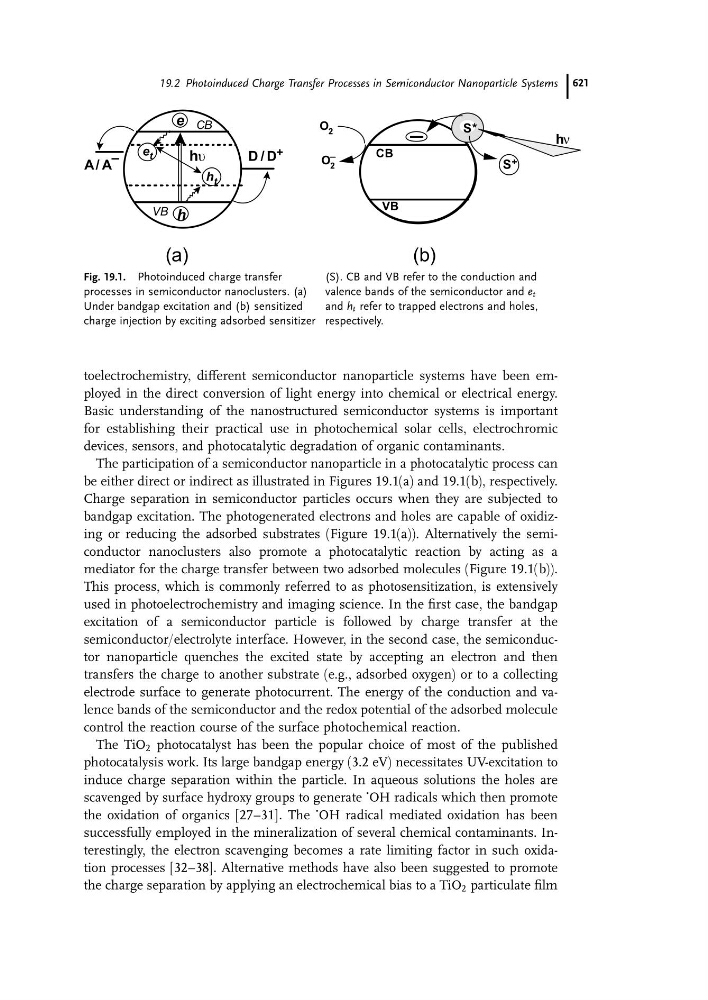
The participation of a semiconductor nanoparticle in a photocatalytic process can
be either direct or indirect as illustrated in Figures 19.1(a) and 19.1(b), respectively.
Charge separation in semiconductor particles occurs when they are subjected to
bandgap excitation. The photogenerated electrons and holes are capable of oxidizing or reducing the adsorbed substrates (Figure 19.1(a)). Alternatively the semiconductor nanoclusters also promote a photocatalytic reaction by acting as a
mediator for the charge transfer between two adsorbed molecules (Figure 19.1(b)).
This process, which is commonly referred to as photosensitization, is extensively
used in photoelectrochemistry and imaging science. In the first case, the bandgap
excitation of a semiconductor particle is followed by charge transfer at the
semiconductor/electrolyte interface. However, in the second case, the semiconductor nanoparticle quenches the excited state by accepting an electron and then
transfers the charge to another substrate (e.g., adsorbed oxygen) or to a collecting
electrode surface to generate photocurrent. The energy of the conduction and valence bands of the semiconductor and the redox potential of the adsorbed molecule
control the reaction course of the surface photochemical reaction.
The TiO 2 photocatalyst has been the popular choice of most of the published
photocatalysis work. Its large bandgap energy (3.2 eV) necessitates UV-excitation to
induce charge separation within the particle. In aqueous solutions the holes are
scavenged by surface hydroxy groups to generate
. OH radicals which then promote
the oxidation of organics [27–31]. The
.
OH radical mediated oxidation has been
successfully employed in the mineralization of several chemical contaminants. Interestingly, the electron scavenging becomes a rate limiting factor in such oxidation processes [32–38]. Alternative methods have also been suggested to promote
the charge separation by applying an electrochemical bias to a TiO 2 particulate film
CB
VB
S*
S +
O 2
O 2
hn
D / D +
e
A / A
VB
CB
hu
–
h
h t
e t
(a)
(b)
Fig. 19.1. Photoinduced charge transfer
processes in semiconductor nanoclusters. (a)
Under bandgap excitation and (b) sensitized
charge injection by exciting adsorbed sensitizer
(S). CB and VB refer to the conduction and
valence bands of the semiconductor and e t
and h t refer to trapped electrons and holes,
respectively.
19.2 Photoinduced Charge Transfer Processes in Semiconductor Nanoparticle Systems 621