

positional flexibility for coordinating oxygen atoms is also critical in determining
the overall M–O–M dimensionality of hybrid metal oxides [151]. This is a consequence of the requirement of oxygen atoms to be in very specific locations to satisfy the coordination requirements of stable transition metal–oxygen networks.
Based on this supposition, simple, monofunctional organic molecules would in
fact be more likely to form materials with extended M–O–M connectivity than
polyfunctional ones. The existence of three-dimensional zeolite-like phosphonates
such as b-Cu(O 3 PCH 3 ) [152], Zn(O 3 PC 2 H 4 NH 2 ) [153] and b-Al 2 (CH 3 PO 3 ) 3 ÁH 2 O
[154], supports this. One surprising result from this area has been the discovery
of a remarkable antimony(III) methylphosphonate nanotube structure [155]. Even
more surprising is the recent discovery by Forster and Cheetham of a number of
open-framework formats [151, 156], acetates [151] and other monocarboxylates
[157] with two- and three-dimensional M–O–M networks. For example, Figure
18.10 shows the structure of an open-framework nickel formate. These monocarboxylates are synthesized under virtually identical conditions as the polycarboxylate
hybrid metal oxides.
Several drawbacks limit the utility of the hybrid metal oxides prepared to date.
Firstly, it has proven extremely difficult to create materials with porosity as high as
is in coordination polymers. This is especially true in the case of materials with
two- and three-dimensional M–O–M frameworks. Secondly, while some examples
of these materials have relatively high magnetic ordering temperatures, there are
still no examples that order at or above room temperature. However, there do not
appear to be any fundamental reasons why these difficulties cannot be overcome.
18.7
Conclusions
The field of nanoporous materials has emerged as one of the most exciting and
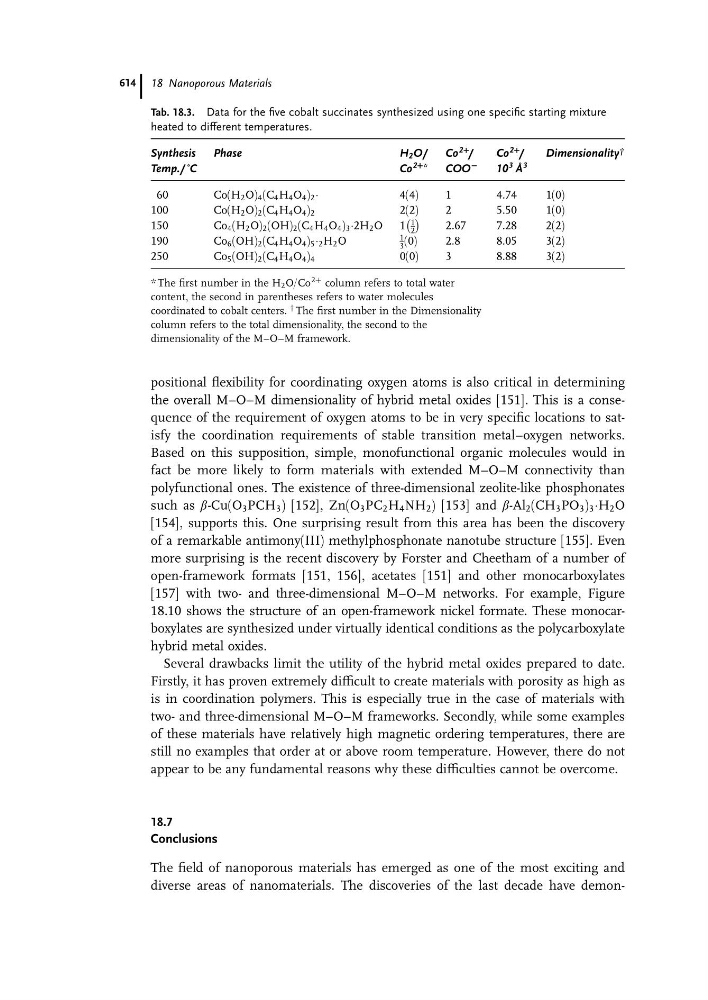
diverse areas of nanomaterials. The discoveries of the last decade have demonTab. 18.3. Data for the five cobalt succinates synthesized using one specific starting mixture
heated to different temperatures.
Synthesis
Temp./ ˚C
Phase
H 2 O/
Co
2B*
Co
2B
/
COO
C
Co
2B
/
10
3 A ˚ 3
Dimensionality †
60
Co(H 2 O) 4 (C 4 H 4 O 4 ) 2 Á
4(4)
1
4.74
1(0)
100
Co(H 2 O) 2 (C 4 H 4 O 4 ) 2
2(2)
2
5.50
1(0)
150
Co 4 (H 2 O) 2 (OH) 2 (C 4 H 4 O 4 ) 3 Á2H 2 O 1
1
2
À Á
2.67
7.28
2(2)
190
Co 6 (OH) 2 (C 4 H 4 O 4 ) 5 Á 2 H 2 O
1
3 (0)
2.8
8.05
3(2)
250
Co 5 (OH) 2 (C 4 H 4 O 4 ) 4
0(0)
3
8.88
3(2)
* The first number in the H 2 O/Co
2þ column refers to total water
content, the second in parentheses refers to water molecules
coordinated to cobalt centers.
y The first number in the Dimensionality
column refers to the total dimensionality, the second to the
dimensionality of the M–O–M framework.
18 Nanoporous Materials
614