

catalysis, which is widely found with the aluminosilicate zeolites, VSB-1 shows
little reactivity. However, it exhibits excellent stability and high selectivity (>80%)
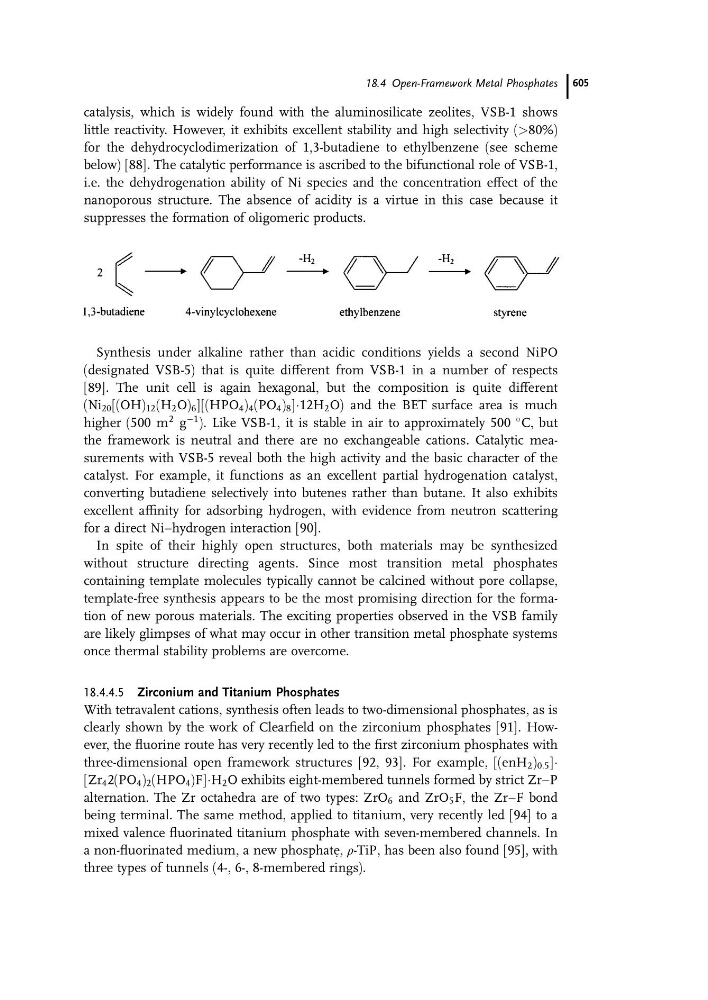
for the dehydrocyclodimerization of 1,3-butadiene to ethylbenzene (see scheme
below) [88]. The catalytic performance is ascribed to the bifunctional role of VSB-1,
i.e. the dehydrogenation ability of Ni species and the concentration effect of the
nanoporous structure. The absence of acidity is a virtue in this case because it
suppresses the formation of oligomeric products.
Synthesis under alkaline rather than acidic conditions yields a second NiPO
(designated VSB-5) that is quite different from VSB-1 in a number of respects
[89]. The unit cell is again hexagonal, but the composition is quite different
(Ni 20 [(OH) 12 (H 2 O) 6 ][(HPO 4 ) 4 (PO 4 ) 8 ]Á12H 2 O) and the BET surface area is much
higher (500 m
2 g
À1 ). Like VSB-1, it is stable in air to approximately 500
C, but
the framework is neutral and there are no exchangeable cations. Catalytic measurements with VSB-5 reveal both the high activity and the basic character of the
catalyst. For example, it functions as an excellent partial hydrogenation catalyst,
converting butadiene selectively into butenes rather than butane. It also exhibits
excellent affinity for adsorbing hydrogen, with evidence from neutron scattering
for a direct Ni–hydrogen interaction [90].
In spite of their highly open structures, both materials may be synthesized
without structure directing agents. Since most transition metal phosphates
containing template molecules typically cannot be calcined without pore collapse,
template-free synthesis appears to be the most promising direction for the formation of new porous materials. The exciting properties observed in the VSB family
are likely glimpses of what may occur in other transition metal phosphate systems
once thermal stability problems are overcome.
18.4.4.5 Zirconium and Titanium Phosphates
With tetravalent cations, synthesis often leads to two-dimensional phosphates, as is
clearly shown by the work of Clearfield on the zirconium phosphates [91]. However, the fluorine route has very recently led to the first zirconium phosphates with
three-dimensional open framework structures [92, 93]. For example, [(enH 2 ) 0:5 ]Á
[Zr 4 2(PO 4 ) 2 (HPO 4 )F]ÁH 2 O exhibits eight-membered tunnels formed by strict ZraP
alternation. The Zr octahedra are of two types: ZrO 6 and ZrO 5 F, the ZraF bond
being terminal. The same method, applied to titanium, very recently led [94] to a
mixed valence fluorinated titanium phosphate with seven-membered channels. In
a non-fluorinated medium, a new phosphate
˙
, r-TiP, has been also found [95], with
three types of tunnels (4-, 6-, 8-membered rings).
18.4 Open-Framework Metal Phosphates 605