

apparently porous material [85]. These materials demonstrate that compounds
with very open architectures may be prepared through high temperature reactions,
offering materials scientists an alternative tool for the synthesis of porous compounds.
Recent work in Versailles and Santa Barbara has led to the synthesis of several nanoporous nickel(II) phosphates. A zeolitic nickel(II) phosphate, VSB-1
(Versailles/Santa Barbara-1), was prepared under simple hydrothermal conditions
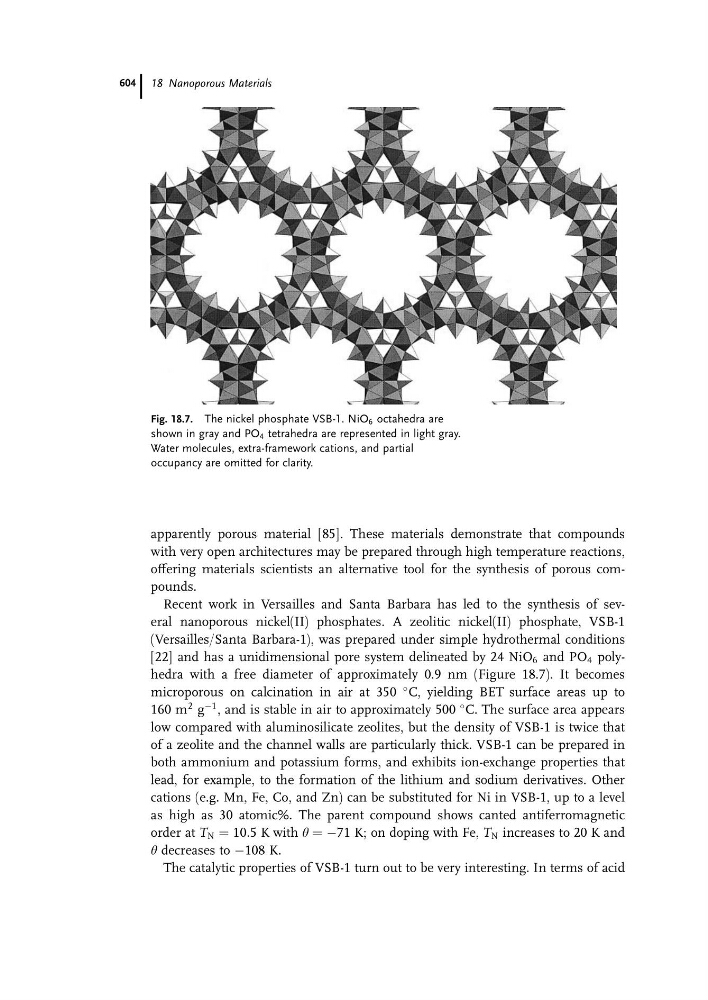
[22] and has a unidimensional pore system delineated by 24 NiO 6 and PO 4 polyhedra with a free diameter of approximately 0.9 nm (Figure 18.7). It becomes
microporous on calcination in air at 350
C, yielding BET surface areas up to
160 m
2 g
À1 , and is stable in air to approximately 500
C. The surface area appears
low compared with aluminosilicate zeolites, but the density of VSB-1 is twice that
of a zeolite and the channel walls are particularly thick. VSB-1 can be prepared in
both ammonium and potassium forms, and exhibits ion-exchange properties that
lead, for example, to the formation of the lithium and sodium derivatives. Other
cations (e.g. Mn, Fe, Co, and Zn) can be substituted for Ni in VSB-1, up to a level
as high as 30 atomic%. The parent compound shows canted antiferromagnetic
order at T N ¼ 10:5 K with y ¼ À71 K; on doping with Fe, T N increases to 20 K and
y decreases to À108 K.
The catalytic properties of VSB-1 turn out to be very interesting. In terms of acid
Fig. 18.7. The nickel phosphate VSB-1. NiO 6 octahedra are
shown in gray and PO 4 tetrahedra are represented in light gray.
Water molecules, extra-framework cations, and partial
occupancy are omitted for clarity.
18 Nanoporous Materials
604