

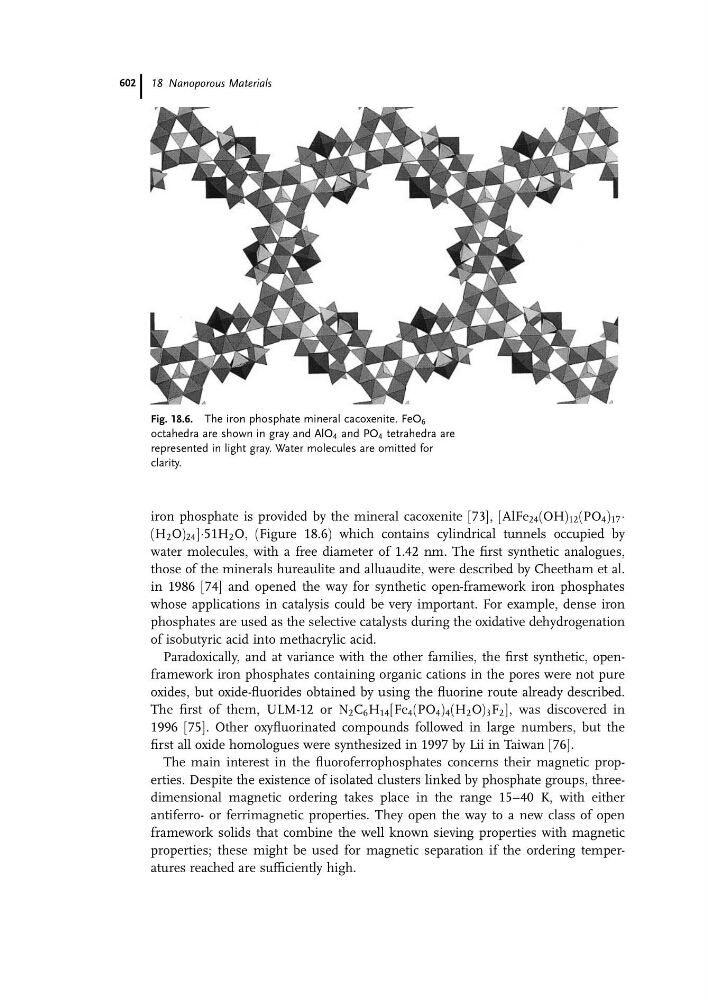
iron phosphate is provided by the mineral cacoxenite [73], [AlFe 24 (OH) 12 (PO 4 ) 17 Á
(H 2 O) 24 ]Á51H 2 O, (Figure 18.6) which contains cylindrical tunnels occupied by
water molecules, with a free diameter of 1.42 nm. The first synthetic analogues,
those of the minerals hureaulite and alluaudite, were described by Cheetham et al.
in 1986 [74] and opened the way for synthetic open-framework iron phosphates
whose applications in catalysis could be very important. For example, dense iron
phosphates are used as the selective catalysts during the oxidative dehydrogenation
of isobutyric acid into methacrylic acid.
Paradoxically, and at variance with the other families, the first synthetic, openframework iron phosphates containing organic cations in the pores were not pure
oxides, but oxide-fluorides obtained by using the fluorine route already described.
The first of them, ULM-12 or N 2 C 6 H 14 [Fe 4 (PO 4 ) 4 (H 2 O) 3 F 2 ], was discovered in
1996 [75]. Other oxyfluorinated compounds followed in large numbers, but the
first all oxide homologues were synthesized in 1997 by Lii in Taiwan [76].
The main interest in the fluoroferrophosphates concerns their magnetic properties. Despite the existence of isolated clusters linked by phosphate groups, threedimensional magnetic ordering takes place in the range 15–40 K, with either
antiferro- or ferrimagnetic properties. They open the way to a new class of open
framework solids that combine the well known sieving properties with magnetic
properties; these might be used for magnetic separation if the ordering temperatures reached are sufficiently high.
Fig. 18.6. The iron phosphate mineral cacoxenite. FeO 6
octahedra are shown in gray and AlO 4 and PO 4 tetrahedra are
represented in light gray. Water molecules are omitted for
clarity.
18 Nanoporous Materials
602