

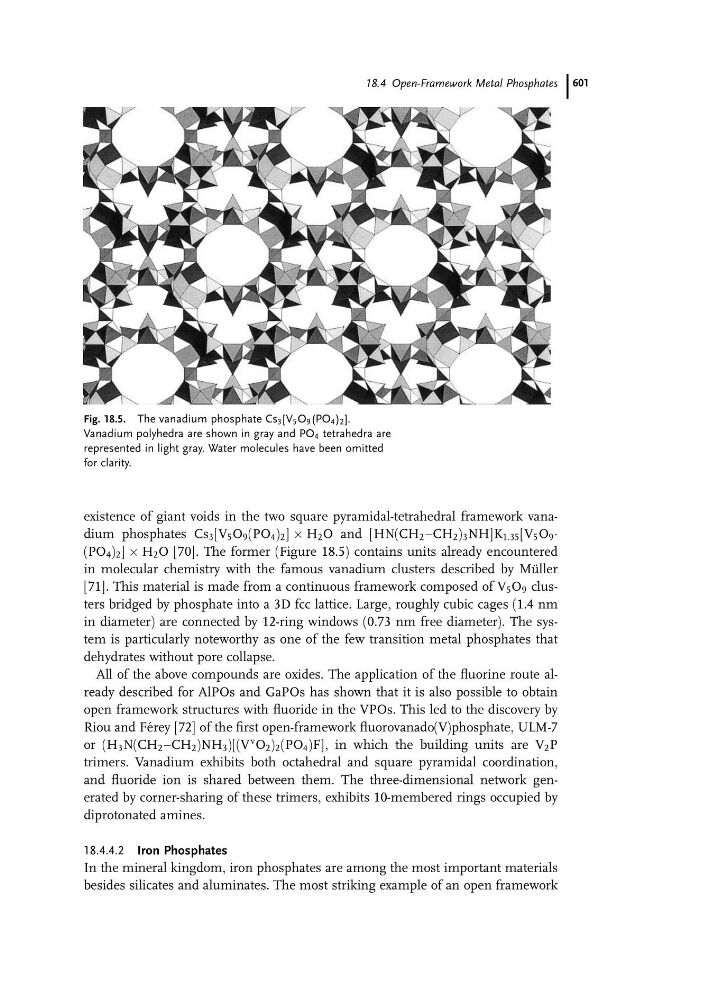
existence of giant voids in the two square pyramidal-tetrahedral framework vanadium phosphates Cs 3 [V 5 O 9 (PO 4 ) 2 ] Â H 2 O and [HN(CH 2 aCH 2 ) 3 NH]K 1:35 [V 5 O 9 Á
(PO 4 ) 2 ] Â H 2 O [70]. The former (Figure 18.5) contains units already encountered
in molecular chemistry with the famous vanadium clusters described by Mu ¨ller
[71]. This material is made from a continuous framework composed of V 5 O 9 clusters bridged by phosphate into a 3D fcc lattice. Large, roughly cubic cages (1.4 nm
in diameter) are connected by 12-ring windows (0.73 nm free diameter). The system is particularly noteworthy as one of the few transition metal phosphates that
dehydrates without pore collapse.
All of the above compounds are oxides. The application of the fluorine route already described for AlPOs and GaPOs has shown that it is also possible to obtain
open framework structures with fluoride in the VPOs. This led to the discovery by
Riou and Fe ´rey [72] of the first open-framework fluorovanado(V)phosphate, ULM-7
or (H 3 N(CH 2 aCH 2 )NH 3 )[(V
v O 2 ) 2 (PO 4 )F], in which the building units are V 2 P
trimers. Vanadium exhibits both octahedral and square pyramidal coordination,
and fluoride ion is shared between them. The three-dimensional network generated by corner-sharing of these trimers, exhibits 10-membered rings occupied by
diprotonated amines.
18.4.4.2 Iron Phosphates
In the mineral kingdom, iron phosphates are among the most important materials
besides silicates and aluminates. The most striking example of an open framework
Fig. 18.5. The vanadium phosphate Cs 3 [V 5 O 9 (PO 4 ) 2 ].
Vanadium polyhedra are shown in gray and PO 4 tetrahedra are
represented in light gray. Water molecules have been omitted
for clarity.
18.4 Open-Framework Metal Phosphates 601