

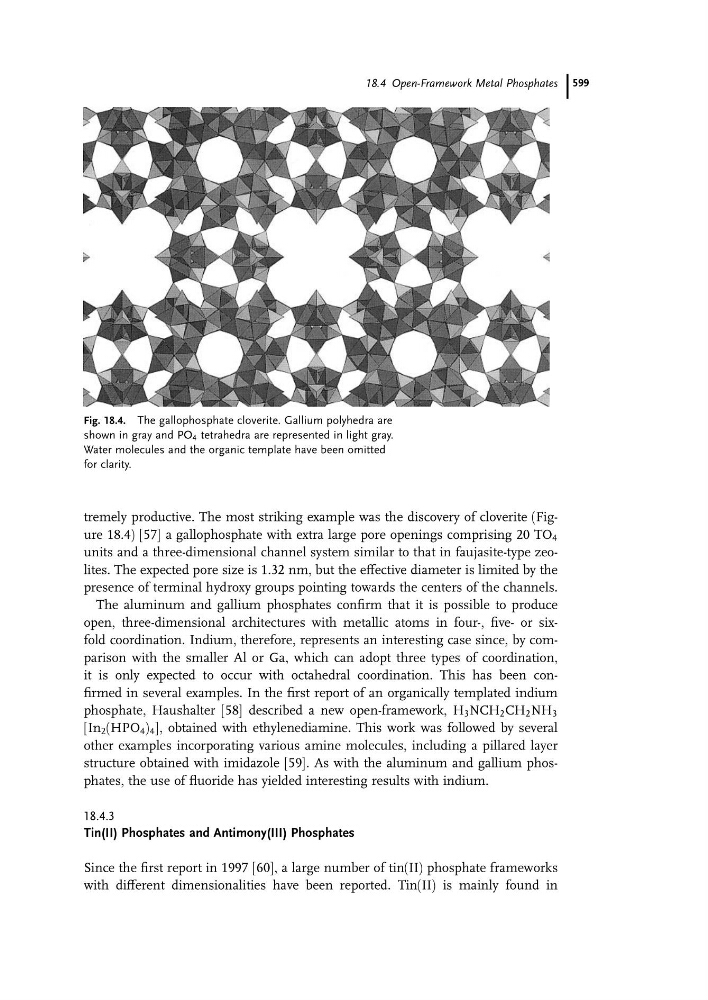
tremely productive. The most striking example was the discovery of cloverite (Figure 18.4) [57] a gallophosphate with extra large pore openings comprising 20 TO 4
units and a three-dimensional channel system similar to that in faujasite-type zeolites. The expected pore size is 1.32 nm, but the effective diameter is limited by the
presence of terminal hydroxy groups pointing towards the centers of the channels.
The aluminum and gallium phosphates confirm that it is possible to produce
open, three-dimensional architectures with metallic atoms in four-, five- or sixfold coordination. Indium, therefore, represents an interesting case since, by comparison with the smaller Al or Ga, which can adopt three types of coordination,
it is only expected to occur with octahedral coordination. This has been confirmed in several examples. In the first report of an organically templated indium
phosphate, Haushalter [58] described a new open-framework, H 3 NCH 2 CH 2 NH 3
[In 2 (HPO 4 ) 4 ], obtained with ethylenediamine. This work was followed by several
other examples incorporating various amine molecules, including a pillared layer
structure obtained with imidazole [59]. As with the aluminum and gallium phosphates, the use of fluoride has yielded interesting results with indium.
18.4.3
Tin(II) Phosphates and Antimony(III) Phosphates
Since the first report in 1997 [60], a large number of tin(II) phosphate frameworks
with different dimensionalities have been reported. Tin(II) is mainly found in
Fig. 18.4. The gallophosphate cloverite. Gallium polyhedra are
shown in gray and PO 4 tetrahedra are represented in light gray.
Water molecules and the organic template have been omitted
for clarity.
18.4 Open-Framework Metal Phosphates 599