

or hexamers. For the tetramers, the connection of the metal atom is via fluorine
corner- or edge-sharing. The hexameric unit is quite common in fluorinated materials. It is composed of a central Al octahedron linked to two Al trigonal bipyramids, via fluorine. This trimer is capped by three phosphate groups. The connection of these hexamers generates different packing structures, such as ULM-3 or
ULM-4 where the channels are delimited by 10-rings windows. The hexameric unit
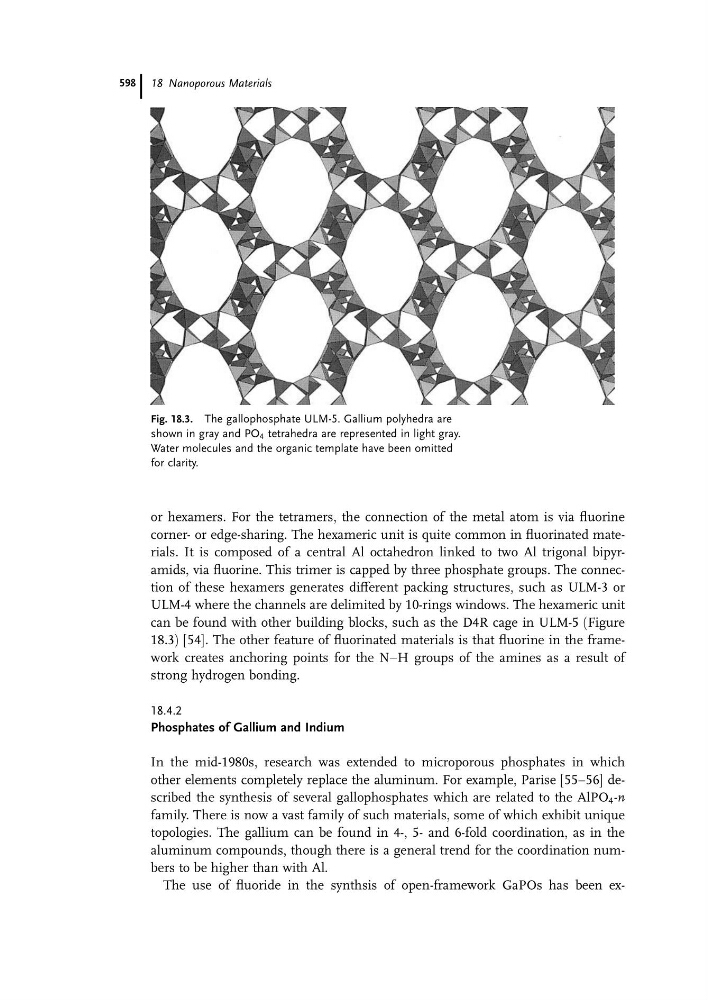
can be found with other building blocks, such as the D4R cage in ULM-5 (Figure
18.3) [54]. The other feature of fluorinated materials is that fluorine in the framework creates anchoring points for the NaH groups of the amines as a result of
strong hydrogen bonding.
18.4.2
Phosphates of Gallium and Indium
In the mid-1980s, research was extended to microporous phosphates in which
other elements completely replace the aluminum. For example, Parise [55–56] described the synthesis of several gallophosphates which are related to the AlPO 4 -n
family. There is now a vast family of such materials, some of which exhibit unique
topologies. The gallium can be found in 4-, 5- and 6-fold coordination, as in the
aluminum compounds, though there is a general trend for the coordination numbers to be higher than with Al.
The use of fluoride in the synthsis of open-framework GaPOs has been exFig. 18.3. The gallophosphate ULM-5. Gallium polyhedra are
shown in gray and PO 4 tetrahedra are represented in light gray.
Water molecules and the organic template have been omitted
for clarity.
18 Nanoporous Materials
598