

Further details of the reaction mechanism were obtained by complementary
theoretical simulations [35] revealing that the bonding of O 2 to Au 2
À is characterized by partial electron transfer (0.4 e) from the metal cluster to the antibonding
p-orbital of the oxygen molecule, making the oxygen molecule a superoxo-like
species. The binding energy is 1.39 eV. The molecular adsorption is clearly favored
energetically over dissociative adsorption. In agreement with the experimental
findings, the molecular binding is a non-activated process, i.e. a barrierless reaction channel exists for the approaching oxygen molecule, leading to the described
configuration. The binding energy of CO to Au 2
À is 0.91 eV. The stronger binding
of O 2 to Au 2
À explains the observation that high CO partial pressures are required
before CO adsorption can compete with O 2 adsorption as the first reaction step.
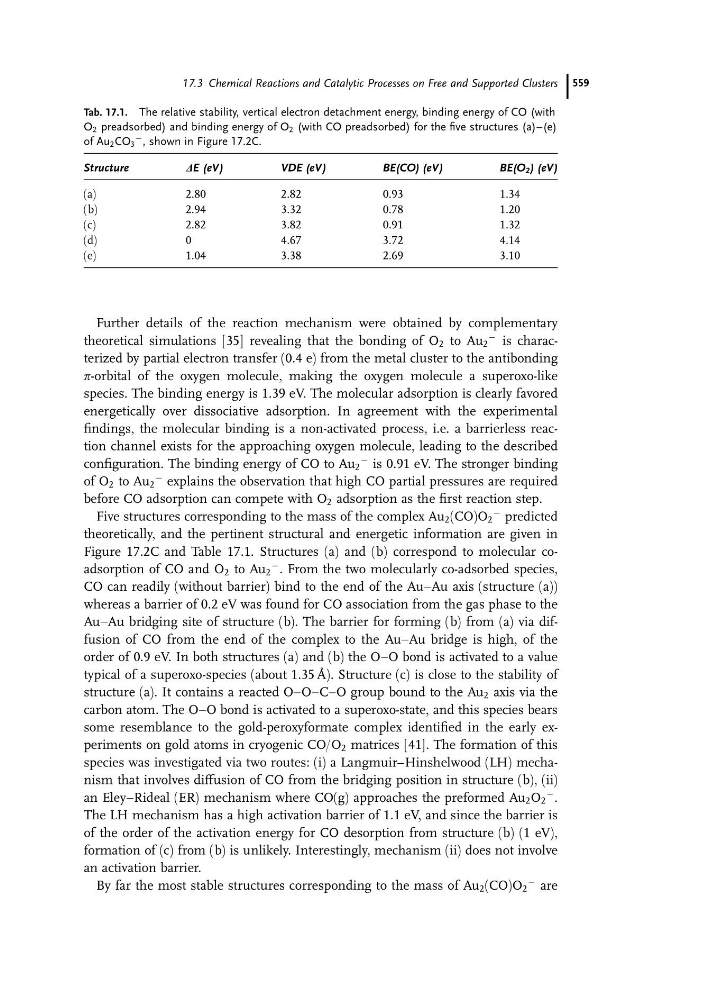
Five structures corresponding to the mass of the complex Au 2 (CO)O 2
À predicted
theoretically, and the pertinent structural and energetic information are given in
Figure 17.2C and Table 17.1. Structures (a) and (b) correspond to molecular coadsorption of CO and O 2 to Au 2
À . From the two molecularly co-adsorbed species,
CO can readily (without barrier) bind to the end of the AuaAu axis (structure (a))
whereas a barrier of 0.2 eV was found for CO association from the gas phase to the
AuaAu bridging site of structure (b). The barrier for forming (b) from (a) via diffusion of CO from the end of the complex to the AuaAu bridge is high, of the
order of 0.9 eV. In both structures (a) and (b) the OaO bond is activated to a value
typical of a superoxo-species (about 1.35 A ˚ ). Structure (c) is close to the stability of
structure (a). It contains a reacted OaOaCaO group bound to the Au 2 axis via the
carbon atom. The OaO bond is activated to a superoxo-state, and this species bears
some resemblance to the gold-peroxyformate complex identified in the early experiments on gold atoms in cryogenic CO/O 2 matrices [41]. The formation of this
species was investigated via two routes: (i) a Langmuir–Hinshelwood (LH) mechanism that involves diffusion of CO from the bridging position in structure (b), (ii)
an Eley–Rideal (ER) mechanism where CO(g) approaches the preformed Au 2 O 2
À .
The LH mechanism has a high activation barrier of 1.1 eV, and since the barrier is
of the order of the activation energy for CO desorption from structure (b) (1 eV),
formation of (c) from (b) is unlikely. Interestingly, mechanism (ii) does not involve
an activation barrier.
By far the most stable structures corresponding to the mass of Au 2 (CO)O 2
À are
Tab. 17.1. The relative stability, vertical electron detachment energy, binding energy of CO (with
O 2 preadsorbed) and binding energy of O 2 (with CO preadsorbed) for the five structures (a)–(e)
of Au 2 CO 3
À , shown in Figure 17.2C.
Structure
DE (eV)
VDE (eV)
BE(CO) (eV)
BE(O 2 ) (eV)
(a)
2.80
2.82
0.93
1.34
(b)
2.94
3.32
0.78
1.20
(c)
2.82
3.82
0.91
1.32
(d)
0
4.67
3.72
4.14
(e)
1.04
3.38
2.69
3.10
17.3 Chemical Reactions and Catalytic Processes on Free and Supported Clusters 559