

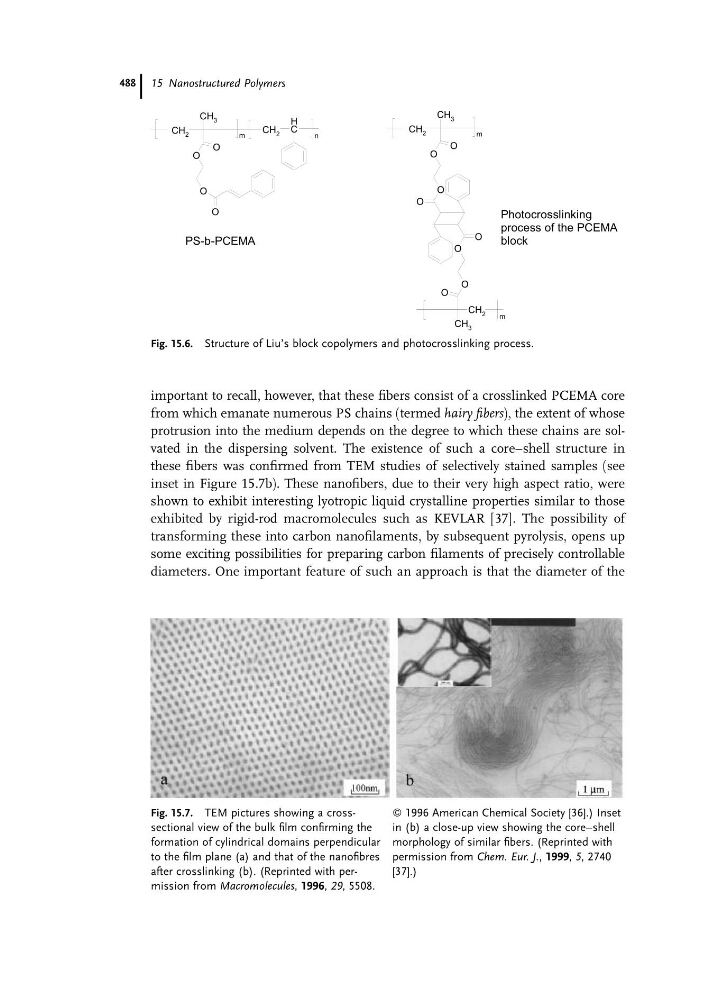
important to recall, however, that these fibers consist of a crosslinked PCEMA core
from which emanate numerous PS chains (termed hairy fibers), the extent of whose
protrusion into the medium depends on the degree to which these chains are solvated in the dispersing solvent. The existence of such a core–shell structure in
these fibers was confirmed from TEM studies of selectively stained samples (see
inset in Figure 15.7b). These nanofibers, due to their very high aspect ratio, were
shown to exhibit interesting lyotropic liquid crystalline properties similar to those
exhibited by rigid-rod macromolecules such as KEVLAR [37]. The possibility of
transforming these into carbon nanofilaments, by subsequent pyrolysis, opens up
some exciting possibilities for preparing carbon filaments of precisely controllable
diameters. One important feature of such an approach is that the diameter of the
CH 2
CH 3
O
O
O
O
CH 2
n
C
H
m
CH 2
m
m
CH 3
O
O
O
O
CH 2
CH 3
O
O
O
O
PS-b-PCEMA
Photocrosslinking
process of the PCEMA
block
Fig. 15.6. Structure of Liu’s block copolymers and photocrosslinking process.
Fig. 15.7. TEM pictures showing a crosssectional view of the bulk film confirming the
formation of cylindrical domains perpendicular
to the film plane (a) and that of the nanofibres
after crosslinking (b). (Reprinted with permission from Macromolecules, 1996, 29, 5508.
8 1996 American Chemical Society [36].) Inset
in (b) a close-up view showing the core–shell
morphology of similar fibers. (Reprinted with
permission from Chem. Eur. J., 1999, 5, 2740
[37].)
15 Nanostructured Polymers
488
from which emanate numerous PS chains (termed hairy fibers), the extent of whose
protrusion into the medium depends on the degree to which these chains are solvated in the dispersing solvent. The existence of such a core–shell structure in
these fibers was confirmed from TEM studies of selectively stained samples (see
inset in Figure 15.7b). These nanofibers, due to their very high aspect ratio, were
shown to exhibit interesting lyotropic liquid crystalline properties similar to those
exhibited by rigid-rod macromolecules such as KEVLAR [37]. The possibility of
transforming these into carbon nanofilaments, by subsequent pyrolysis, opens up
some exciting possibilities for preparing carbon filaments of precisely controllable
diameters. One important feature of such an approach is that the diameter of the
CH 2
CH 3
O
O
O
O
CH 2
n
C
H
m
CH 2
m
m
CH 3
O
O
O
O
CH 2
CH 3
O
O
O
O
PS-b-PCEMA
Photocrosslinking
process of the PCEMA
block
Fig. 15.6. Structure of Liu’s block copolymers and photocrosslinking process.
Fig. 15.7. TEM pictures showing a crosssectional view of the bulk film confirming the
formation of cylindrical domains perpendicular
to the film plane (a) and that of the nanofibres
after crosslinking (b). (Reprinted with permission from Macromolecules, 1996, 29, 5508.
8 1996 American Chemical Society [36].) Inset
in (b) a close-up view showing the core–shell
morphology of similar fibers. (Reprinted with
permission from Chem. Eur. J., 1999, 5, 2740
[37].)
15 Nanostructured Polymers
488