

structural control of the polymer chain is concerned the first feature ensures that
the growing polymer chain-ends remain living, i.e., active, and are capable of adding on further monomer units to increase their chain length. This is a particularly
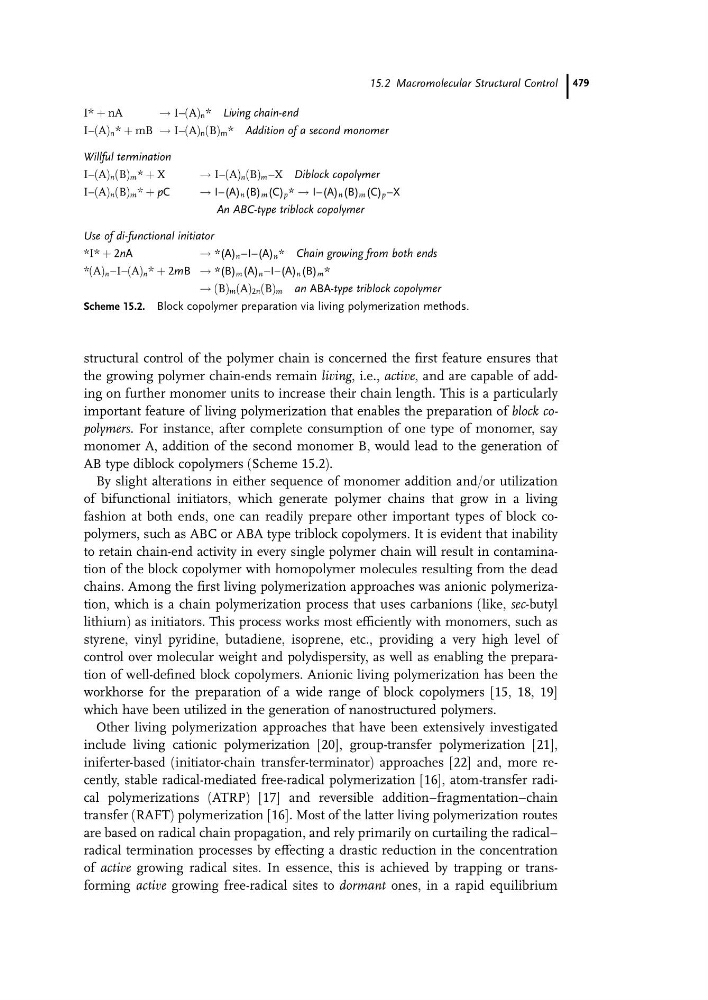
important feature of living polymerization that enables the preparation of block copolymers. For instance, after complete consumption of one type of monomer, say
monomer A, addition of the second monomer B, would lead to the generation of
AB type diblock copolymers (Scheme 15.2).
By slight alterations in either sequence of monomer addition and/or utilization
of bifunctional initiators, which generate polymer chains that grow in a living
fashion at both ends, one can readily prepare other important types of block copolymers, such as ABC or ABA type triblock copolymers. It is evident that inability
to retain chain-end activity in every single polymer chain will result in contamination of the block copolymer with homopolymer molecules resulting from the dead
chains. Among the first living polymerization approaches was anionic polymerization, which is a chain polymerization process that uses carbanions (like, sec-butyl
lithium) as initiators. This process works most efficiently with monomers, such as
styrene, vinyl pyridine, butadiene, isoprene, etc., providing a very high level of
control over molecular weight and polydispersity, as well as enabling the preparation of well-defined block copolymers. Anionic living polymerization has been the
workhorse for the preparation of a wide range of block copolymers [15, 18, 19]
which have been utilized in the generation of nanostructured polymers.
Other living polymerization approaches that have been extensively investigated
include living cationic polymerization [20], group-transfer polymerization [21],
iniferter-based (initiator-chain transfer-terminator) approaches [22] and, more recently, stable radical-mediated free-radical polymerization [16], atom-transfer radical polymerizations (ATRP) [17] and reversible addition–fragmentation–chain
transfer (RAFT) polymerization [16]. Most of the latter living polymerization routes
are based on radical chain propagation, and rely primarily on curtailing the radical–
radical termination processes by effecting a drastic reduction in the concentration
of active growing radical sites. In essence, this is achieved by trapping or transforming active growing free-radical sites to dormant ones, in a rapid equilibrium
I* þ nA
! I–(A) n * Living chain-end
I–(A) n * þ mB ! I–(A) n (B) m * Addition of a second monomer
Willful termination
I–(A) n (B) m * þ X
! I–(A) n (B) m –X Diblock copolymer
I–(A) n (B) m * þ pC
! I–(A) n (B) m (C) p * ! I–(A) n (B) m (C) p –X
An ABC-type triblock copolymer
Use of di-functional initiator
*I* þ 2nA
! *(A) n –I–(A) n * Chain growing from both ends
*(A) n –I–(A) n * þ 2mB ! *(B) m (A) n –I–(A) n (B) m *
! (B) m (A) 2n (B) m an ABA-type triblock copolymer
Scheme 15.2. Block copolymer preparation via living polymerization methods.
15.2 Macromolecular Structural Control 479
the growing polymer chain-ends remain living, i.e., active, and are capable of adding on further monomer units to increase their chain length. This is a particularly
important feature of living polymerization that enables the preparation of block copolymers. For instance, after complete consumption of one type of monomer, say
monomer A, addition of the second monomer B, would lead to the generation of
AB type diblock copolymers (Scheme 15.2).
By slight alterations in either sequence of monomer addition and/or utilization
of bifunctional initiators, which generate polymer chains that grow in a living
fashion at both ends, one can readily prepare other important types of block copolymers, such as ABC or ABA type triblock copolymers. It is evident that inability
to retain chain-end activity in every single polymer chain will result in contamination of the block copolymer with homopolymer molecules resulting from the dead
chains. Among the first living polymerization approaches was anionic polymerization, which is a chain polymerization process that uses carbanions (like, sec-butyl
lithium) as initiators. This process works most efficiently with monomers, such as
styrene, vinyl pyridine, butadiene, isoprene, etc., providing a very high level of
control over molecular weight and polydispersity, as well as enabling the preparation of well-defined block copolymers. Anionic living polymerization has been the
workhorse for the preparation of a wide range of block copolymers [15, 18, 19]
which have been utilized in the generation of nanostructured polymers.
Other living polymerization approaches that have been extensively investigated
include living cationic polymerization [20], group-transfer polymerization [21],
iniferter-based (initiator-chain transfer-terminator) approaches [22] and, more recently, stable radical-mediated free-radical polymerization [16], atom-transfer radical polymerizations (ATRP) [17] and reversible addition–fragmentation–chain
transfer (RAFT) polymerization [16]. Most of the latter living polymerization routes
are based on radical chain propagation, and rely primarily on curtailing the radical–
radical termination processes by effecting a drastic reduction in the concentration
of active growing radical sites. In essence, this is achieved by trapping or transforming active growing free-radical sites to dormant ones, in a rapid equilibrium
I* þ nA
! I–(A) n * Living chain-end
I–(A) n * þ mB ! I–(A) n (B) m * Addition of a second monomer
Willful termination
I–(A) n (B) m * þ X
! I–(A) n (B) m –X Diblock copolymer
I–(A) n (B) m * þ pC
! I–(A) n (B) m (C) p * ! I–(A) n (B) m (C) p –X
An ABC-type triblock copolymer
Use of di-functional initiator
*I* þ 2nA
! *(A) n –I–(A) n * Chain growing from both ends
*(A) n –I–(A) n * þ 2mB ! *(B) m (A) n –I–(A) n (B) m *
! (B) m (A) 2n (B) m an ABA-type triblock copolymer
Scheme 15.2. Block copolymer preparation via living polymerization methods.
15.2 Macromolecular Structural Control 479