

structural irregularities due to regio- and stereochemical complexities, and monomer sequence distribution in the case of copolymers (polymers that contain more
than one type of monomer unit). During the last few decades, many of these issues
have been addressed to varying levels of perfection by clever manipulation of catalyst structure, polymerization temperature and other reaction conditions. Of these
different structural heterogeneities, control of two factors, more than any other, has
been crucial for the development of nanostructured polymers. These are: (i) the
precise control of length of the polymer chain and, (ii) the generation of block copolymers, in which two (or more) types of monomers (repeat units) are sequencesegregated along the polymer backbone. Control of both these features has become
possible because of the development of a special type of polymer-forming process
termed ‘‘living polymerization’’ [15–17].
15.2.1
Living Polymerization
Living polymerizations are limited to the realm of chain-growth polymerizations,
in which a monomer is transformed to a polymer by a reactive species (an initiator,
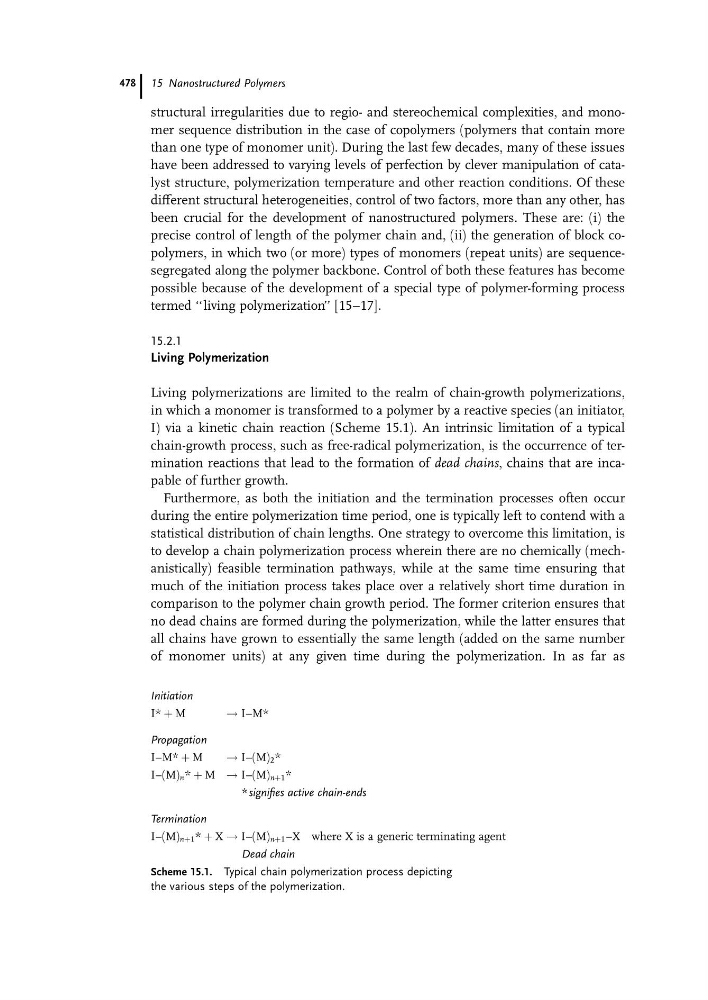
I) via a kinetic chain reaction (Scheme 15.1). An intrinsic limitation of a typical
chain-growth process, such as free-radical polymerization, is the occurrence of termination reactions that lead to the formation of dead chains, chains that are incapable of further growth.
Furthermore, as both the initiation and the termination processes often occur
during the entire polymerization time period, one is typically left to contend with a
statistical distribution of chain lengths. One strategy to overcome this limitation, is
to develop a chain polymerization process wherein there are no chemically (mechanistically) feasible termination pathways, while at the same time ensuring that
much of the initiation process takes place over a relatively short time duration in
comparison to the polymer chain growth period. The former criterion ensures that
no dead chains are formed during the polymerization, while the latter ensures that
all chains have grown to essentially the same length (added on the same number
of monomer units) at any given time during the polymerization. In as far as
Initiation
I* þ M
! I–M*
Propagation
I–M* þ M
! I–(M) 2 *
I–(M) n * þ M ! I–(M) nþ1 *
* signifies active chain-ends
Termination
I–(M) nþ1 * þ X ! I–(M) nþ1 –X where X is a generic terminating agent
Dead chain
Scheme 15.1. Typical chain polymerization process depicting
the various steps of the polymerization.
15 Nanostructured Polymers
478
than one type of monomer unit). During the last few decades, many of these issues
have been addressed to varying levels of perfection by clever manipulation of catalyst structure, polymerization temperature and other reaction conditions. Of these
different structural heterogeneities, control of two factors, more than any other, has
been crucial for the development of nanostructured polymers. These are: (i) the
precise control of length of the polymer chain and, (ii) the generation of block copolymers, in which two (or more) types of monomers (repeat units) are sequencesegregated along the polymer backbone. Control of both these features has become
possible because of the development of a special type of polymer-forming process
termed ‘‘living polymerization’’ [15–17].
15.2.1
Living Polymerization
Living polymerizations are limited to the realm of chain-growth polymerizations,
in which a monomer is transformed to a polymer by a reactive species (an initiator,
I) via a kinetic chain reaction (Scheme 15.1). An intrinsic limitation of a typical
chain-growth process, such as free-radical polymerization, is the occurrence of termination reactions that lead to the formation of dead chains, chains that are incapable of further growth.
Furthermore, as both the initiation and the termination processes often occur
during the entire polymerization time period, one is typically left to contend with a
statistical distribution of chain lengths. One strategy to overcome this limitation, is
to develop a chain polymerization process wherein there are no chemically (mechanistically) feasible termination pathways, while at the same time ensuring that
much of the initiation process takes place over a relatively short time duration in
comparison to the polymer chain growth period. The former criterion ensures that
no dead chains are formed during the polymerization, while the latter ensures that
all chains have grown to essentially the same length (added on the same number
of monomer units) at any given time during the polymerization. In as far as
Initiation
I* þ M
! I–M*
Propagation
I–M* þ M
! I–(M) 2 *
I–(M) n * þ M ! I–(M) nþ1 *
* signifies active chain-ends
Termination
I–(M) nþ1 * þ X ! I–(M) nþ1 –X where X is a generic terminating agent
Dead chain
Scheme 15.1. Typical chain polymerization process depicting
the various steps of the polymerization.
15 Nanostructured Polymers
478