

symmetry breaking. But still the question remains: how can such a structure be
produced or how can a large number of building blocks be generated in solution?
It is known that the largest cluster in acidified molybdate solution is, in the absence of a reducing agent, the ‘‘rather small’’ {Mo 36 } type anion [3a, 4, 6, 7] which
starts growing under reducing conditions. (Note that this is even larger than the
largest discrete silicate ion.) An increase in negative charge, due to reducing conditions, not only prevents uncontrolled linking, but also initiates further protonation which is a prerequisite for further growth [4]. The increase in negative
charge in the present case is also supported by the abundance of SO 4
2À ligands
coordinated to the intermediates and the final cluster species. Another important
aspect is the related coordination ability: SO 4
2À is a moderately strong ligand and
therefore favors an increase in the number of building blocks which might be
coordinated or non-coordinated. In the presence of much weaker coordinating ligands, such as Cl
À or ClO 4
À ions, in cases where HClO 4 or HCl is used as acidification agent instead of H 2 SO 4 , the {Mo 368 } cluster is not formed, ‘‘only’’ pure
molybdenum oxide-based {Mo 154 } or {Mo 176 } wheel-type species, i.e. without Cl
À
or ClO 4
À ligands, are formed. For the present purpose it is important to note that
the coordination ability of the SO 4
2À ligand is ideal, as it is not too strong (as
would be the case for PO 4
3À where all units would be coordinated) and not too
weak [4].
14.3
Nanoscaled Clusters with Unusual Form–Function Relationships
Let us continue our tour of sophisticated nanostructures by giving some striking
examples of the multifaceted form–functionality correlation principles involved.
The following parent cluster types will be considered (here we refer to earlier published reviews):
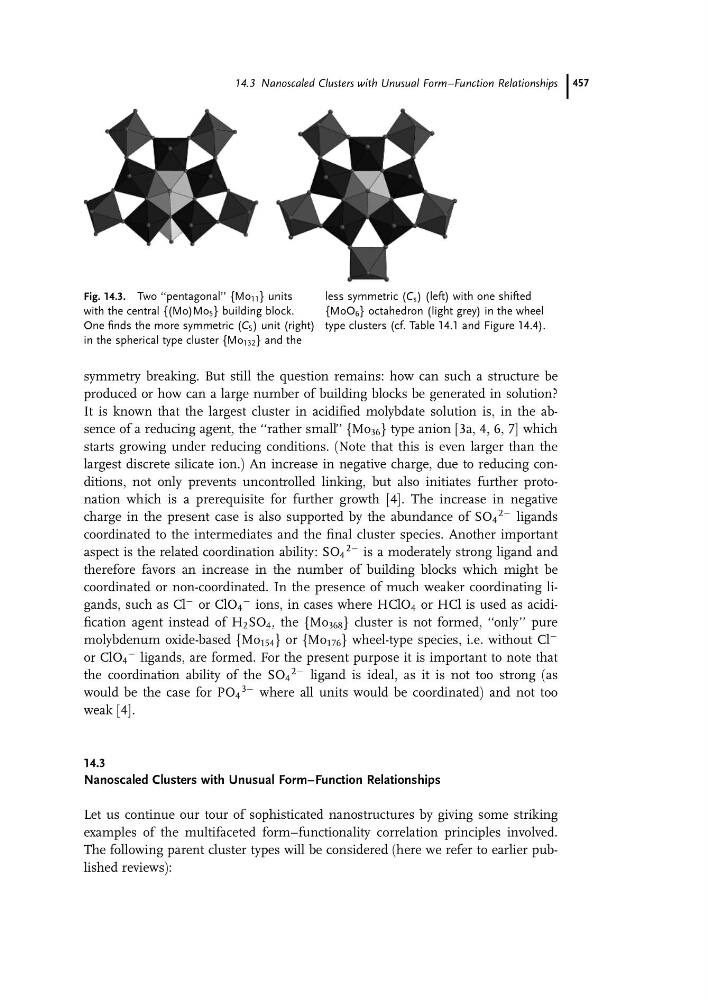
Fig. 14.3. Two ‘‘pentagonal’’ {Mo 11 } units
with the central {(Mo)Mo 5 } building block.
One finds the more symmetric (C 5 ) unit (right)
in the spherical type cluster {Mo 132 } and the
less symmetric (C s ) (left) with one shifted
{MoO 6 } octahedron (light grey) in the wheel
type clusters (cf. Table 14.1 and Figure 14.4).
14.3 Nanoscaled Clusters with Unusual Form–Function Relationships 457
produced or how can a large number of building blocks be generated in solution?
It is known that the largest cluster in acidified molybdate solution is, in the absence of a reducing agent, the ‘‘rather small’’ {Mo 36 } type anion [3a, 4, 6, 7] which
starts growing under reducing conditions. (Note that this is even larger than the
largest discrete silicate ion.) An increase in negative charge, due to reducing conditions, not only prevents uncontrolled linking, but also initiates further protonation which is a prerequisite for further growth [4]. The increase in negative
charge in the present case is also supported by the abundance of SO 4
2À ligands
coordinated to the intermediates and the final cluster species. Another important
aspect is the related coordination ability: SO 4
2À is a moderately strong ligand and
therefore favors an increase in the number of building blocks which might be
coordinated or non-coordinated. In the presence of much weaker coordinating ligands, such as Cl
À or ClO 4
À ions, in cases where HClO 4 or HCl is used as acidification agent instead of H 2 SO 4 , the {Mo 368 } cluster is not formed, ‘‘only’’ pure
molybdenum oxide-based {Mo 154 } or {Mo 176 } wheel-type species, i.e. without Cl
À
or ClO 4
À ligands, are formed. For the present purpose it is important to note that
the coordination ability of the SO 4
2À ligand is ideal, as it is not too strong (as
would be the case for PO 4
3À where all units would be coordinated) and not too
weak [4].
14.3
Nanoscaled Clusters with Unusual Form–Function Relationships
Let us continue our tour of sophisticated nanostructures by giving some striking
examples of the multifaceted form–functionality correlation principles involved.
The following parent cluster types will be considered (here we refer to earlier published reviews):
Fig. 14.3. Two ‘‘pentagonal’’ {Mo 11 } units
with the central {(Mo)Mo 5 } building block.
One finds the more symmetric (C 5 ) unit (right)
in the spherical type cluster {Mo 132 } and the
less symmetric (C s ) (left) with one shifted
{MoO 6 } octahedron (light grey) in the wheel
type clusters (cf. Table 14.1 and Figure 14.4).
14.3 Nanoscaled Clusters with Unusual Form–Function Relationships 457