

nanoclusters with condensed structural types. The basic principle is to form a
metal–trimethylsilylchalcogenolate complex MaESiMe 3 where the demonstrated
reactivity of the aSiMe 3 moiety can be exploited to promote the formation of
M–E–M
0 bonding interactions. With a suitable designed ancillary ligand sphere,
reaction conditions can be controlled to access nanometer-sized M x M
0 y E z clusters. The reaction of (Pr 3 P) 3 CuaESiMe 3 (E ¼ S, Se) with phosphine solubilized
Hg(OAc) 2 leads to the formation of [Hg 15 Cu 20 E 25 (PPr 3 ) 18 ] 26 (26a E ¼ S; 26b
E ¼ Se; Figure 13.22) in good yields [92, 93]. The ‘‘pinwheel’’-like structure in
26 displays intimate mixing of the three core elements, with linear and trigonal
coordination about the Hg(II) centers. Thermal treatment of cluster 26a results
in the formation of Hg metal, Pr 3 P/Pr 3 PbS and various forms of Cu(I)/Cu(II) sulfides, illustrating the kinetic stabilization of the mixed HgCuS core in 26a with
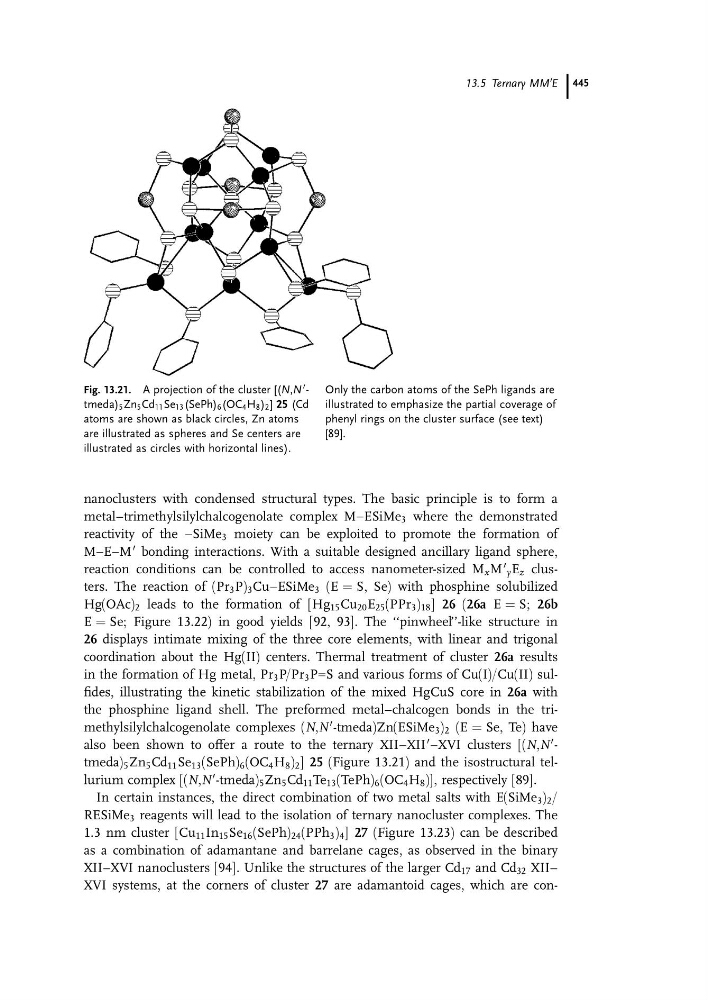
the phosphine ligand shell. The preformed metal–chalcogen bonds in the trimethylsilylchalcogenolate complexes (N,N
0 -tmeda)Zn(ESiMe 3 ) 2 (E ¼ Se, Te) have
also been shown to offer a route to the ternary XII–XII
0 –XVI clusters [(N,N
0 -
tmeda) 5 Zn 5 Cd 11 Se 13 (SePh) 6 (OC 4 H 8 ) 2 ] 25 (Figure 13.21) and the isostructural tellurium complex [(N,N
0 -tmeda) 5 Zn 5 Cd 11 Te 13 (TePh) 6 (OC 4 H 8 )], respectively [89].
In certain instances, the direct combination of two metal salts with E(SiMe 3 ) 2 /
RESiMe 3 reagents will lead to the isolation of ternary nanocluster complexes. The
1.3 nm cluster [Cu 11 In 15 Se 16 (SePh) 24 (PPh 3 ) 4 ] 27 (Figure 13.23) can be described
as a combination of adamantane and barrelane cages, as observed in the binary
XII–XVI nanoclusters [94]. Unlike the structures of the larger Cd 17 and Cd 32 XII–
XVI systems, at the corners of cluster 27 are adamantoid cages, which are conFig. 13.21. A projection of the cluster [(N,N
0 -
tmeda) 5 Zn 5 Cd 11 Se 13 (SePh) 6 (OC 4 H 8 ) 2 ] 25 (Cd
atoms are shown as black circles, Zn atoms
are illustrated as spheres and Se centers are
illustrated as circles with horizontal lines).
Only the carbon atoms of the SePh ligands are
illustrated to emphasize the partial coverage of
phenyl rings on the cluster surface (see text)
[89].
13.5 Ternary MM
0
E 445
metal–trimethylsilylchalcogenolate complex MaESiMe 3 where the demonstrated
reactivity of the aSiMe 3 moiety can be exploited to promote the formation of
M–E–M
0 bonding interactions. With a suitable designed ancillary ligand sphere,
reaction conditions can be controlled to access nanometer-sized M x M
0 y E z clusters. The reaction of (Pr 3 P) 3 CuaESiMe 3 (E ¼ S, Se) with phosphine solubilized
Hg(OAc) 2 leads to the formation of [Hg 15 Cu 20 E 25 (PPr 3 ) 18 ] 26 (26a E ¼ S; 26b
E ¼ Se; Figure 13.22) in good yields [92, 93]. The ‘‘pinwheel’’-like structure in
26 displays intimate mixing of the three core elements, with linear and trigonal
coordination about the Hg(II) centers. Thermal treatment of cluster 26a results
in the formation of Hg metal, Pr 3 P/Pr 3 PbS and various forms of Cu(I)/Cu(II) sulfides, illustrating the kinetic stabilization of the mixed HgCuS core in 26a with
the phosphine ligand shell. The preformed metal–chalcogen bonds in the trimethylsilylchalcogenolate complexes (N,N
0 -tmeda)Zn(ESiMe 3 ) 2 (E ¼ Se, Te) have
also been shown to offer a route to the ternary XII–XII
0 –XVI clusters [(N,N
0 -
tmeda) 5 Zn 5 Cd 11 Se 13 (SePh) 6 (OC 4 H 8 ) 2 ] 25 (Figure 13.21) and the isostructural tellurium complex [(N,N
0 -tmeda) 5 Zn 5 Cd 11 Te 13 (TePh) 6 (OC 4 H 8 )], respectively [89].
In certain instances, the direct combination of two metal salts with E(SiMe 3 ) 2 /
RESiMe 3 reagents will lead to the isolation of ternary nanocluster complexes. The
1.3 nm cluster [Cu 11 In 15 Se 16 (SePh) 24 (PPh 3 ) 4 ] 27 (Figure 13.23) can be described
as a combination of adamantane and barrelane cages, as observed in the binary
XII–XVI nanoclusters [94]. Unlike the structures of the larger Cd 17 and Cd 32 XII–
XVI systems, at the corners of cluster 27 are adamantoid cages, which are conFig. 13.21. A projection of the cluster [(N,N
0 -
tmeda) 5 Zn 5 Cd 11 Se 13 (SePh) 6 (OC 4 H 8 ) 2 ] 25 (Cd
atoms are shown as black circles, Zn atoms
are illustrated as spheres and Se centers are
illustrated as circles with horizontal lines).
Only the carbon atoms of the SePh ligands are
illustrated to emphasize the partial coverage of
phenyl rings on the cluster surface (see text)
[89].
13.5 Ternary MM
0
E 445