

ferred to as the tight-binding model, which is based upon the linear combination
of atomic orbitals, is favored [77].
The study of the optical properties of structurally characterized XII–XVI semiconductor nanoclusters is attractive because the effects of polydispersity are removed, and because they allow the study of the development of bulk properties
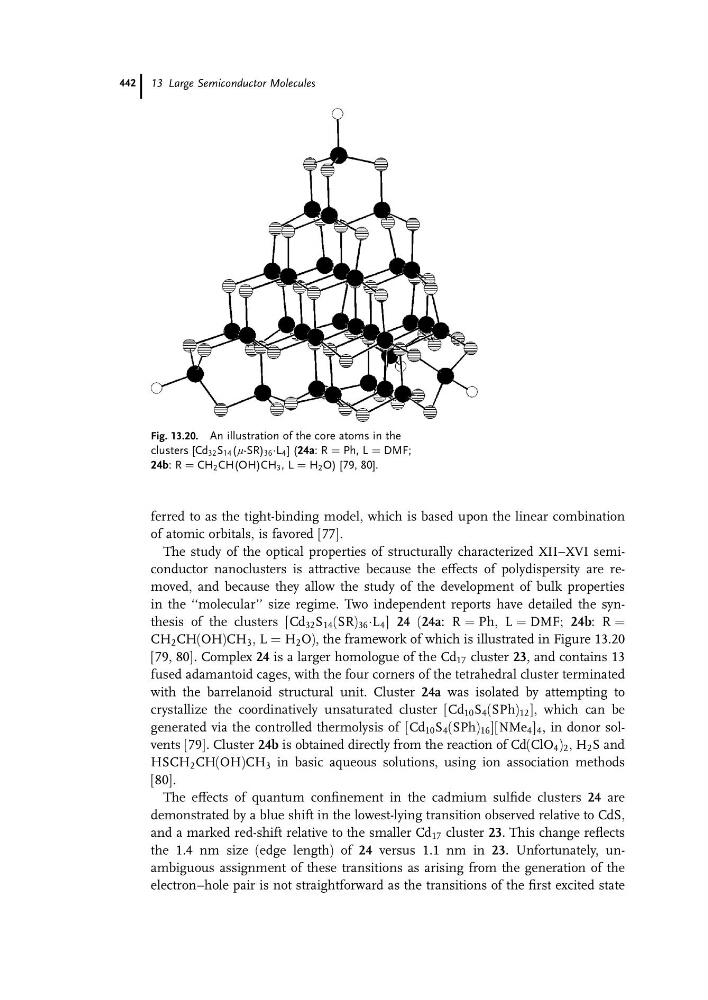
in the ‘‘molecular’’ size regime. Two independent reports have detailed the synthesis of the clusters [Cd 32 S 14 (SR) 36 ÁL 4 ] 24 (24a: R ¼ Ph, L ¼ DMF; 24b: R ¼
CH 2 CH(OH)CH 3 , L ¼ H 2 O), the framework of which is illustrated in Figure 13.20
[79, 80]. Complex 24 is a larger homologue of the Cd 17 cluster 23, and contains 13
fused adamantoid cages, with the four corners of the tetrahedral cluster terminated
with the barrelanoid structural unit. Cluster 24a was isolated by attempting to
crystallize the coordinatively unsaturated cluster [Cd 10 S 4 (SPh) 12 ], which can be
generated via the controlled thermolysis of [Cd 10 S 4 (SPh) 16 ][NMe 4 ] 4 , in donor solvents [79]. Cluster 24b is obtained directly from the reaction of Cd(ClO 4 ) 2 , H 2 S and
HSCH 2 CH(OH)CH 3 in basic aqueous solutions, using ion association methods
[80].
The effects of quantum confinement in the cadmium sulfide clusters 24 are
demonstrated by a blue shift in the lowest-lying transition observed relative to CdS,
and a marked red-shift relative to the smaller Cd 17 cluster 23. This change reflects
the 1.4 nm size (edge length) of 24 versus 1.1 nm in 23. Unfortunately, unambiguous assignment of these transitions as arising from the generation of the
electron–hole pair is not straightforward as the transitions of the first excited state
Fig. 13.20. An illustration of the core atoms in the
clusters [Cd 32 S 14 (m-SR) 36 ÁL 4 ] (24a: R ¼ Ph, L ¼ DMF;
24b: R ¼ CH 2 CH(OH)CH 3 , L ¼ H 2 O) [79, 80].
13 Large Semiconductor Molecules
442
of atomic orbitals, is favored [77].
The study of the optical properties of structurally characterized XII–XVI semiconductor nanoclusters is attractive because the effects of polydispersity are removed, and because they allow the study of the development of bulk properties
in the ‘‘molecular’’ size regime. Two independent reports have detailed the synthesis of the clusters [Cd 32 S 14 (SR) 36 ÁL 4 ] 24 (24a: R ¼ Ph, L ¼ DMF; 24b: R ¼
CH 2 CH(OH)CH 3 , L ¼ H 2 O), the framework of which is illustrated in Figure 13.20
[79, 80]. Complex 24 is a larger homologue of the Cd 17 cluster 23, and contains 13
fused adamantoid cages, with the four corners of the tetrahedral cluster terminated
with the barrelanoid structural unit. Cluster 24a was isolated by attempting to
crystallize the coordinatively unsaturated cluster [Cd 10 S 4 (SPh) 12 ], which can be
generated via the controlled thermolysis of [Cd 10 S 4 (SPh) 16 ][NMe 4 ] 4 , in donor solvents [79]. Cluster 24b is obtained directly from the reaction of Cd(ClO 4 ) 2 , H 2 S and
HSCH 2 CH(OH)CH 3 in basic aqueous solutions, using ion association methods
[80].
The effects of quantum confinement in the cadmium sulfide clusters 24 are
demonstrated by a blue shift in the lowest-lying transition observed relative to CdS,
and a marked red-shift relative to the smaller Cd 17 cluster 23. This change reflects
the 1.4 nm size (edge length) of 24 versus 1.1 nm in 23. Unfortunately, unambiguous assignment of these transitions as arising from the generation of the
electron–hole pair is not straightforward as the transitions of the first excited state
Fig. 13.20. An illustration of the core atoms in the
clusters [Cd 32 S 14 (m-SR) 36 ÁL 4 ] (24a: R ¼ Ph, L ¼ DMF;
24b: R ¼ CH 2 CH(OH)CH 3 , L ¼ H 2 O) [79, 80].
13 Large Semiconductor Molecules
442