

each cluster is bound covalently to its neighbours via sharing of a thiolate ligand at
the corners of the tetrahedra, resulting in an extended network [72]. The intercluster thiolate bridges are displaced with strong donor solvents, allowing a comparison of the spectral features of molecular ‘‘Cd 17 S 4 (SCH 2 CH 2 OH) 26 ’’ and the
solid network. Although very similar, the UV spectrum of the solid is slightly redshifted relative to that observed for the individual molecules in solution. Dipole–
dipole and electronic interactions between the linked cluster units have been proposed to account for the observed difference [73].
Both solid-state and solution absorption spectra of [Cd 17 S 4 (SCH 2 CH 2 OH) 26 ]
display a sharp, discrete maximum (@4.3 eV) that is markedly blue-shifted from
the absorption onset of bulk CdS (2.4 eV); this is assigned to the excitonic transition. This transition is observed in the absorption spectra of XII–XVI colloids and
clusters as a sharp absorption near the absorption edge, the energy of which is a
measure of the size of the ‘‘band gap’’ of the nanoparticles [74]. To this end, UV–
visible spectroscopy can be used to demonstrate the effects of quantum confinement in XII–XVI particles of various sizes, highlighted by the systematic shift of
the excitonic transition to higher energy with decreasing particle size [75]. As the
size of a semiconductor crystal decreases into the nanometer-size regime, a unique
situation develops in which the particle size becomes on the order of, or even
smaller than, the Bohr radius of the exciton (electron–hole pair). In this circumstance, the exciton must adopt a state of higher kinetic energy to ‘‘fit’’ into such a
particle [76]. The result is an increase in the size of the ‘‘band gap’’ (relative to the
bulk) and the quantization of energy levels within the bands with decreasing size.
Thus the electronic properties of nanometer-sized cluster molecules lie between
those of small, molecular species and those of the related XII–XVI solid.
The correlation between the energy of the band gap and the size of the nanoparticle can be described using one of two theoretical models [74, 75, 77]. The first
model is a modification of the effective mass approximation, in which the Coulombic interaction between the electron and hole are taken into consideration. In
this approach, the valence and conduction bands are assumed to be parabolic near
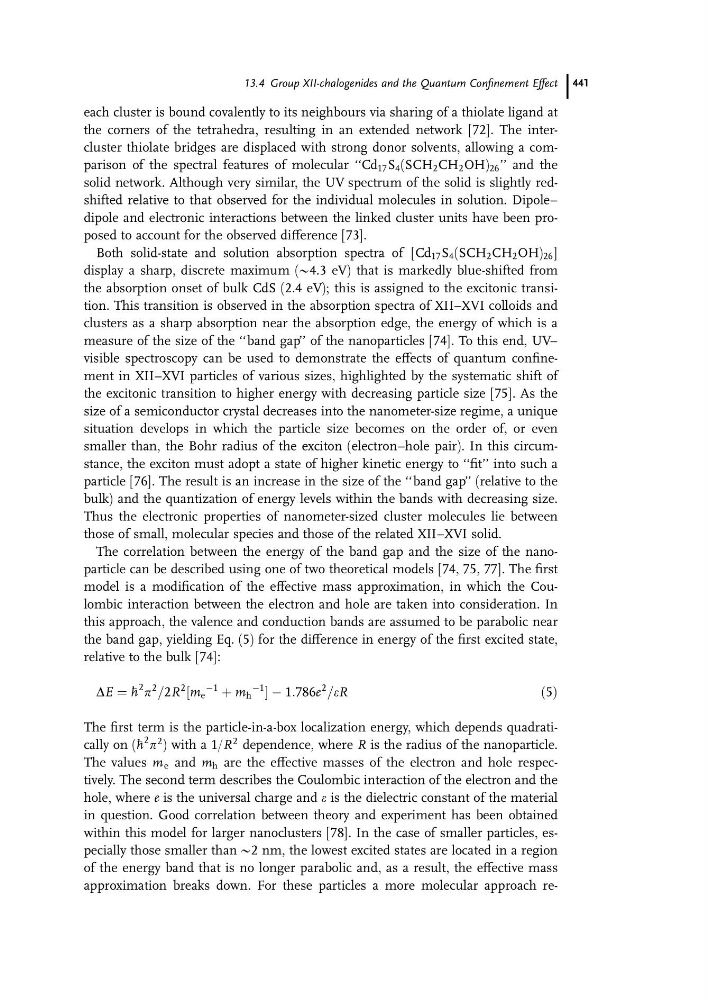
the band gap, yielding Eq. (5) for the difference in energy of the first excited state,
relative to the bulk [74]:
DE ¼
h
2 p
2 =2R
2 ½m e
À1 þ m h
À1 À 1:786e
2 =eR
ð5Þ
The first term is the particle-in-a-box localization energy, which depends quadratically on ( h
2 p
2 ) with a 1/R
2 dependence, where R is the radius of the nanoparticle.
The values m e and m h are the effective masses of the electron and hole respectively. The second term describes the Coulombic interaction of the electron and the
hole, where e is the universal charge and e is the dielectric constant of the material
in question. Good correlation between theory and experiment has been obtained
within this model for larger nanoclusters [78]. In the case of smaller particles, especially those smaller than @2 nm, the lowest excited states are located in a region
of the energy band that is no longer parabolic and, as a result, the effective mass
approximation breaks down. For these particles a more molecular approach re13.4 Group XII-chalogenides and the Quantum Confinement Effect 441
the corners of the tetrahedra, resulting in an extended network [72]. The intercluster thiolate bridges are displaced with strong donor solvents, allowing a comparison of the spectral features of molecular ‘‘Cd 17 S 4 (SCH 2 CH 2 OH) 26 ’’ and the
solid network. Although very similar, the UV spectrum of the solid is slightly redshifted relative to that observed for the individual molecules in solution. Dipole–
dipole and electronic interactions between the linked cluster units have been proposed to account for the observed difference [73].
Both solid-state and solution absorption spectra of [Cd 17 S 4 (SCH 2 CH 2 OH) 26 ]
display a sharp, discrete maximum (@4.3 eV) that is markedly blue-shifted from
the absorption onset of bulk CdS (2.4 eV); this is assigned to the excitonic transition. This transition is observed in the absorption spectra of XII–XVI colloids and
clusters as a sharp absorption near the absorption edge, the energy of which is a
measure of the size of the ‘‘band gap’’ of the nanoparticles [74]. To this end, UV–
visible spectroscopy can be used to demonstrate the effects of quantum confinement in XII–XVI particles of various sizes, highlighted by the systematic shift of
the excitonic transition to higher energy with decreasing particle size [75]. As the
size of a semiconductor crystal decreases into the nanometer-size regime, a unique
situation develops in which the particle size becomes on the order of, or even
smaller than, the Bohr radius of the exciton (electron–hole pair). In this circumstance, the exciton must adopt a state of higher kinetic energy to ‘‘fit’’ into such a
particle [76]. The result is an increase in the size of the ‘‘band gap’’ (relative to the
bulk) and the quantization of energy levels within the bands with decreasing size.
Thus the electronic properties of nanometer-sized cluster molecules lie between
those of small, molecular species and those of the related XII–XVI solid.
The correlation between the energy of the band gap and the size of the nanoparticle can be described using one of two theoretical models [74, 75, 77]. The first
model is a modification of the effective mass approximation, in which the Coulombic interaction between the electron and hole are taken into consideration. In
this approach, the valence and conduction bands are assumed to be parabolic near
the band gap, yielding Eq. (5) for the difference in energy of the first excited state,
relative to the bulk [74]:
DE ¼
h
2 p
2 =2R
2 ½m e
À1 þ m h
À1 À 1:786e
2 =eR
ð5Þ
The first term is the particle-in-a-box localization energy, which depends quadratically on ( h
2 p
2 ) with a 1/R
2 dependence, where R is the radius of the nanoparticle.
The values m e and m h are the effective masses of the electron and hole respectively. The second term describes the Coulombic interaction of the electron and the
hole, where e is the universal charge and e is the dielectric constant of the material
in question. Good correlation between theory and experiment has been obtained
within this model for larger nanoclusters [78]. In the case of smaller particles, especially those smaller than @2 nm, the lowest excited states are located in a region
of the energy band that is no longer parabolic and, as a result, the effective mass
approximation breaks down. For these particles a more molecular approach re13.4 Group XII-chalogenides and the Quantum Confinement Effect 441