

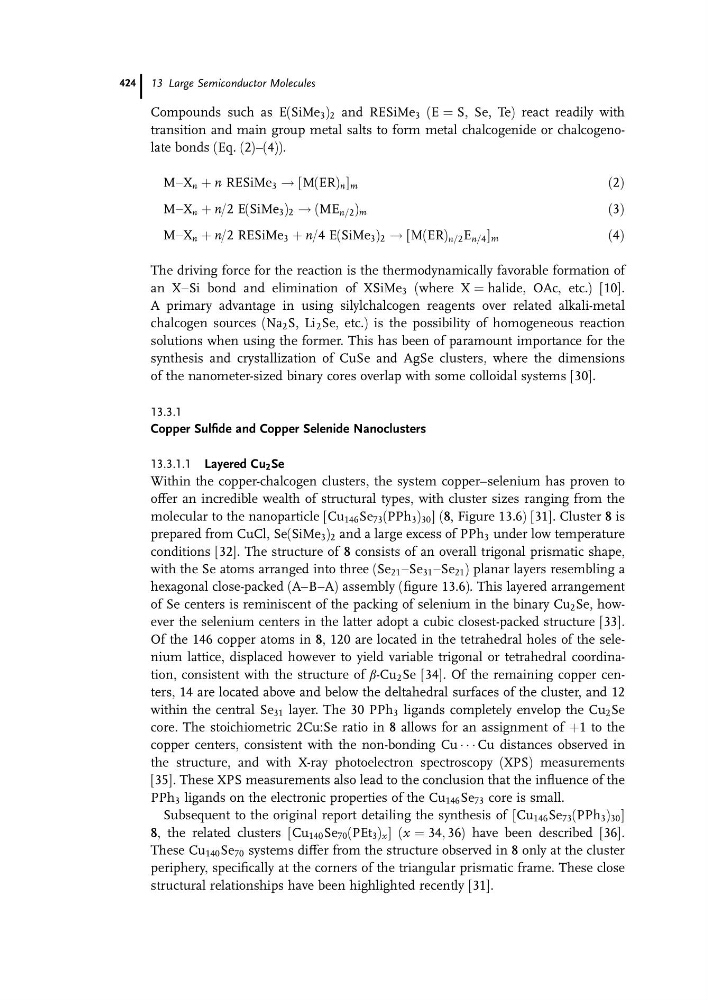
Compounds such as E(SiMe 3 ) 2 and RESiMe 3 (E ¼ S, Se, Te) react readily with
transition and main group metal salts to form metal chalcogenide or chalcogenolate bonds (Eq. (2)–(4)).
MaX n þ n RESiMe 3 ! [M(ER) n ] m
ð2Þ
MaX n þ n/2 E(SiMe 3 ) 2 ! (ME n=2 ) m
ð3Þ
MaX n þ n/2 RESiMe 3 þ n/4 E(SiMe 3 ) 2 ! [M(ER) n=2 E n=4 ] m
ð4Þ
The driving force for the reaction is the thermodynamically favorable formation of
an XaSi bond and elimination of XSiMe 3 (where X ¼ halide, OAc, etc.) [10].
A primary advantage in using silylchalcogen reagents over related alkali-metal
chalcogen sources (Na 2 S, Li 2 Se, etc.) is the possibility of homogeneous reaction
solutions when using the former. This has been of paramount importance for the
synthesis and crystallization of CuSe and AgSe clusters, where the dimensions
of the nanometer-sized binary cores overlap with some colloidal systems [30].
13.3.1
Copper Sulfide and Copper Selenide Nanoclusters
13.3.1.1 Layered Cu 2 Se
Within the copper-chalcogen clusters, the system copper–selenium has proven to
offer an incredible wealth of structural types, with cluster sizes ranging from the
molecular to the nanoparticle [Cu 146 Se 73 (PPh 3 ) 30 ] (8, Figure 13.6) [31]. Cluster 8 is
prepared from CuCl, Se(SiMe 3 ) 2 and a large excess of PPh 3 under low temperature
conditions [32]. The structure of 8 consists of an overall trigonal prismatic shape,
with the Se atoms arranged into three (Se 21 aSe 31 aSe 21 ) planar layers resembling a
hexagonal close-packed (A–B–A) assembly (figure 13.6). This layered arrangement
of Se centers is reminiscent of the packing of selenium in the binary Cu 2 Se, however the selenium centers in the latter adopt a cubic closest-packed structure [33].
Of the 146 copper atoms in 8, 120 are located in the tetrahedral holes of the selenium lattice, displaced however to yield variable trigonal or tetrahedral coordination, consistent with the structure of b-Cu 2 Se [34]. Of the remaining copper centers, 14 are located above and below the deltahedral surfaces of the cluster, and 12
within the central Se 31 layer. The 30 PPh 3 ligands completely envelop the Cu 2 Se
core. The stoichiometric 2Cu:Se ratio in 8 allows for an assignment of þ1 to the
copper centers, consistent with the non-bonding Cu Á Á Á Cu distances observed in
the structure, and with X-ray photoelectron spectroscopy (XPS) measurements
[35]. These XPS measurements also lead to the conclusion that the influence of the
PPh 3 ligands on the electronic properties of the Cu 146 Se 73 core is small.
Subsequent to the original report detailing the synthesis of [Cu 146 Se 73 (PPh 3 ) 30 ]
8, the related clusters [Cu 140 Se 70 (PEt 3 ) x ] (x ¼ 34; 36) have been described [36].
These Cu 140 Se 70 systems differ from the structure observed in 8 only at the cluster
periphery, specifically at the corners of the triangular prismatic frame. These close
structural relationships have been highlighted recently [31].
13 Large Semiconductor Molecules
424
transition and main group metal salts to form metal chalcogenide or chalcogenolate bonds (Eq. (2)–(4)).
MaX n þ n RESiMe 3 ! [M(ER) n ] m
ð2Þ
MaX n þ n/2 E(SiMe 3 ) 2 ! (ME n=2 ) m
ð3Þ
MaX n þ n/2 RESiMe 3 þ n/4 E(SiMe 3 ) 2 ! [M(ER) n=2 E n=4 ] m
ð4Þ
The driving force for the reaction is the thermodynamically favorable formation of
an XaSi bond and elimination of XSiMe 3 (where X ¼ halide, OAc, etc.) [10].
A primary advantage in using silylchalcogen reagents over related alkali-metal
chalcogen sources (Na 2 S, Li 2 Se, etc.) is the possibility of homogeneous reaction
solutions when using the former. This has been of paramount importance for the
synthesis and crystallization of CuSe and AgSe clusters, where the dimensions
of the nanometer-sized binary cores overlap with some colloidal systems [30].
13.3.1
Copper Sulfide and Copper Selenide Nanoclusters
13.3.1.1 Layered Cu 2 Se
Within the copper-chalcogen clusters, the system copper–selenium has proven to
offer an incredible wealth of structural types, with cluster sizes ranging from the
molecular to the nanoparticle [Cu 146 Se 73 (PPh 3 ) 30 ] (8, Figure 13.6) [31]. Cluster 8 is
prepared from CuCl, Se(SiMe 3 ) 2 and a large excess of PPh 3 under low temperature
conditions [32]. The structure of 8 consists of an overall trigonal prismatic shape,
with the Se atoms arranged into three (Se 21 aSe 31 aSe 21 ) planar layers resembling a
hexagonal close-packed (A–B–A) assembly (figure 13.6). This layered arrangement
of Se centers is reminiscent of the packing of selenium in the binary Cu 2 Se, however the selenium centers in the latter adopt a cubic closest-packed structure [33].
Of the 146 copper atoms in 8, 120 are located in the tetrahedral holes of the selenium lattice, displaced however to yield variable trigonal or tetrahedral coordination, consistent with the structure of b-Cu 2 Se [34]. Of the remaining copper centers, 14 are located above and below the deltahedral surfaces of the cluster, and 12
within the central Se 31 layer. The 30 PPh 3 ligands completely envelop the Cu 2 Se
core. The stoichiometric 2Cu:Se ratio in 8 allows for an assignment of þ1 to the
copper centers, consistent with the non-bonding Cu Á Á Á Cu distances observed in
the structure, and with X-ray photoelectron spectroscopy (XPS) measurements
[35]. These XPS measurements also lead to the conclusion that the influence of the
PPh 3 ligands on the electronic properties of the Cu 146 Se 73 core is small.
Subsequent to the original report detailing the synthesis of [Cu 146 Se 73 (PPh 3 ) 30 ]
8, the related clusters [Cu 140 Se 70 (PEt 3 ) x ] (x ¼ 34; 36) have been described [36].
These Cu 140 Se 70 systems differ from the structure observed in 8 only at the cluster
periphery, specifically at the corners of the triangular prismatic frame. These close
structural relationships have been highlighted recently [31].
13 Large Semiconductor Molecules
424