

ML n þ R 3 PbE/R 3 P ! M x E y (PR 3 ) z þ nL þ R 3 P
ð1Þ
Whereas at higher temperatures these reactions typically yield bulk solid M/E
materials, similar reactions at room temperature offer a synthetic route to cluster
complexes, which are stabilized via the incorporation of ancillary PR 3 ligands. The
isolation and structural characterization of these cluster intermediates has been
termed the ‘‘molecules-to-clusters-to-solids’’ pathway [18].
Thus the reaction of Ni(COD) 2 (COD ¼ cyclooctadiene) with Et 3 PbSe in refluxing toluene results in a mixture of Ni 3 Se 2 and elemental nickel, whereas the
molecular complex [Ni 23 Se 12 (PEt 3 ) 13 ] 2 is isolated in crystalline form from the
combination of these reagents under ambient conditions [19]. Cluster 2 is rather
unique in that it is best viewed as being comprised of two unrelated fragments
(Figure 13.2): the ‘‘top’’ of the cluster is comprised of a Se-rich Ni 10 Se 9 unit with
the Se
2À ligands located on the surface of a nickel-only cluster core (acting as
either m 4 - or m 5 -capping ligands) whereas the ‘‘bottom’’ component of the framework is Ni-rich, consisting of 13 nickel atoms and only three Se
2À ligands. The
metal-rich unit has a central Ni within bonding contact to 12 additional Ni centers,
ranging from 2.52 to 2.57 A ˚ . The structural similarities between the ‘‘top’’ half of
the cluster and that observed for NiSe and the ‘‘bottom’’ half and that observed for
elemental nickel, suggest this cluster may result from an intergrowth of two different cluster types. Thermolysis induced PEt 3 ligand elimination yields however
Ni 3 Se 2 , of which neither substructure is reminiscent.
The heavier congener Et 3 PbTe has been used similarly to access the highnuclearity nickel telluride cluster [Ni 20 Te 18 (PEt 3 ) 12 ] 3, the largest structurally characterized Ni/Te cluster, with dimensions in the nanometer size regime [20]. The
arrangement of core atoms can be described in terms of a twisted Ni 6 trigonal
prism with a central Te, capped by two Ni atoms (Figure 13.3), with a similar
fragment observed in the structure of solid Ni 1þx Te [21]. The other twelve Ni
atoms are each bonded to four Te
2À ligands, and further bonded to an ancillary
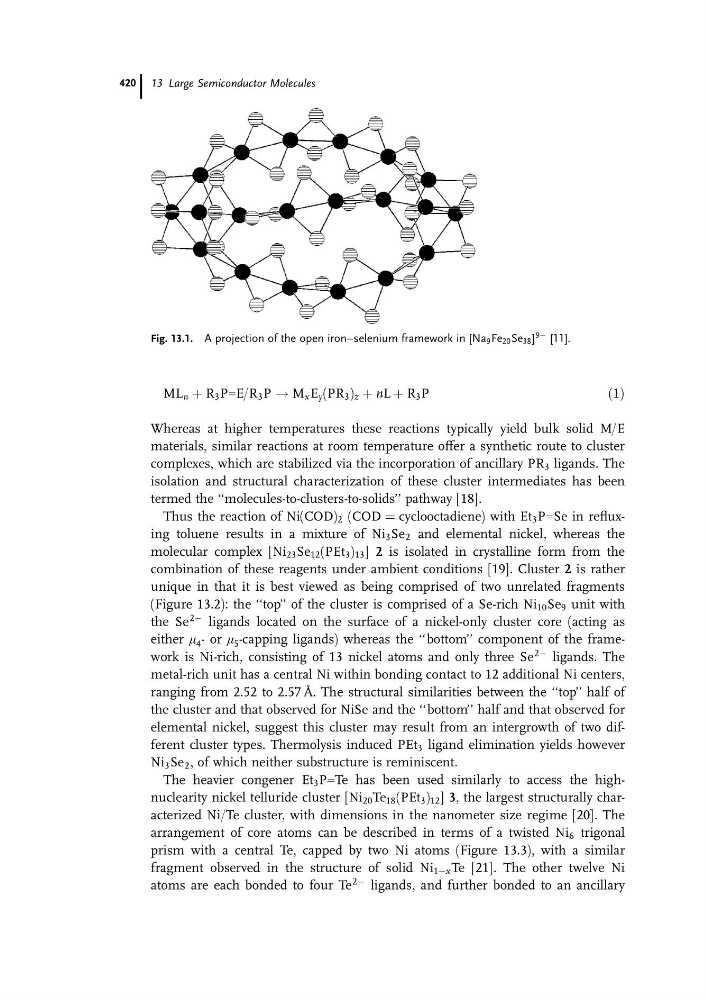
Fig. 13.1. A projection of the open iron–selenium framework in [Na 9 Fe 20 Se 38 ]
9À [11].
13 Large Semiconductor Molecules
420
ð1Þ
Whereas at higher temperatures these reactions typically yield bulk solid M/E
materials, similar reactions at room temperature offer a synthetic route to cluster
complexes, which are stabilized via the incorporation of ancillary PR 3 ligands. The
isolation and structural characterization of these cluster intermediates has been
termed the ‘‘molecules-to-clusters-to-solids’’ pathway [18].
Thus the reaction of Ni(COD) 2 (COD ¼ cyclooctadiene) with Et 3 PbSe in refluxing toluene results in a mixture of Ni 3 Se 2 and elemental nickel, whereas the
molecular complex [Ni 23 Se 12 (PEt 3 ) 13 ] 2 is isolated in crystalline form from the
combination of these reagents under ambient conditions [19]. Cluster 2 is rather
unique in that it is best viewed as being comprised of two unrelated fragments
(Figure 13.2): the ‘‘top’’ of the cluster is comprised of a Se-rich Ni 10 Se 9 unit with
the Se
2À ligands located on the surface of a nickel-only cluster core (acting as
either m 4 - or m 5 -capping ligands) whereas the ‘‘bottom’’ component of the framework is Ni-rich, consisting of 13 nickel atoms and only three Se
2À ligands. The
metal-rich unit has a central Ni within bonding contact to 12 additional Ni centers,
ranging from 2.52 to 2.57 A ˚ . The structural similarities between the ‘‘top’’ half of
the cluster and that observed for NiSe and the ‘‘bottom’’ half and that observed for
elemental nickel, suggest this cluster may result from an intergrowth of two different cluster types. Thermolysis induced PEt 3 ligand elimination yields however
Ni 3 Se 2 , of which neither substructure is reminiscent.
The heavier congener Et 3 PbTe has been used similarly to access the highnuclearity nickel telluride cluster [Ni 20 Te 18 (PEt 3 ) 12 ] 3, the largest structurally characterized Ni/Te cluster, with dimensions in the nanometer size regime [20]. The
arrangement of core atoms can be described in terms of a twisted Ni 6 trigonal
prism with a central Te, capped by two Ni atoms (Figure 13.3), with a similar
fragment observed in the structure of solid Ni 1þx Te [21]. The other twelve Ni
atoms are each bonded to four Te
2À ligands, and further bonded to an ancillary
Fig. 13.1. A projection of the open iron–selenium framework in [Na 9 Fe 20 Se 38 ]
9À [11].
13 Large Semiconductor Molecules
420