

than single Rhodamine 6G molecules [16]. This makes the case that QDs have
highly desirable characteristics for fluorescent labeling.
12.3
Synthesis
The synthesis of nanocrystals from both the II–VI (e.g. ZnS, ZnSe, CdS, CdSe,
CdTe and HgS) and III–V (e.g. GaAs, InP and InAs) semiconductor families has
long been the subject of study, but until the early 1990s, QDs were usually synthesized in aqueous media using stabilizing agents, similar to the techniques used
to produce colloidal gold nanoparticles. Unfortunately, these procedures yielded
low-quality QDs with large size variations (relative standard deviation [RSD] >
15%) and very low luminescence quantum yields. These problems made it nearly
impossible to resolve the theorized size-dependent properties of the nanocrystals.
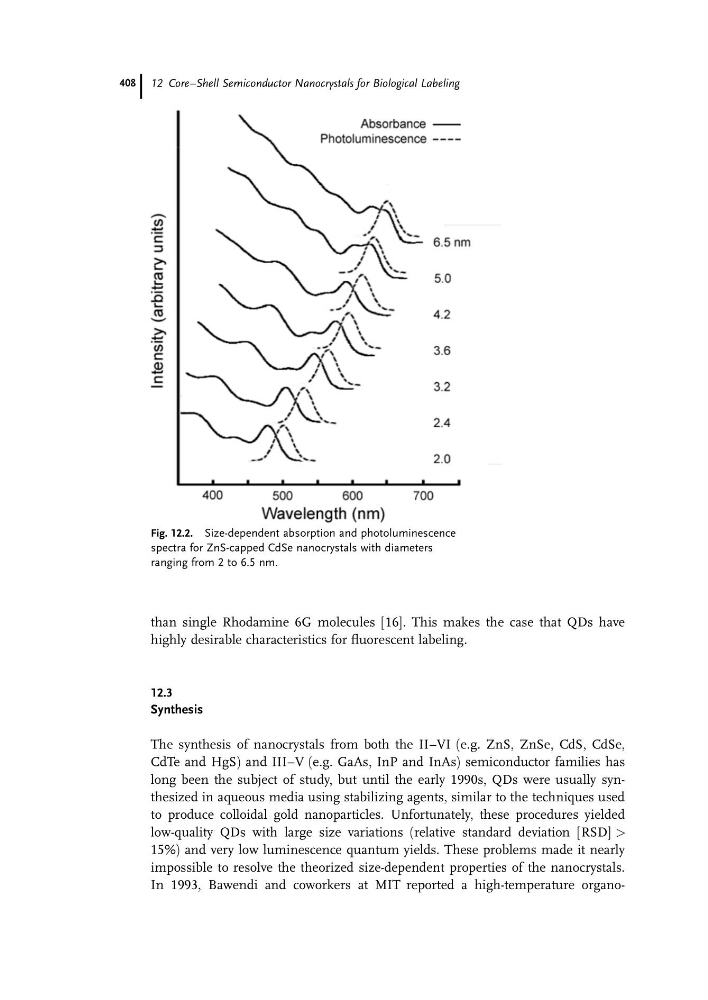
In 1993, Bawendi and coworkers at MIT reported a high-temperature organoFig. 12.2. Size-dependent absorption and photoluminescence
spectra for ZnS-capped CdSe nanocrystals with diameters
ranging from 2 to 6.5 nm.
12 Core–Shell Semiconductor Nanocrystals for Biological Labeling
408
highly desirable characteristics for fluorescent labeling.
12.3
Synthesis
The synthesis of nanocrystals from both the II–VI (e.g. ZnS, ZnSe, CdS, CdSe,
CdTe and HgS) and III–V (e.g. GaAs, InP and InAs) semiconductor families has
long been the subject of study, but until the early 1990s, QDs were usually synthesized in aqueous media using stabilizing agents, similar to the techniques used
to produce colloidal gold nanoparticles. Unfortunately, these procedures yielded
low-quality QDs with large size variations (relative standard deviation [RSD] >
15%) and very low luminescence quantum yields. These problems made it nearly
impossible to resolve the theorized size-dependent properties of the nanocrystals.
In 1993, Bawendi and coworkers at MIT reported a high-temperature organoFig. 12.2. Size-dependent absorption and photoluminescence
spectra for ZnS-capped CdSe nanocrystals with diameters
ranging from 2 to 6.5 nm.
12 Core–Shell Semiconductor Nanocrystals for Biological Labeling
408