

devices used for light generation are based on direct band gap materials exclusively. Similarly, direct band gap materials must be used to prepare highly luminescent semiconductor nanocrystals. The direct band gap semiconductor cadmium
selenide is most frequently used for size-confinement studies [4–7] because of its
simple synthesis and efficient photoluminescence properties [4–7].
By examining the absorption spectra of QDs or by simply observing the deeply
colored colloids, it is clear that the density of states within their energy levels is
very high. In samples of sufficient monodispersity, there are significant fine structures in the absorption spectra (Fig. 12.2). At the absorption onset there is an observable peak followed by several ripples as the absorption increases with energy.
This first peak is the first excitonic peak followed by the higher excited excitonic
states which are analogous to the first excited and higher excited states in molecular systems. The fact that the absorption coefficient increases towards shorter
wavelengths is an important feature for multicolor applications because it allows
simultaneous excitation of multicolor dots at a single wavelength. In addition to
large molar absorptivity coefficients (@10
5 –10
6 M
À1 cm
À1 ), the emission spectra of
core–shell quantum dots are narrow, symmetric (Gaussian in shape), and can span
a broad range of wavelengths by a judicious choice of particle size and composition. The width of the emission spectrum is directly related to the sample quality
and monodispersity. Typically, room temperature spectra of high quality samples
show spectral widths of 25–35 nm (full-width at half maximum or FWHM) due
to the finite particle size distribution, whereas the emission spectra of single
(CdSe)ZnS QDs are as narrow as 13 nm (FWHM). It has been estimated that
single (CdSe)ZnS QDs are @20 times brighter and @100–200 times more stable
550
600
650
700
750
800
850
900
Wavelength (nm)
Normalized Intensity
2
CdSe
CdTe
CdSe
1
CdTe
1
2
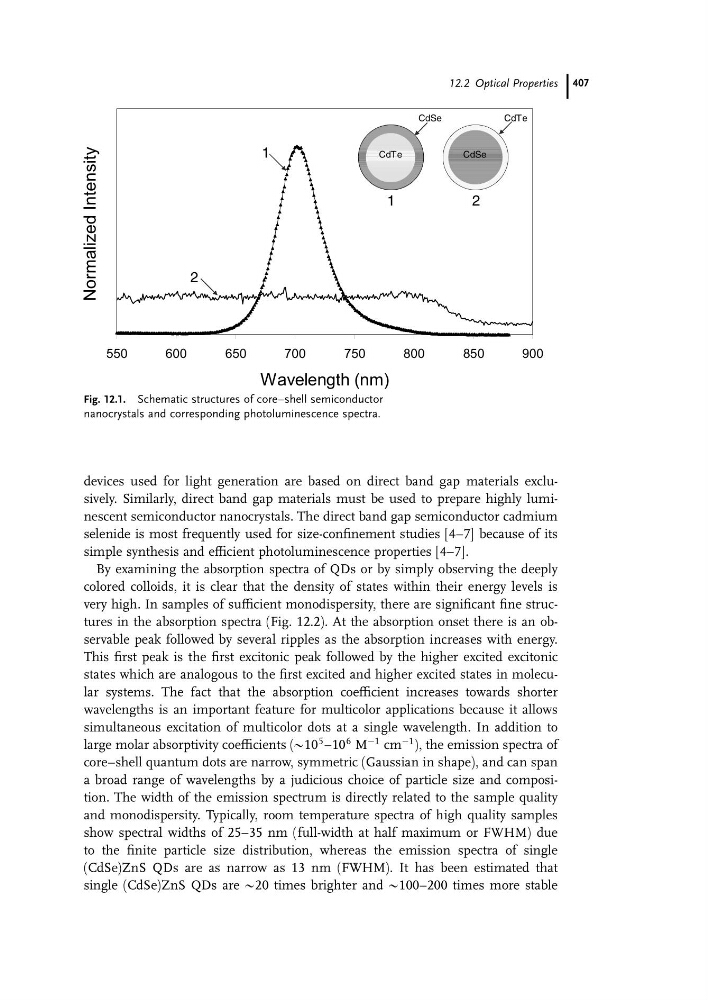
Fig. 12.1. Schematic structures of core–shell semiconductor
nanocrystals and corresponding photoluminescence spectra.
12.2 Optical Properties 407
selenide is most frequently used for size-confinement studies [4–7] because of its
simple synthesis and efficient photoluminescence properties [4–7].
By examining the absorption spectra of QDs or by simply observing the deeply
colored colloids, it is clear that the density of states within their energy levels is
very high. In samples of sufficient monodispersity, there are significant fine structures in the absorption spectra (Fig. 12.2). At the absorption onset there is an observable peak followed by several ripples as the absorption increases with energy.
This first peak is the first excitonic peak followed by the higher excited excitonic
states which are analogous to the first excited and higher excited states in molecular systems. The fact that the absorption coefficient increases towards shorter
wavelengths is an important feature for multicolor applications because it allows
simultaneous excitation of multicolor dots at a single wavelength. In addition to
large molar absorptivity coefficients (@10
5 –10
6 M
À1 cm
À1 ), the emission spectra of
core–shell quantum dots are narrow, symmetric (Gaussian in shape), and can span
a broad range of wavelengths by a judicious choice of particle size and composition. The width of the emission spectrum is directly related to the sample quality
and monodispersity. Typically, room temperature spectra of high quality samples
show spectral widths of 25–35 nm (full-width at half maximum or FWHM) due
to the finite particle size distribution, whereas the emission spectra of single
(CdSe)ZnS QDs are as narrow as 13 nm (FWHM). It has been estimated that
single (CdSe)ZnS QDs are @20 times brighter and @100–200 times more stable
550
600
650
700
750
800
850
900
Wavelength (nm)
Normalized Intensity
2
CdSe
CdTe
CdSe
1
CdTe
1
2
Fig. 12.1. Schematic structures of core–shell semiconductor
nanocrystals and corresponding photoluminescence spectra.
12.2 Optical Properties 407